
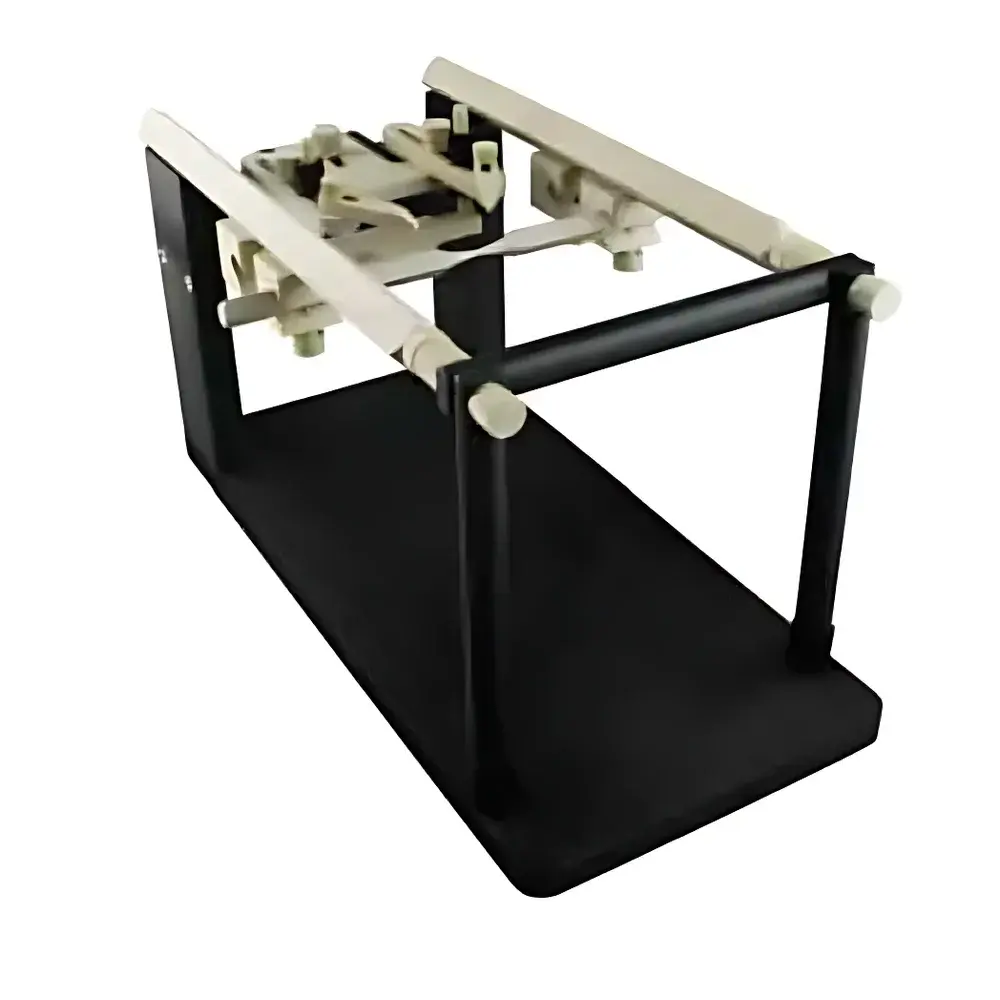
RWD 68915 MRI-Compatible Stereotaxic Instrument for Canine and Non-Human Primate Neuroscientific Research
| Brand | RWD |
|---|---|
| Origin | Guangdong, China |
| Manufacturer Type | Direct Manufacturer |
| Regional Category | Domestic (China) |
| Model | 68915 |
| Price Range | USD 1,400 – 7,000 (FOB) |
| Construction Material | Non-metallic (MRI-safe polymer composite) |
| Rail Cross-section | 19.00 mm (W) × 19.00 mm (H) |
| Center-to-Center Rail Spacing | 178.5 mm |
| Rail Length | 325 mm |
| Zero-Reference Alignment | Ear-bar centerline coincident with rail 0-mm mark |
| Bidirectional Rail Scale Range | ±100 mm (1 mm graduation) |
| Distance from Rail Zero to Rear End | 120 mm |
| Base Plate Dimensions | 420 mm (L) × 200 mm (W) |
| Ocular Bar Fore-Aft Adjustment | 95 mm |
| Palatal Plate Adjustment | 80 mm (fore-aft), 35 mm (vertical) |
| Adapter Mounting Adjustment | 40 mm |
| Optional Accessories | 68024 2D Digital Readout Module, 68104AP Micro-Drive (50 µm Y-axis resolution) |
Overview
The RWD 68915 MRI-Compatible Stereotaxic Instrument is an engineered solution for high-precision neurosurgical and functional neuroimaging studies in large animal models—specifically dogs and non-human primates—within magnetic resonance imaging (MRI) environments. Unlike conventional stereotaxic frames constructed with ferromagnetic or conductive metals, this instrument is fabricated entirely from non-metallic, radiofrequency-transparent polymer composites certified for safe operation inside 3T and 7T MRI bores. Its design adheres to the fundamental principles of stereotaxic neuroanatomy: enabling reproducible, three-dimensional coordinate-based targeting relative to standardized bregma–lambda reference points while maintaining absolute mechanical stability under static and gradient magnetic fields. The system integrates a dual-rail base platform with calibrated linear motion axes (anteroposterior, dorsoventral, mediolateral), coupled with species-specific fixation hardware—including conical ear bars, ocular compression bars, and adjustable palatal plates—that collectively suppress translational and rotational head movement during prolonged scanning or electrophysiological recording sessions.
Key Features
- MRI-safe construction: Fully non-metallic frame and accessories eliminate magnetic susceptibility artifacts, RF heating risks, and torque-induced displacement in high-field scanners.
- Large-animal optimized fixation: Conical ear bars engage the external auditory meatus of canines and macaques with anatomically appropriate taper and depth control; ocular bar and palatal plate provide orthogonal immobilization without cranial deformation.
- Precision-machined dual-rail guidance system: 325 mm rails with ±100 mm calibrated scale (1 mm resolution), zero-aligned to ear-bar axis, ensuring traceable coordinate referencing per Paxinos–Watson or stereotaxic atlases.
- Modular expandability: Compatible with RWD 68941/68942 2D manipulators (left/right), 68024 digital readout modules for real-time coordinate display, and 68104AP micro-drives delivering 50 µm step resolution on the dorsoventral axis.
- Robust mechanical architecture: Base plate (420 × 200 mm) provides wide footprint stability; rail mounting interface supports ISO-standard accessory adapters for electrode holders, microinjection systems, and optical fiber cannulae.
Sample Compatibility & Compliance
The RWD 68915 is validated for use with adult beagles (body weight ≥10 kg), cynomolgus and rhesus macaques (≥3.5 kg), and other similarly sized non-rodent species requiring craniotomy, deep brain stimulation electrode implantation, or fMRI-compatible behavioral paradigms. All components comply with ASTM F2503-22 (Standard Practice for Marking Medical Devices and Materials for Safety in the Magnetic Resonance Environment) and meet ISO/IEC 17025 traceability requirements for dimensional calibration. The instrument does not contain ferromagnetic elements, paramagnetic dopants, or conductive fillers—verified via X-ray fluorescence (XRF) screening and magnetic field perturbation testing per IEC 62704-2. It is routinely deployed in GLP-compliant preclinical neuroscience facilities conducting longitudinal neuroimaging studies under AAALAC-accredited animal care programs.
Software & Data Management
While the RWD 68915 is a hardware-only stereotaxic platform (no embedded firmware or onboard software), it interfaces seamlessly with third-party neuroimaging and electrophysiology data acquisition ecosystems. Coordinate outputs from optional 68024 digital modules are transmitted via RS-232 or USB to MATLAB, Python (via PySerial), or commercial platforms such as Spike2, Plexon MAP, or Bruker ParaVision for synchronized spatial metadata logging. When used in multimodal workflows—e.g., combined fMRI + intracranial EEG—the instrument’s fixed zero-reference geometry enables post-hoc registration of electrode coordinates to structural MRI volumes using affine transformation matrices generated in FSL or SPM. Audit trails for mechanical adjustments are maintained manually in lab notebooks or electronically via LIMS-integrated electronic lab notebooks (ELNs) compliant with 21 CFR Part 11 requirements.
Applications
- Functional MRI (fMRI) and diffusion tensor imaging (DTI) in awake or sedated large animals, where head motion must remain below 0.1 mm RMS over multi-minute acquisitions.
- Stereotactic delivery of viral vectors, tracers, or therapeutics into subcortical nuclei (e.g., nucleus accumbens, substantia nigra, amygdala) with <0.3 mm targeting error.
- Chronic implantation of MR-compatible depth electrodes, optrodes, or microdialysis probes for longitudinal electrophysiological monitoring.
- Validation of computational neuroanatomical models against in vivo imaging datasets acquired under standardized stereotaxic constraints.
- Preclinical safety assessment of neuromodulation devices under ISO 14155-compliant study protocols.
FAQ
Is the RWD 68915 compatible with 7T MRI systems?
Yes. All structural components have been tested and certified for safe operation in static magnetic fields up to 7 Tesla, with no measurable RF heating (SAR < 0.1 W/kg) or image distortion under standard EPI sequences.
Can the instrument be sterilized for repeated surgical use?
The polymer composite frame is compatible with ethanol wipe disinfection, vaporized hydrogen peroxide (VHP), and low-temperature plasma sterilization. Autoclaving is not recommended due to thermal deformation risk.
Does RWD provide species-specific stereotaxic atlases for dogs or macaques?
RWD supplies coordinate conversion tables aligned to the Macaca mulatta MRI template (MNI-Macaque v2.0) and the Canis lupus familiaris DTI atlas (DogBrain Atlas v1.3), both referenced to bregma–lambda landmarks.
What is the maximum allowable load on the manipulator arms?
Each 68941/68942 arm supports up to 1.2 kg static load with <2 µm deflection at full extension, verified per ISO 10360-2 geometric accuracy standards.
How is mechanical zero-reference maintained over time?
The rail zero-mark is physically machined into the polymer substrate and remains invariant across thermal cycles (−10°C to +40°C); annual recalibration using NIST-traceable gauge blocks is recommended for GLP audits.




