
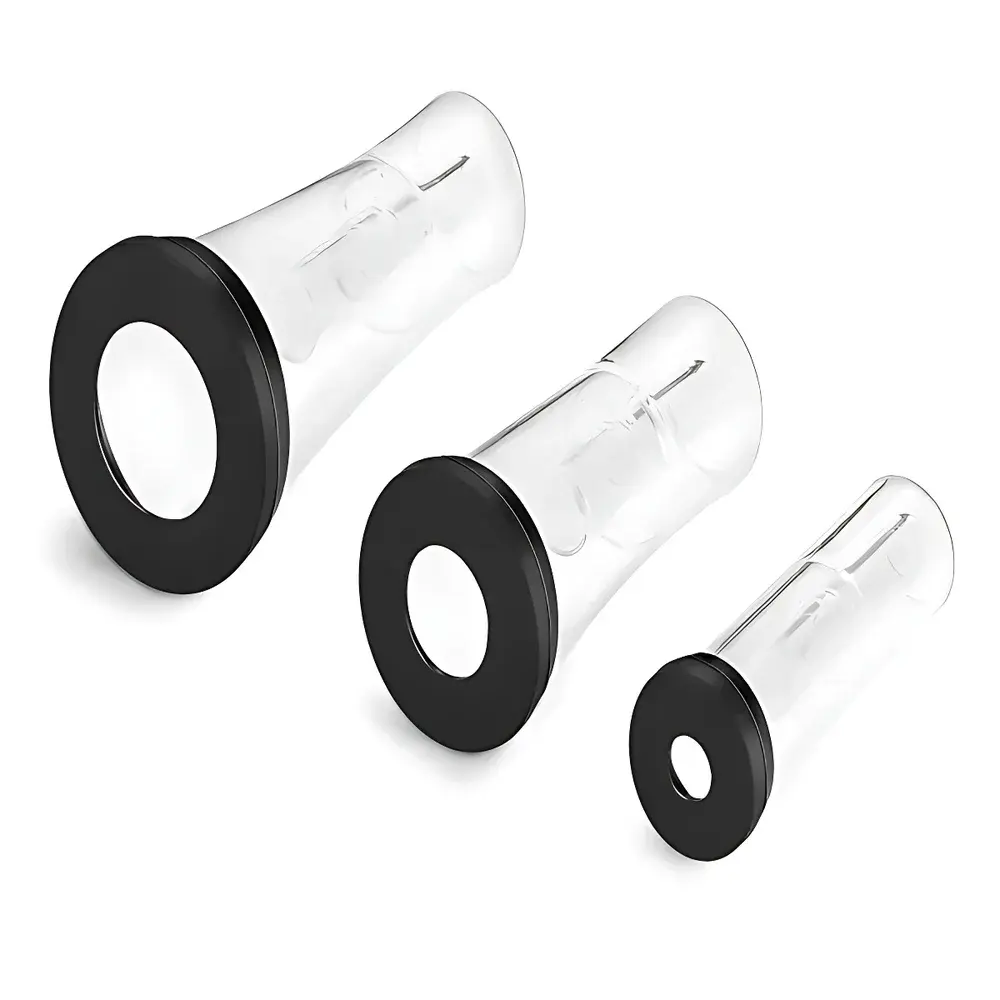
RWD 68613 Conical Rodent Anesthesia Mask with Exhaust Gas Filtration
| Brand | RWD |
|---|---|
| Origin | Guangdong, China |
| Manufacturer Type | OEM Manufacturer |
| Region | Domestic (China) |
| Model | 68613 |
| Pricing | Upon Request |
| Dimensions (for 68658 variant) | Outer Diameter 13 mm, Inner Diameter 5 mm, Depth 24 mm |
| Compatible Species | Mice and juvenile rats (<70 g) |
| Exhaust Interface | Integrated tubing for connection to charcoal or chemical gas scavenging systems |
| Mounting Options | Stand-mounted (models 68656, 68657) or direct-handheld use |
Overview
The RWD 68613 Conical Rodent Anesthesia Mask is an engineered solution for precise, low-profile inhalational anesthesia delivery in preclinical research settings. Designed according to standard veterinary and institutional animal care guidelines, this conical mask employs a tapered geometry optimized for anatomical fit across small rodent species—particularly mice and juvenile rats weighing under 70 g. Its core functional distinction lies in the integrated exhaust gas management pathway: exhaled anesthetic vapors (e.g., isoflurane, sevoflurane) are directed through a dedicated outlet port connected via flexible tubing (e.g., R-CT-6/15, 45 cm length) to external active scavenging systems—typically activated charcoal canisters or centralized vacuum-assisted gas capture units. This design mitigates ambient anesthetic buildup, reducing occupational exposure risk and maintaining compliance with OSHA permissible exposure limits (PELs) and NIOSH recommendations for volatile anesthetics.
Key Features
- Tapered conical geometry ensures secure, leak-resistant seal around the snout without occluding ocular or cranial access—critical for concurrent ophthalmic procedures, EEG electrode placement, or stereotaxic surgery.
- Low-profile profile minimizes interference with head-stage positioning, microscope objectives, or behavioral apparatuses during longitudinal imaging or neurophysiological recordings.
- Exhaust-integrated port enables passive or vacuum-driven gas evacuation directly from the mask chamber, eliminating reliance on ambient room ventilation alone.
- Autoclavable and chemically resistant construction (medical-grade silicone or thermoplastic elastomer) supports repeated sterilization cycles and compatibility with common disinfectants including 70% ethanol and hydrogen peroxide vapor.
- Modular compatibility with RWD’s full ecosystem: includes single-unit stand (68656), five-channel parallel mounting bracket (68657), and standardized gas tubing (R-CT-6/15) for seamless integration into multi-animal induction stations.
Sample Compatibility & Compliance
The 68613 mask system is validated for use with murine models and young rats (≤70 g). Dimensionally matched variants—including 68658 (13 × 5 × 24 mm), 68659 (20 × 10 × 28.5 mm), and 68660 (25 × 15 × 38 mm)—support scalable application across developmental stages and strain-specific head morphologies. All components conform to ISO 10993-1 (biological evaluation of medical devices) for cytotoxicity and skin sensitization. The exhaust pathway design aligns with AVMA Guidelines for the Euthanasia of Animals and AAALAC International standards for waste gas management in vivaria. When deployed with certified scavenging hardware, the system contributes to facility-wide adherence to ANSI Z9.10 (Laboratory Ventilation) and EU Directive 2004/40/EC on electromagnetic fields and occupational exposure.
Software & Data Management
While the 68613 mask itself is a passive hardware component, its integration into automated anesthesia workflows is supported via interoperability with third-party vaporizer controllers (e.g., Matrx Vortex, SomnoSuite) and digital gas monitoring platforms (e.g., Datex-Ohmeda S/5, GE Aisys CS2). Real-time feedback from inline infrared anesthetic analyzers can be logged in GLP-compliant electronic lab notebooks (ELNs) such as LabArchives or Benchling. Audit trails for mask usage—including duration, agent concentration, and scavenger cartridge replacement timestamps—can be maintained to satisfy IACUC protocol documentation requirements and FDA 21 CFR Part 11 data integrity expectations where applicable.
Applications
- Induction and maintenance of inhalational anesthesia during terminal or survival surgical procedures in mice and juvenile rats.
- Functional neuroimaging (fMRI, PET, optical intrinsic signal imaging) requiring stable head positioning and minimal hardware obstruction.
- Ocular interventions—including intraocular injections, ERG recording, and retinal imaging—where unobstructed anterior segment access is essential.
- Longitudinal behavioral phenotyping with simultaneous gas anesthesia, enabling repeated assessments without injectable sedative confounds.
- Teaching laboratories emphasizing safe anesthetic handling practices and occupational health stewardship.
FAQ
Is the 68613 mask compatible with isoflurane vaporizers from non-RWD manufacturers?
Yes—its inlet and exhaust ports adhere to standard Luer-lock and 1/4″ barbed fittings, ensuring mechanical compatibility with most veterinary-grade vaporizers and scavenging systems.
Can the mask be sterilized using ethylene oxide (EtO)?
EtO sterilization is not recommended due to potential residual absorption in elastomeric materials; autoclaving at 121°C for 15–20 minutes or immersion in 70% ethanol for 10 minutes is validated and preferred.
What is the expected service life of the mask under routine IACUC-approved use?
With proper cleaning and storage, the mask maintains structural integrity and sealing performance for ≥200 uses; visual inspection for cracking or deformation is required before each use per institutional SOPs.
Does RWD provide calibration documentation or traceable metrology reports?
As a Class I non-measuring medical device under FDA 21 CFR 866.2120 and China NMPA Category I classification, formal calibration is not mandated; dimensional tolerances are controlled within ±0.3 mm during manufacturing and verified via first-article inspection.




