
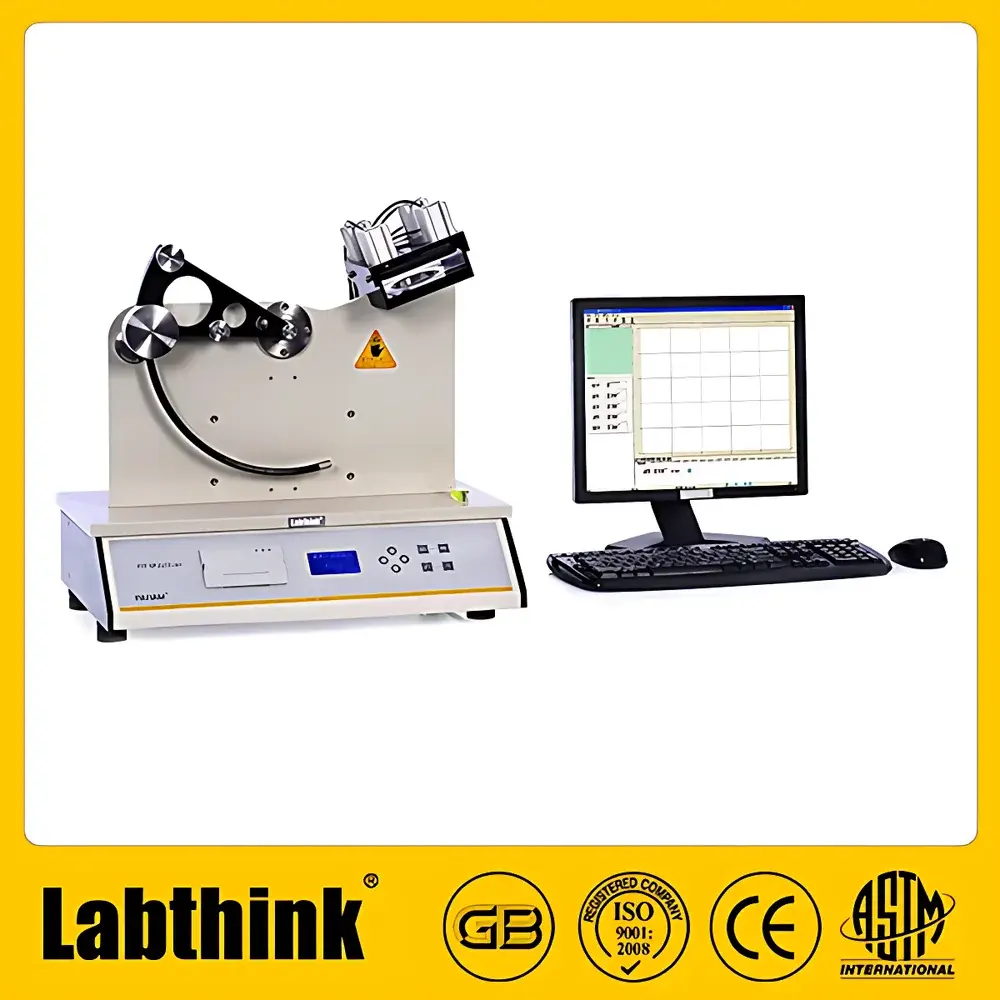
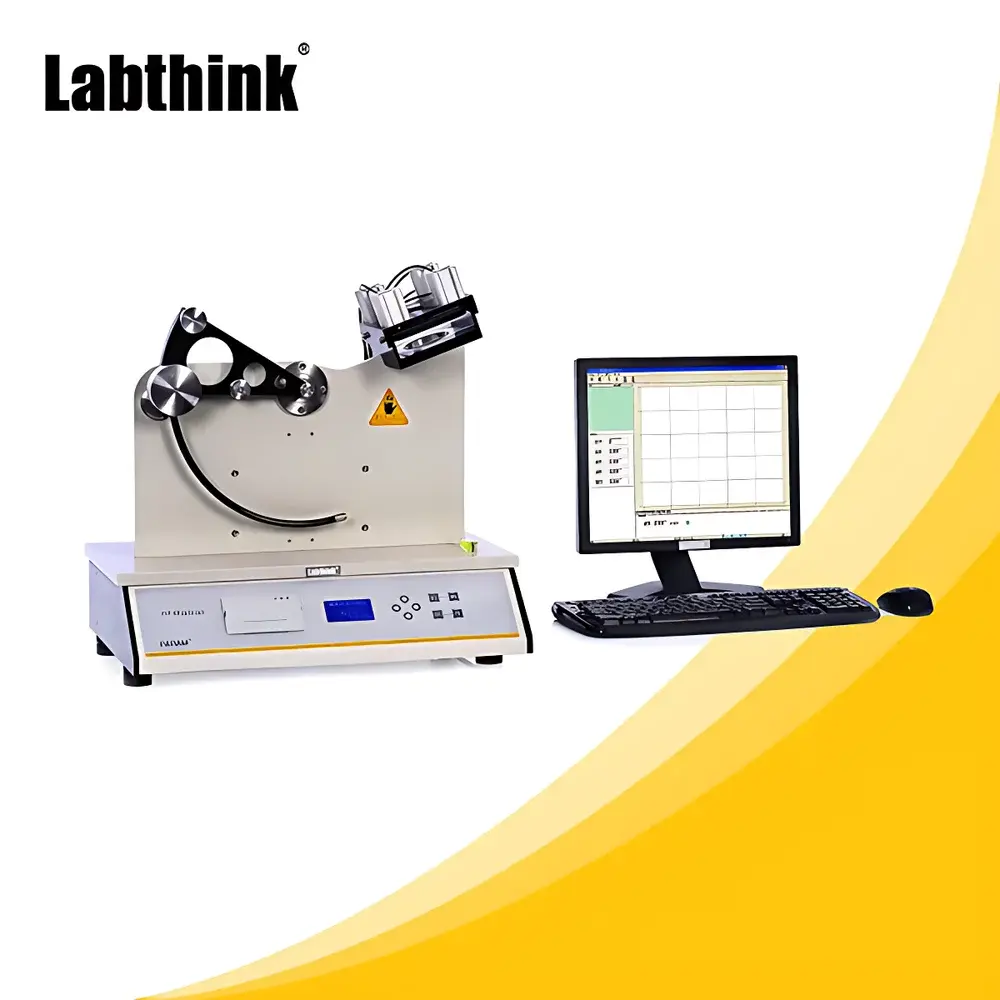
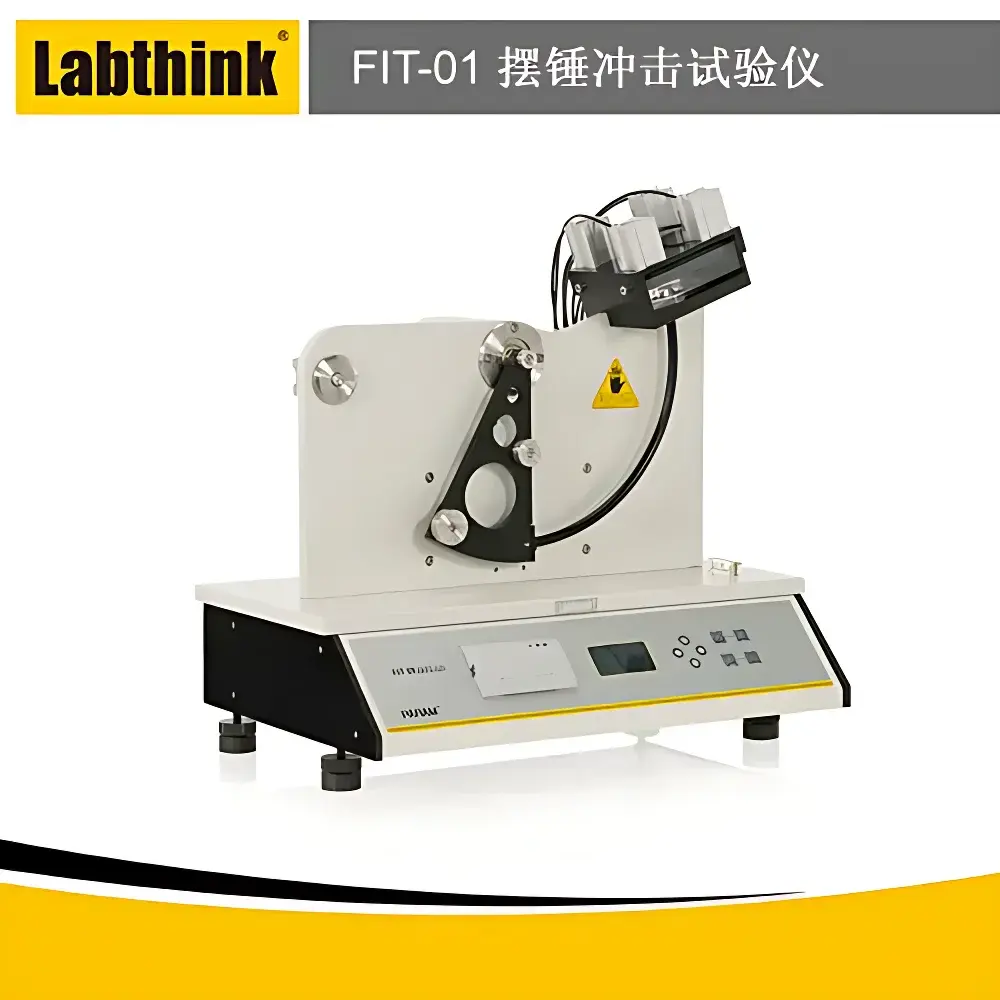
Labthink FIT-01 Pendulum Impact Tester for Thin Films and Flexible Packaging Materials
| Brand | Labthink |
|---|---|
| Origin | Shandong, China |
| Manufacturer Type | Direct Manufacturer |
| Product Category | Domestic |
| Model | FIT-01 |
| Price Range | USD 7,000–14,000 (FOB) |
| Instrument Type | Pendulum Impact Tester |
| Impact Energy | 1 J, 2 J, 3 J |
| Impact Velocity | Determined by pendulum arc geometry (standardized per ISO 179-1 & ASTM D3420) |
| Pendulum Moment (Impact Constant) | Configurable via interchangeable pendulum arms with effective lengths corresponding to Φ25.4 mm, Φ19 mm, and Φ12.7 mm radius-of-gyration equivalents |
| Force Sensor Range & Resolution | 0.001 J (energy resolution, derived from high-precision load cell and angular displacement integration) |
| Maximum Lift Height | Adjustable per energy level (1 J / 2 J / 3 J), calibrated to ISO-compliant pendulum geometry |
| Sample Clamp Aperture | Φ89 mm and Φ60 mm |
| Specimen Dimensions | 100 mm × 100 mm or Ø100 mm circular |
| Pneumatic Requirements | 0.6 MPa (user-supplied compressed air, Ø6 mm polyurethane tubing interface) |
| Overall Dimensions | 600 mm (L) × 390 mm (W) × 600 mm (H) |
| Compliance | GB/T 8809–2014, ASTM D3420–2008a, NF T54-116–1973, ISO 179-1 (adapted), ISO 8256 (indirect reference) |
Overview
The Labthink FIT-01 Pendulum Impact Tester is an electromechanical instrument engineered for the quantitative determination of puncture resistance and impact energy absorption in thin, flexible polymeric materials—including plastic films, laminates, foils, and coated papers—under standardized pendulum impact conditions. It operates on the fundamental principle of conservation of mechanical energy: a calibrated pendulum arm, raised to a defined height, releases a hemispherical striker (with selectable tip diameters) that impacts a horizontally clamped specimen. The residual kinetic energy post-penetration is measured via high-resolution angular transduction and integrated force sensing; the difference between initial potential energy and residual energy yields the absorbed impact energy (in joules). This method directly correlates with real-world packaging integrity challenges such as drop-induced puncture, handling abrasion, and transport-related mechanical stress. Designed for laboratory-grade repeatability and traceable calibration, the FIT-01 conforms to internationally recognized test protocols governing film toughness evaluation.
Key Features
- Triple selectable impact energy levels (1 J, 2 J, 3 J) with automatic energy-level recognition and display calibration
- Interchangeable hemispherical strikers (Φ12.7 mm, Φ19 mm, Φ25.4 mm) enabling material-specific penetration profiling per ASTM D3420 Annex A1
- Pneumatically actuated specimen clamping system ensuring consistent clamping force (±2% repeatability) across ≥100 mm diameter apertures (Φ60 mm and Φ89 mm options)
- Microprocessor-controlled pendulum release mechanism eliminating manual trigger variability and reducing operator-induced standard deviation by >40% versus manual systems
- Integrated angular encoder and dynamic load cell delivering energy resolution of 0.001 J—validated per ISO/IEC 17025-accredited internal calibration procedures
- LCD interface with menu-driven navigation, PVC tactile keypad, and real-time energy readout synchronized with impact event detection
- RS232 serial port and optional USB-to-serial adapter for direct data export to LIMS or Excel; supports ASCII and CSV formats
Sample Compatibility & Compliance
The FIT-01 accommodates planar specimens up to 100 mm × 100 mm or Ø100 mm, with thicknesses ranging from 12 µm to 500 µm—covering monolayer PE, BOPP, PET, aluminum foil laminates, metallized CPP, and barrier-coated paperboard substrates. Its mechanical architecture satisfies dimensional and procedural requirements of GB/T 8809–2014 (identical to ISO 179-1:2018 adaptation for thin sections), ASTM D3420–2008a (Standard Test Method for Pendulum Impact Resistance of Plastic Film), and NF T54-116–1973. All critical components—including pendulum inertia, striker geometry, clamp concentricity, and energy calculation algorithms—are traceably aligned to NIST-traceable reference standards. The system supports GLP-compliant audit trails when integrated with Lystem™ Laboratory Data Management System (LDMS), including user authentication logs, calibration history, and electronic signature capture per FDA 21 CFR Part 11.
Software & Data Management
Embedded firmware enables automatic statistical computation of mean impact energy, standard deviation, coefficient of variation (CV%), and pass/fail flagging against user-defined specification limits. Raw angular position vs. time and force vs. time waveforms are stored locally and exportable for advanced waveform analysis (e.g., peak force timing, energy partitioning). When connected to Lystem™ LDMS (v3.2+), test records synchronize with centralized databases, supporting multi-site comparison, trending reports, and automated PDF certificate generation compliant with ISO/IEC 17025 clause 7.8. Data encryption, role-based access control, and immutable audit logs ensure regulatory readiness for pharmaceutical packaging validation (ICH Q5C), food contact material assessments (EU 10/2011), and automotive interior component qualification (SAE J2527).
Applications
- Quality control of rollstock prior to converting—detecting batch-to-batch variations in extrusion quench efficiency or coextrusion layer adhesion
- Development of high-toughness barrier films for medical device pouches requiring ASTM F1608-compliant seal integrity under impact
- Evaluation of recyclable mono-material structures (e.g., PP-based laminates) where impact resistance must be retained despite reduced gauge
- Comparative assessment of bio-based films (PLA, PHA) versus conventional polyolefins under identical impact loading conditions
- Root cause analysis of field failures in retail-ready packaging subjected to palletized distribution stresses
- Supporting ISO 11607-1 Annex C mechanical testing requirements for sterile barrier systems
FAQ
What standards does the FIT-01 natively support without hardware modification?
GB/T 8809–2014, ASTM D3420–2008a, and NF T54-116–1973 are fully implemented in firmware and mechanical configuration; ISO 179-1 compliance requires optional striker calibration kit and software license.
Can the FIT-01 measure impact resistance of non-planar or pre-formed samples?
No—it is strictly configured for flat, tension-free specimens mounted in horizontal orientation per standard methodology; curved or thermoformed parts require alternative instrumentation (e.g., dart impact tester per ASTM D1709).
Is pneumatic supply included with the instrument?
No—users must provide clean, dry, oil-free compressed air at 0.6 MPa ±0.05 MPa via standard Ø6 mm PU tubing; a desiccant-filter regulator is recommended for long-term sensor stability.
How often does the system require recalibration?
Annual verification against certified reference pendulums is recommended; energy calibration checks using NIST-traceable impact energy standards should be performed before each shift when used in regulated environments.
Does the FIT-01 support IQ/OQ/PQ documentation packages?
Yes—Labthink provides GMP-aligned Installation Qualification (IQ), Operational Qualification (OQ), and Performance Qualification (PQ) templates with test protocols, acceptance criteria, and blank execution records upon request.



