
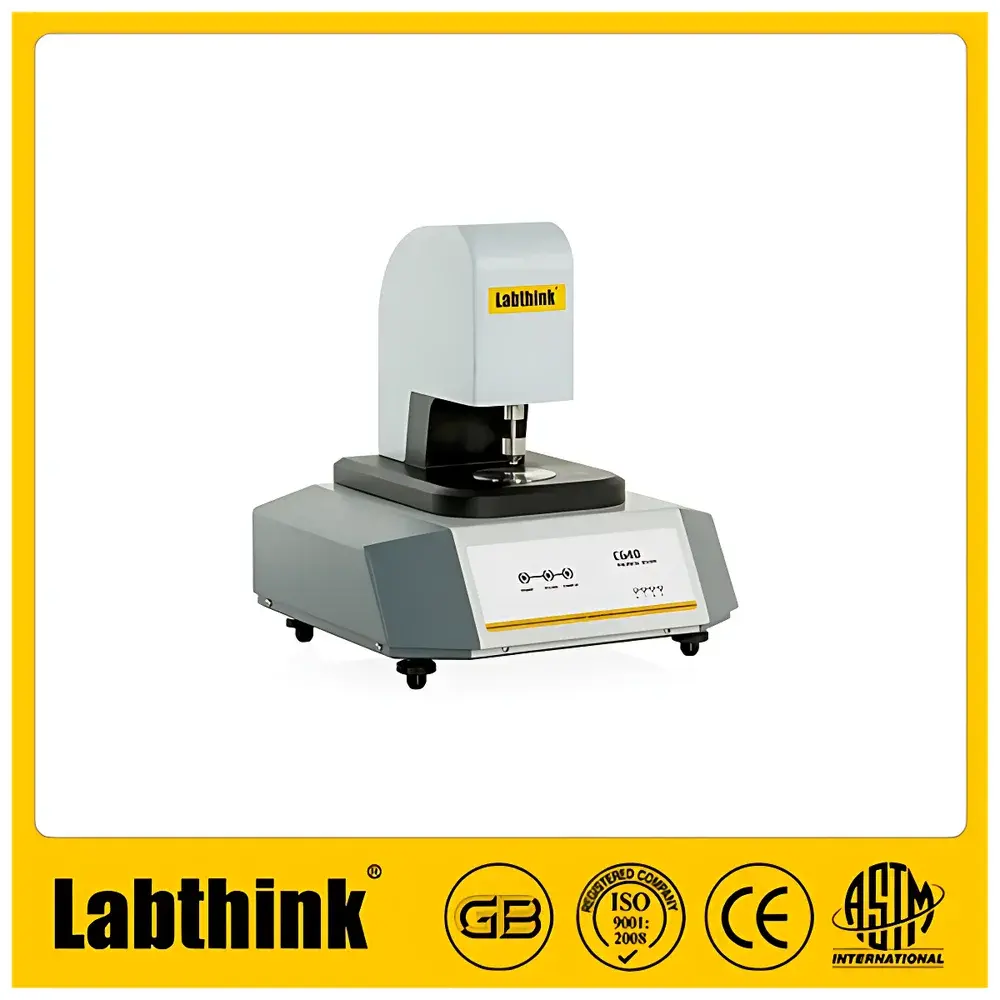
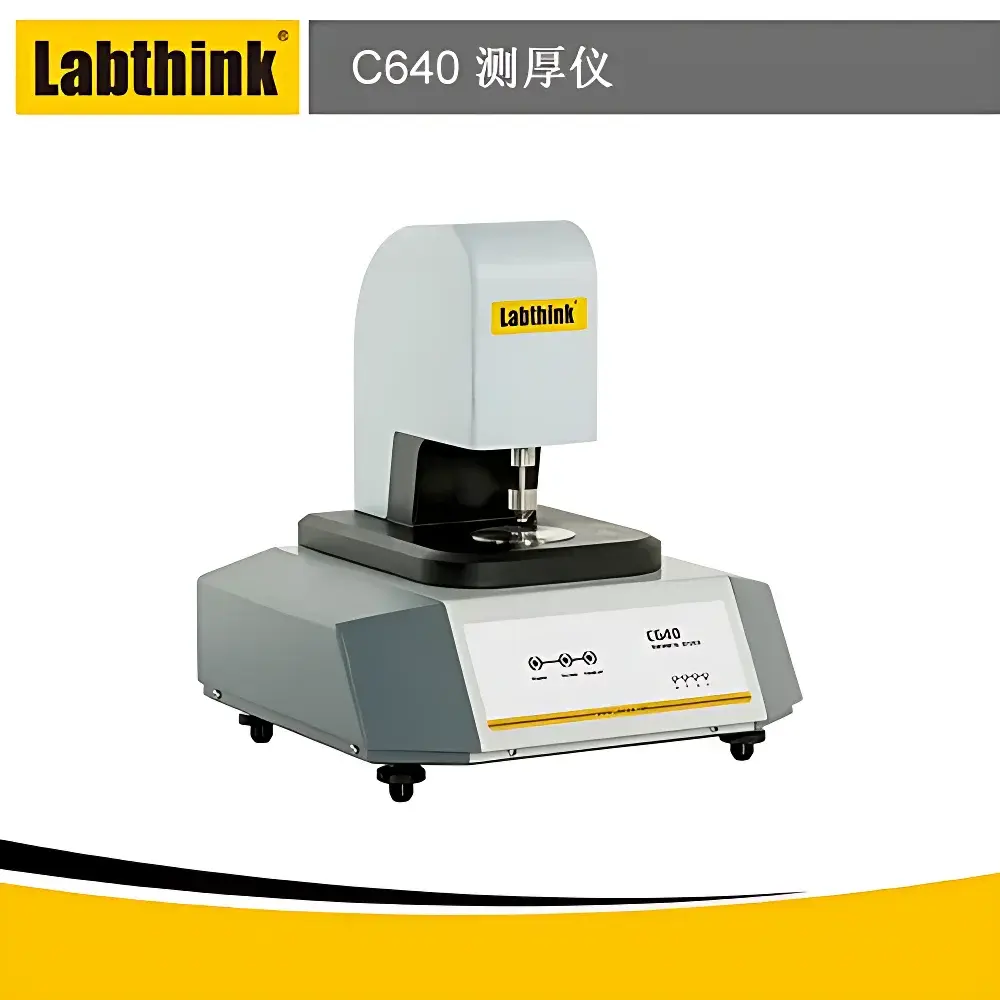
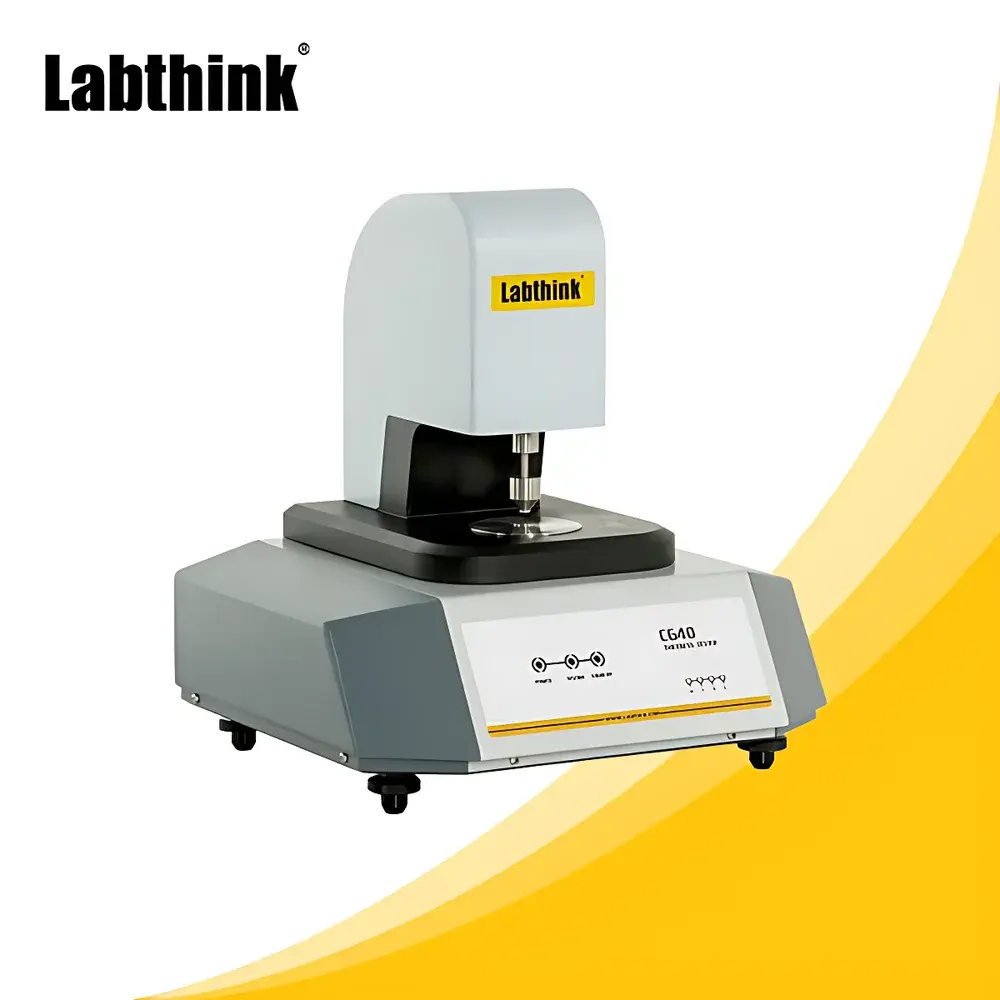
Labthink C640 High-Precision Mechanical Contact Thickness Gauge
| Brand | Labthink |
|---|---|
| Model | C640M / C640H |
| Measurement Principle | Mechanical Contact (Controlled-Pressure Displacement Sensing) |
| Test Range (Std) | 0–2 mm |
| Resolution | 0.1 µm |
| Repeatability | 0.8 µm (C640M) / 0.4 µm (C640H) |
| Applied Pressure | 17.5 ± 1 kPa (film, 50 mm²) / 100 ± 1 kPa (paper, 200 mm²) |
| Compliance | ISO 4593, ISO 534, ASTM D6988, ASTM F2251, GB/T 6672, GB/T 451.3, TAPPI T411, EN 1942, JIS K6250 |
| Optional Features | Auto-Feeding Module, DataShield™ Secure Data Management System, GMP-Compliant Software Validation Package (21 CFR Part 11 & Annex 11 Ready) |
| Power Supply | 220–240 VAC, 50 Hz / 120 VAC, 60 Hz |
| Dimensions | 370 × 350 × 410 mm (L×W×H) |
| Net Weight | 26 kg |
Overview
The Labthink C640 is a high-precision mechanical contact thickness gauge engineered for metrologically rigorous measurement of thin, flexible, and semi-rigid planar materials. It operates on the principle of controlled-force displacement sensing: a calibrated upper measuring anvil applies a standardized pressure—traceable to ISO and ASTM norms—onto the specimen surface, while a high-stability linear variable differential transformer (LVDT) or capacitive displacement sensor detects the gap between the upper and lower anvils with sub-micron resolution. This method ensures direct, traceable, and operator-independent thickness determination without optical interference, thermal drift, or material-dependent signal attenuation. Designed for laboratory, QC, and regulatory environments, the C640 delivers certified repeatability (≤0.4 µm for C640H variant) and long-term stability across daily calibration cycles. Its architecture complies with fundamental metrological requirements for Type A uncertainty evaluation per ISO/IEC 17025 and supports documented instrument qualification (IQ/OQ/PQ) protocols.
Key Features
- Ultra-high-resolution displacement sensing (0.1 µm) with dual-variant repeatability specifications: ≤0.8 µm (C640M) and ≤0.4 µm (C640H), validated per ISO 5725-2 precision testing methodology.
- Programmable pressure application system compliant with ISO 4593 (plastic films), ISO 534 (paper and board), and ASTM D6988 (polymeric films), enabling material-specific test configurations via selectable anvil area (50 mm² or 200 mm²) and pressure setpoints (17.5 kPa or 100 kPa).
- Modular mechanical design supporting optional automated sample handling: the integrated auto-feeder enables unattended multi-point scanning across up to 1000 mm travel range, with programmable feed speed (1.5–80 mm/s) and positional accuracy ±0.02 mm.
- Dual-anvil geometry with hardened stainless-steel contact surfaces, parallelism tolerance <5 µm over full 100 mm span, and thermal drift compensation (<0.3 µm/°C) ensuring dimensional integrity under ambient lab conditions (20–25°C).
- Embedded real-time diagnostics including force verification feedback, sensor linearity monitoring, and mechanical hysteresis tracking—each logged with timestamp and operator ID for audit readiness.
Sample Compatibility & Compliance
The C640 accommodates a broad spectrum of planar specimens defined by ISO 12625-3 (nonwovens), ISO 3034 (rubber sheets), ASTM D374 (electrical insulators), and GB/T 24218.2 (medical nonwovens). Validated applications include polyethylene and PET films (12–250 µm), tissue paper (6–150 g/m²), corrugated board (1.2–8 mm), silicon wafers (300–1200 µm), spunbond/meltblown nonwovens (e.g., surgical mask layers, absorbent cores), and pressure-sensitive adhesive tapes. All measurement modes adhere to mandatory pressure-area specifications per material class—preventing compressive deformation artifacts. The system meets GLP and GMP documentation requirements when equipped with the optional DataShield™ module and 21 CFR Part 11-compliant software package, including electronic signatures, audit trail with immutable timestamps, and role-based access control (RBAC) for operators, reviewers, and administrators.
Software & Data Management
The C640 is operated via Labthink’s proprietary ThicknessTest™ v4.x software—a Windows-based platform developed in accordance with IEC 62304 Class B medical device software standards. It features intuitive workflow-driven test sequencing, real-time thickness mapping visualization, statistical process control (SPC) charting (X-bar/R, Cp/Cpk), and automated report generation in PDF/A-1b and CSV formats. Raw sensor data (including force vs. displacement curves) are stored in encrypted SQLite databases with SHA-256 hashing. With the optional DataShield™ configuration, all data transfers, backups, and report exports undergo AES-256 encryption; audit trails record every action—including parameter changes, calibration events, and user logins—with tamper-evident digital signatures. Software validation documentation (URS, FRS, IQ/OQ protocols, traceability matrices) is provided for regulated industries.
Applications
The C640 serves as a primary metrology tool in packaging R&D labs (film coextrusion optimization), pharmaceutical manufacturing (blister foil thickness uniformity per USP ), medical device QA (surgical drape and mask layer consistency), and automotive composites (nonwoven battery separator thickness control). It is routinely deployed for incoming raw material inspection (e.g., lithium-ion battery separator films per IEC 62620), in-process thickness profiling during calendering or coating operations, and final product release testing against internal specifications aligned with ISO 9001 clause 8.5.2. Its mechanical contact methodology provides definitive reference measurements for cross-validation against non-contact techniques such as laser triangulation or eddy current gauges.
FAQ
What standards does the C640 comply with for film thickness testing?
The C640 conforms to ISO 4593, ASTM D6988, and GB/T 6672 for plastic films; ISO 534 and TAPPI T411 for paper and board; and ISO 12625-3 for nonwovens.
Can the C640 measure rigid substrates like metal foils or silicon wafers?
Yes—the 0–2 mm standard range and programmable 100 kPa pressure mode support thickness verification of aluminum foil (≥6 µm), copper shim stock, and silicon wafers up to 1200 µm, provided surface flatness meets ISO 1101 GD&T requirements.
Is calibration traceable to national metrology institutes?
All factory calibrations use NIST-traceable gauge blocks (certified to ISO 3650), with full calibration certificates issued per ISO/IEC 17025 requirements; on-site recalibration services include uncertainty budgets.
How is data integrity ensured in regulated environments?
With the optional GMP software package, the system enforces 21 CFR Part 11 compliance: electronic signatures, automated audit trails, data encryption, and permission-controlled workflows—validated per Annex 11 and ALCOA+ principles.
What maintenance is required for long-term accuracy?
Annual preventive maintenance includes anvil surface inspection, LVDT linearity verification, pressure transducer recalibration, and mechanical alignment check—documented in the instrument’s maintenance logbook.



