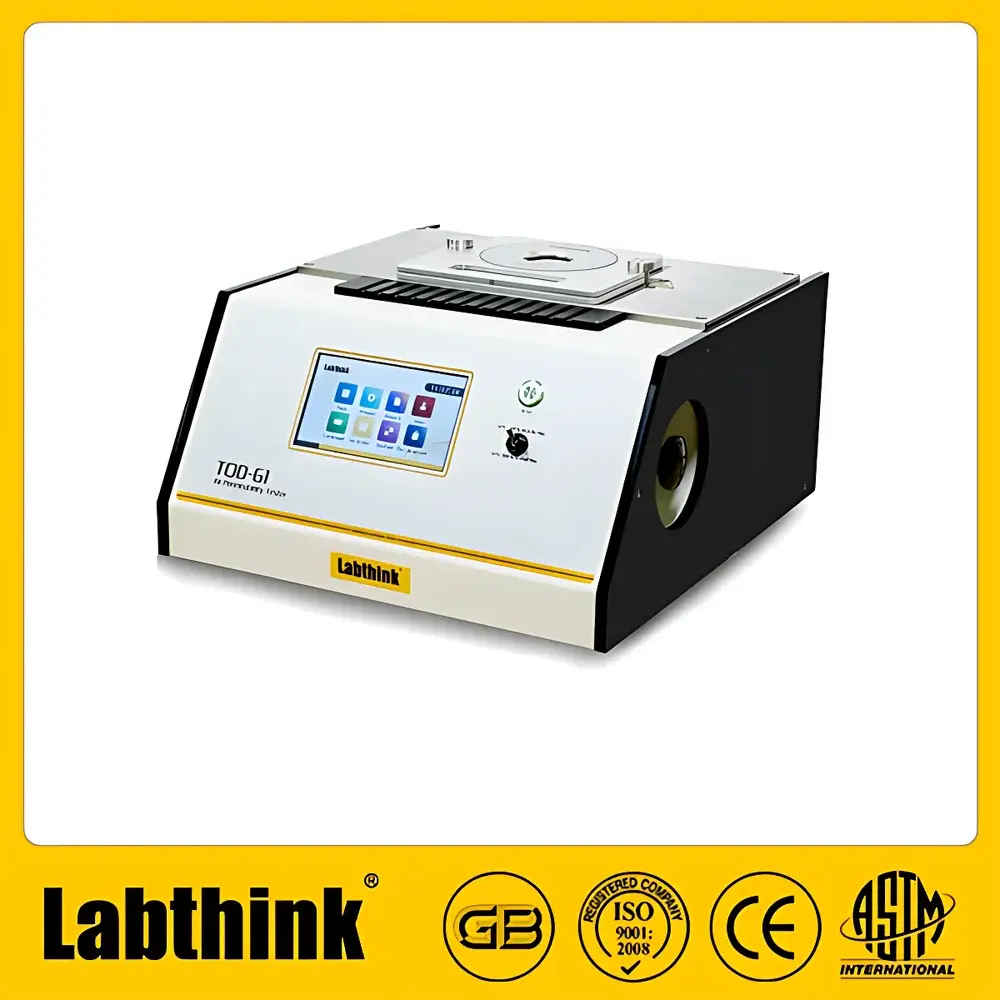
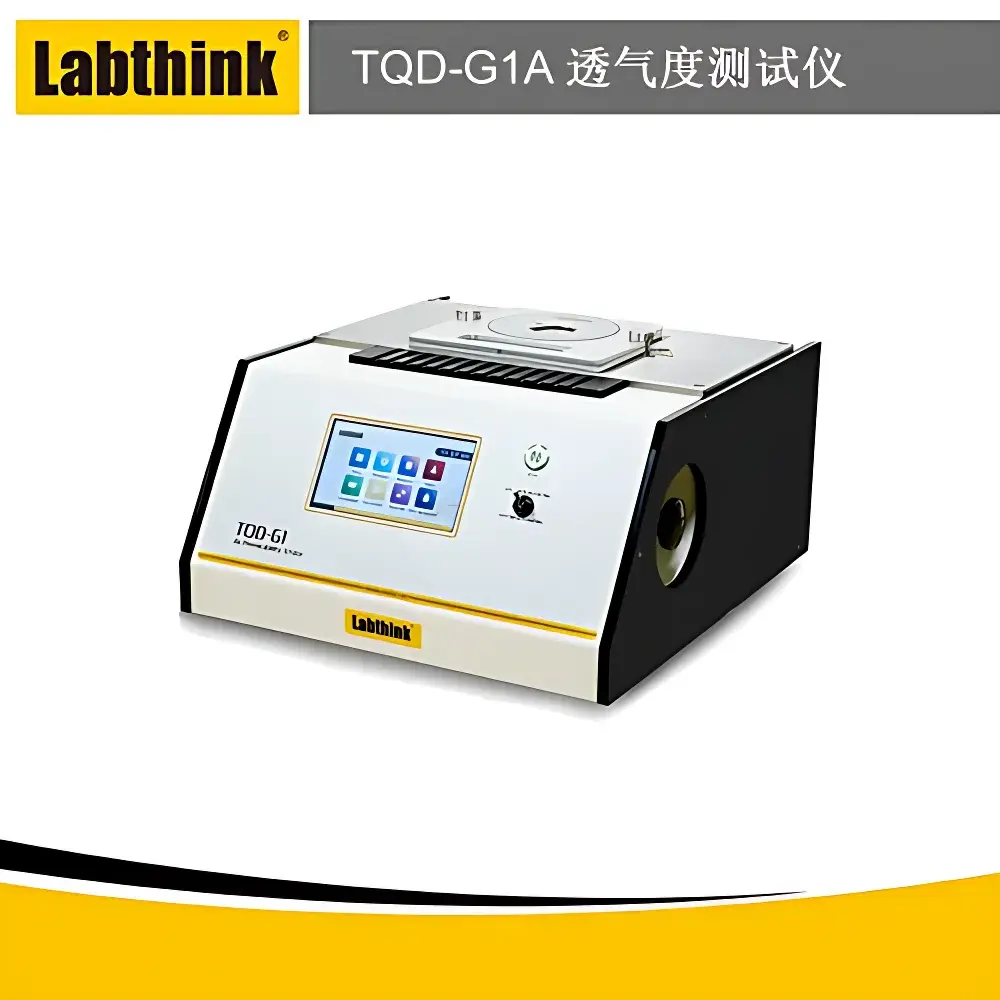
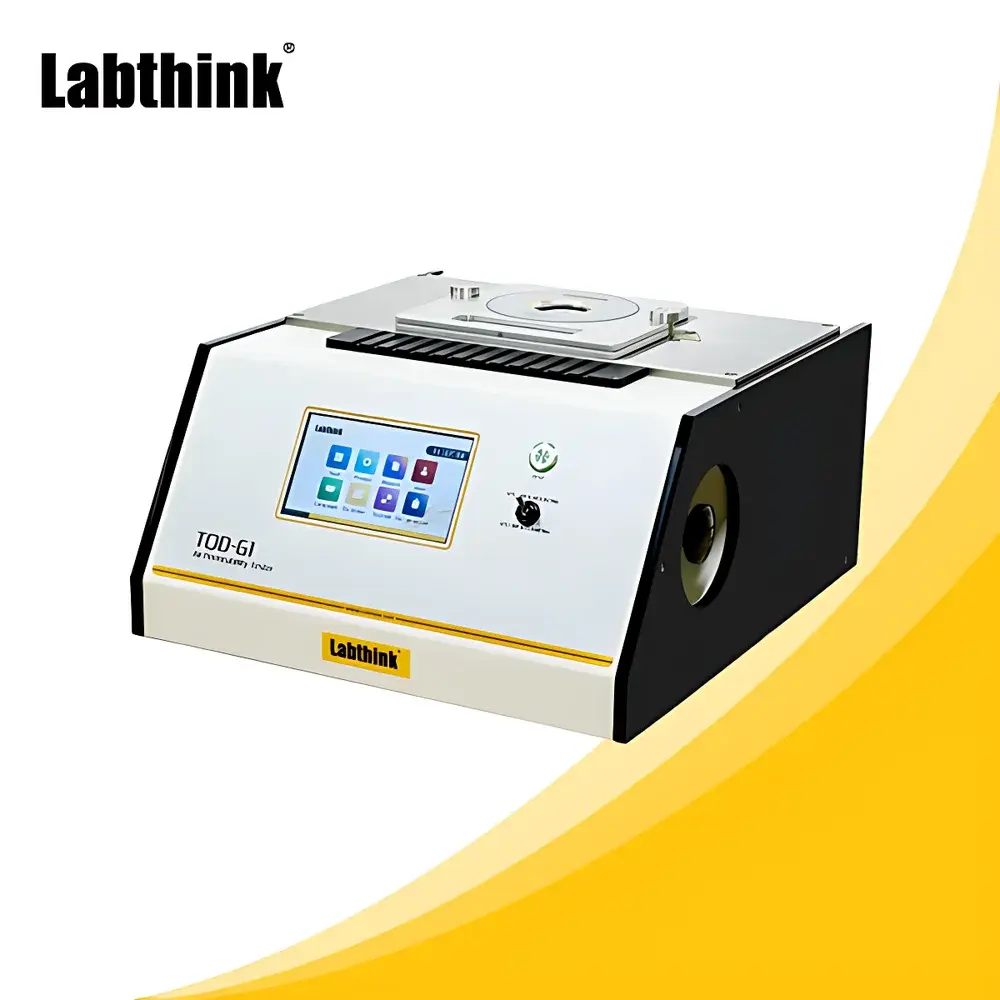
Labthink TQD-G1A Air Permeability Tester for Paper, Packaging, and Automotive Interior Materials
| Brand | Labthink |
|---|---|
| Origin | Shandong, China |
| Manufacturer Type | Direct Manufacturer |
| Country of Origin | China |
| Model | TQD-G1A |
| Price Range | USD 14,000 – 70,000 |
| Measurement Principle | Constant-Pressure-Difference (Method B) & Constant-Flow-Rate (Method A) |
| Standards Compliance | ISO 9237, ISO 4638, ISO 5636, GB/T 5453, GB/T 10655, ASTM D737, TAPPI T460, JIS P8117 |
| Pressure Drop Range | 0–1000 Pa |
| Pressure Resolution | 0.1 Pa |
| Pressure Accuracy | ±0.25% FS |
| Flow Rate Range | 0–30 L/min |
| Flow Resolution | 0.1 L/min |
| Flow Accuracy | ±2% FS |
| Test Area | 20 cm² (standard, customizable) |
| Sample Size | 50 mm × 50 mm |
| Max Sample Thickness | 1 mm |
| Power Supply | 120 VAC ±10% / 60 Hz or 220 VAC ±10% / 50 Hz |
| Dimensions (W×D×H) | 300 × 460 × 520 mm |
| Net Weight | 25 kg |
| Gas Supply | Clean compressed air (user-supplied, ≥550 kPa, >120 L/min) |
Overview
The Labthink TQD-G1A Air Permeability Tester is a precision-engineered instrument designed for quantitative evaluation of gas transmission behavior through planar porous materials under controlled differential pressure or constant flow conditions. It operates on two standardized physical principles: Method A (constant flow rate), where airflow is fixed and the resulting pressure drop across the specimen is measured; and Method B (constant pressure difference), where a defined pressure gradient is applied and volumetric airflow through a standardized test area is quantified. This dual-mode architecture enables rigorous characterization of both air resistance (Pa·s/m) and air permeability (µm/(Pa·s))—key parameters governing breathability, filtration efficiency, thermal comfort, and functional barrier performance in paper, packaging, automotive interior components, and personal protective equipment.
Key Features
- Dual-test-mode operation compliant with ISO 9237 (Method A and B), ASTM D737, and GB/T 5453—ensuring methodological traceability and inter-laboratory comparability.
- High-stability pneumatic system featuring an imported maintenance-free vacuum pump and precision-regulated air supply, delivering consistent flow dynamics and minimizing transient drift during extended testing cycles.
- Electronically calibrated differential pressure transducer (0–1000 Pa range, 0.1 Pa resolution, ±0.25% FS accuracy) and mass flow sensor (0–30 L/min, 0.1 L/min resolution, ±2% FS accuracy) provide metrologically sound data acquisition.
- Pneumatically actuated clamping mechanism ensures uniform compressive force across the 50 mm × 50 mm test area (20 cm² standard), eliminating operator-induced variability and preventing edge leakage—a critical factor in low-permeability material evaluation.
- 7-inch industrial-grade color touchscreen interface supports multi-language UI (English, Chinese, Spanish, Portuguese), real-time graphical display of pressure/flow curves, calendar-based test logging, and hierarchical user permission management aligned with GLP audit requirements.
- Standard RS232 serial interface enables bidirectional communication with external PCs for automated data export, remote calibration verification, and integration into centralized QC databases. Optional thermal printer support allows direct hardcopy generation of test reports with timestamped metadata.
Sample Compatibility & Compliance
The TQD-G1A accommodates rigid and flexible sheet materials up to 1 mm thickness—including paperboard, filter paper, tissue, nonwovens, PU foams, PVC laminates, leather, knitted fabrics, and melt-blown mask media. Its mechanical design conforms to the dimensional constraints specified in ISO 9237 (50 mm square aperture) and ASTM D737 (100 cm² optional via custom fixtures). All measurement protocols adhere strictly to international regulatory frameworks: ISO 4638 (paper air resistance), ISO 5636 (porosity of coated papers), GB/T 4689.22 (leather breathability), and TAPPI T460 (air permeance of packaging substrates). The system supports full traceability documentation required for FDA 21 CFR Part 11-compliant environments when paired with validated software modules.
Software & Data Management
Labthink’s proprietary control software (optional) provides comprehensive test sequence automation, statistical process control (SPC) charting, outlier detection based on ICH Q5A guidelines, and export to CSV, PDF, or XML formats compatible with LIMS platforms. Audit trails record all parameter modifications, user logins, calibration events, and raw signal timestamps—meeting ALCOA+ data integrity criteria. Data encryption at rest and role-based access controls ensure compliance with ISO/IEC 27001 information security standards. Firmware updates are delivered via secure HTTPS channels with SHA-256 signature verification.
Applications
- Paper & Board Manufacturing: Quantification of air permeance in cigarette paper, filter tipping stock, food-grade wrapping paper, and corrugated board liners per ISO 5636-3 and GB/T 10655.
- Automotive Interiors: Validation of airflow resistance in headliner composites, door panel substrates, and seat cushion foams per SAE J1716 and OEM-specific specifications (e.g., Ford WSS-M99P1111-A).
- Medical & Hygiene Products: Determination of pressure differential across surgical gowns (ASTM F1670), N95 respirator filter layers (NIOSH 42 CFR Part 84), and baby diaper backsheet films (EDANA 10.1).
- Technical Textiles: Assessment of breathability in sportswear membranes (ISO 11092), geotextile filtration capacity (ASTM D4491), and HVAC filter media (EN 779).
- Flexible Packaging: Evaluation of oxygen transmission rate (OTR) correlation in metallized PET, PVDC-coated LDPE, and aluminum foil laminates—supporting predictive modeling of shelf-life stability.
FAQ
What gas medium is required for operation?
Clean, oil-free compressed air at ≥550 kPa (79.7 PSI) and minimum flow capacity of 120 L/min. Nitrogen or other inert gases may be used if chemical compatibility is verified.
Can test area be modified beyond the standard 20 cm²?
Yes—custom apertures (e.g., 5 cm², 100 cm²) are available as factory-installed options to meet specific standard requirements such as ASTM D737 (100 cm²) or ISO 9237 (50 cm²).
Is calibration traceable to national standards?
All pressure and flow sensors are calibrated using NIST-traceable reference instruments prior to shipment, with certificate of calibration included. Annual recalibration services are available through Labthink’s ISO/IEC 17025-accredited service centers.
Does the system support GLP/GMP validation protocols?
Yes—the hardware architecture, firmware, and optional software suite comply with Annex 11 (EU GMP), 21 CFR Part 11 (FDA), and ISO 17025 requirements for analytical instrument qualification (IQ/OQ/PQ) and electronic record retention.
What maintenance is required for long-term reliability?
No routine maintenance is needed for the vacuum pump or pressure sensors. Users should inspect O-rings quarterly, clean the test chamber with isopropyl alcohol biannually, and verify seal integrity using the built-in leak-check function before each test series.