
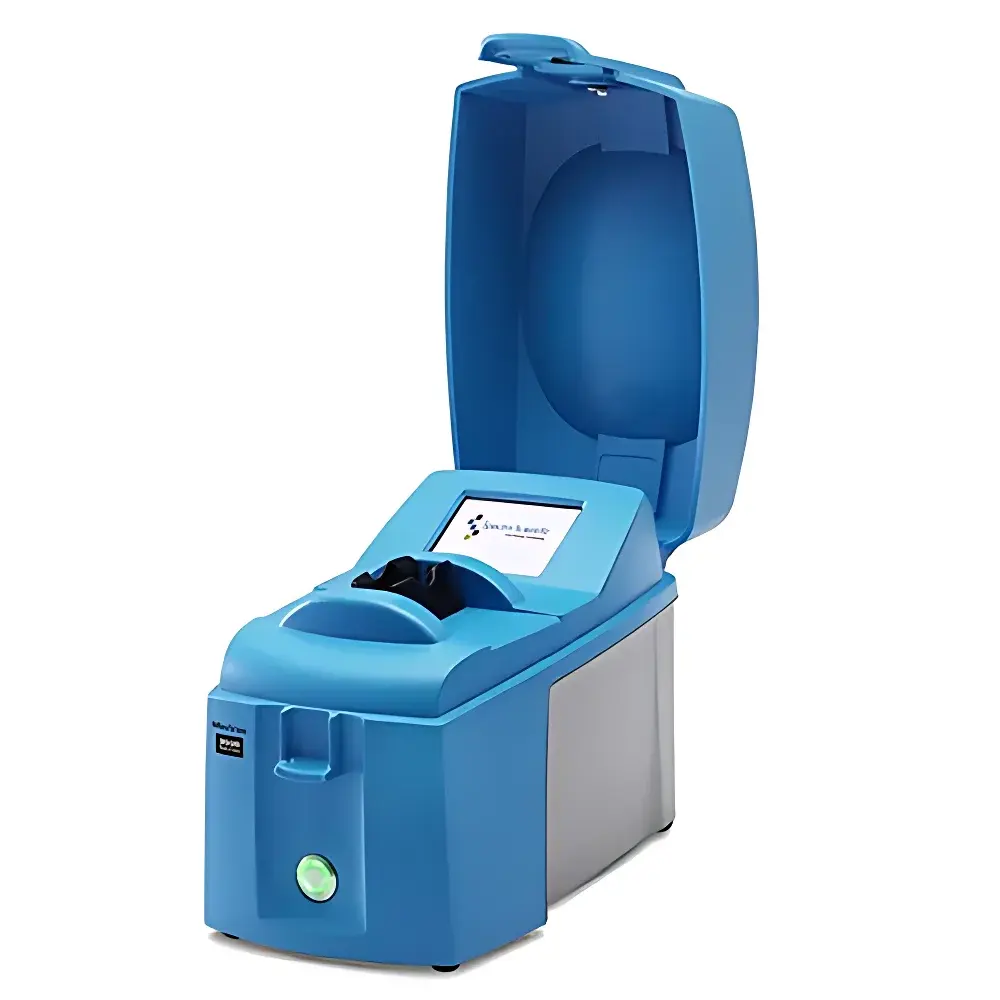
Spectro Scientific MiniVisc 3000 Portable Kinematic Viscometer
| Brand | Spectro Scientific |
|---|---|
| Origin | USA |
| Model | MiniVisc 3000 |
| Kinematic Viscosity Range | 1–700 mm²/s |
| Compliance | ASTM D8092 |
| Dimensions | 15.2 × 12.7 × 20.3 cm |
| Weight | 1.8 kg |
| Power | Rechargeable Lithium Battery |
| Capillary Type | Split-Cell Metal Capillary |
| Sample Prep | Solvent-free, No Pre-treatment Required |
| Analysis Time | 2–4 min per sample |
Overview
The Spectro Scientific MiniVisc 3000 is a field-deployable, ASTM D8092-compliant kinematic viscometer engineered for rapid, quantitative measurement of lubricating oils and hydraulic fluids at 40 °C. Unlike traditional capillary viscometers requiring fixed-bath immersion, gravity-driven flow, and extensive sample conditioning, the MiniVisc 3000 employs a patented split-cell metal capillary architecture that enables direct, in-situ kinematic viscosity determination without solvent dilution, filtration, or temperature equilibration beyond ambient stabilization. Its operational principle relies on precise timing of fluid displacement through a calibrated, thermally stable stainless-steel capillary under controlled gravitational head—yielding kinematic viscosity (ν) in mm²/s via the fundamental relationship ν = K × t, where K is the instrument-specific calibration constant and t is efflux time. Designed for mission-critical reliability in marine, aviation, power generation, and mobile equipment maintenance environments, the MiniVisc 3000 delivers laboratory-grade repeatability (CV < 1.5% per NASC 2013 validation report) while eliminating infrastructure dependencies such as constant-temperature baths, timing stopwatches, or volumetric glassware.
Key Features
- True portable operation: Compact footprint (15.2 × 12.7 × 20.3 cm), lightweight design (1.8 kg), and integrated rechargeable lithium battery enable continuous field use for >8 hours per charge.
- Solvent-free, reagent-free analysis: Eliminates hazardous solvent handling, waste disposal liabilities, and cross-contamination risks associated with conventional Ubbelohde or Cannon-Fenske methods.
- Durable split-cell metal capillary: Precision-machined stainless-steel capillary resists mechanical damage, thermal shock, and chemical degradation—no fragile glass components or replaceable inserts.
- Rapid turnaround: Typical analysis time of 2–4 minutes per sample, dependent on kinematic viscosity; no warm-up delay or post-run cleaning cycles required.
- Embedded temperature compensation: Onboard thermistor continuously monitors sample temperature during efflux; results are automatically corrected to 40 °C using ASTM-recommended interpolation algorithms.
- Calibration traceability: Factory-calibrated against NIST-traceable reference oils; user-accessible calibration verification mode supports routine performance checks per ISO/IEC 17025 quality system requirements.
Sample Compatibility & Compliance
The MiniVisc 3000 is validated for use with mineral-based, synthetic, and semi-synthetic lubricants—including engine oils, turbine oils, hydraulic fluids, gear oils, and compressor oils—within the specified kinematic viscosity range of 1–700 mm²/s at 40 °C. It excludes highly volatile, non-Newtonian, or particulate-laden samples exceeding 5 µm particle concentration without prior centrifugation or filtration (per ASTM D2270 guidance). The instrument meets ASTM D8092 “Standard Test Method for Field Determination of Kinematic Viscosity Using a Portable Viscometer” and supports compliance with broader asset integrity frameworks including MIL-STD-1353, NAVSEA Technical Manual S9086-SH-PRO-010, and ISO 4406:2017 for integrated oil condition monitoring programs. Data output conforms to ASTM E1447 digital reporting conventions and is compatible with LIMS integration via USB-C interface.
Software & Data Management
The MiniVisc 3000 features an embedded ARM Cortex-M4 microcontroller running real-time firmware with secure, audit-ready data logging. Each measurement record includes timestamp, ambient temperature, sample ID, raw efflux time, compensated viscosity value, operator ID, and instrument serial number. All records are stored in encrypted internal memory (≥500 test entries) and exportable in CSV format compliant with FDA 21 CFR Part 11 requirements for electronic records and signatures—supporting full audit trails, user-level access control, and electronic signature capture. When deployed within the Spectro MiniLab ecosystem, viscosity data synchronizes automatically with elemental analysis (ICP-OES), particle counting (ISO 4406), ferrous density (Ferrography), and oxidation/nitration FTIR results, enabling unified diagnostic reporting aligned with ISO 55001 asset management standards.
Applications
- Maritime predictive maintenance: Real-time viscosity screening aboard naval vessels, commercial freighters, and offshore platforms to detect thermal degradation, fuel dilution, or coolant ingress before catastrophic bearing failure.
- Aerospace ground support: On-ramp verification of turbine oil viscosity prior to aircraft engine start, ensuring film thickness adequacy per SAE AS5780 specifications.
- Power plant condition-based monitoring: Routine testing of transformer, turbine, and gearbox oils during scheduled inspections—reducing downtime and extending oil drain intervals via empirical trend analysis.
- Mobile equipment fleet management: In-field verification of hydraulic fluid viscosity across construction, mining, and agricultural machinery to prevent pump cavitation and valve stiction.
- Oil reclamation and blending verification: Confirming viscosity conformity of reclaimed base stocks or blended formulations prior to redistribution or reuse.
FAQ
Does the MiniVisc 3000 require calibration verification between uses?
No—routine calibration verification is recommended every 30 days or after 100 measurements, per ASTM D8092 Section 8.3. A built-in verification mode allows quick confirmation using a certified reference oil.
Can the instrument measure viscosity at temperatures other than 40 °C?
It measures efflux time at ambient temperature and applies ASTM D341-based correction algorithms to report kinematic viscosity at 40 °C. It does not provide direct measurement at alternate temperatures.
Is the MiniVisc 3000 suitable for used oil containing soot or sludge?
Yes—if particles are <5 µm and concentration is below 10,000 particles/mL (per ISO 4406 Class 18/16/13), provided the sample has been homogenized by gentle agitation immediately prior to loading.
How is data security ensured during transfer to enterprise systems?
All exported CSV files include SHA-256 checksums and optional AES-256 encryption; USB-C transfers enforce write-only mode to prevent unauthorized firmware modification.
What regulatory standards does the MiniVisc 3000 support for GxP environments?
It supports 21 CFR Part 11, EU Annex 11, and ISO/IEC 17025 requirements through configurable user roles, electronic signatures, and immutable audit logs with time-stamped operator actions.



