
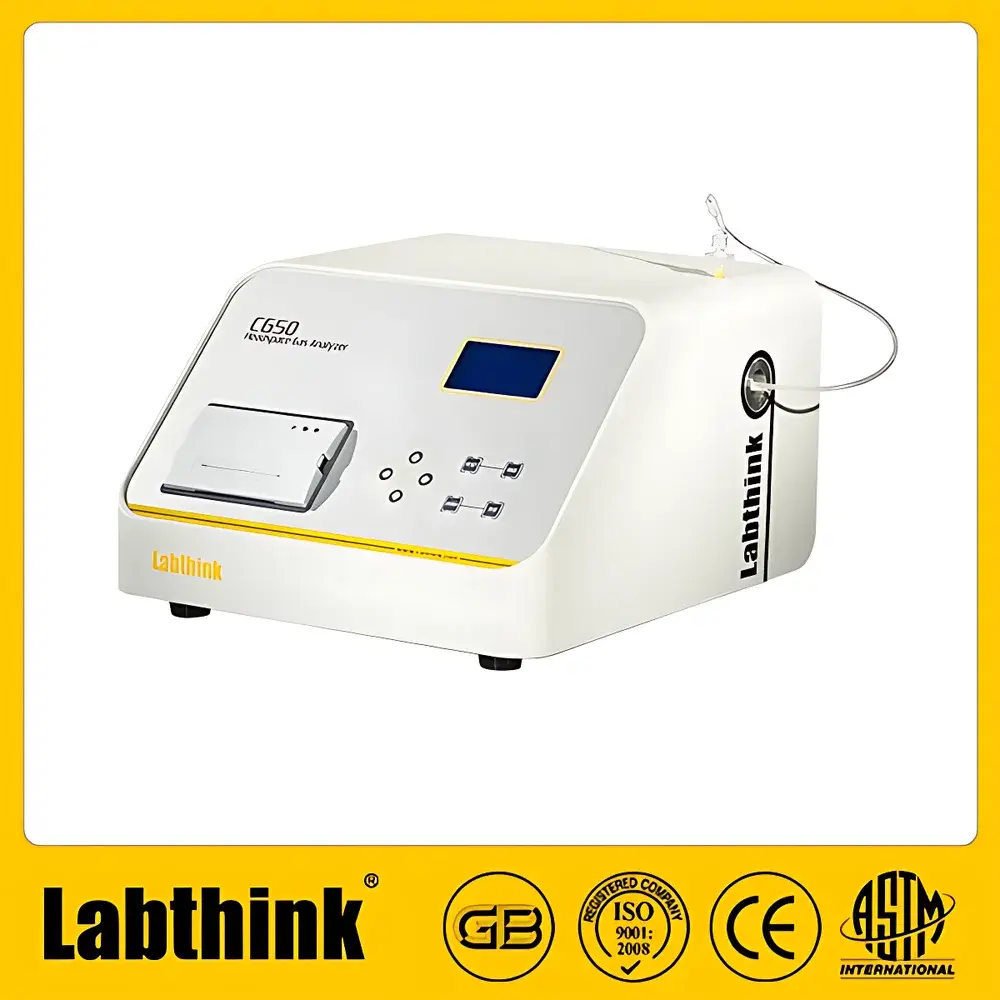
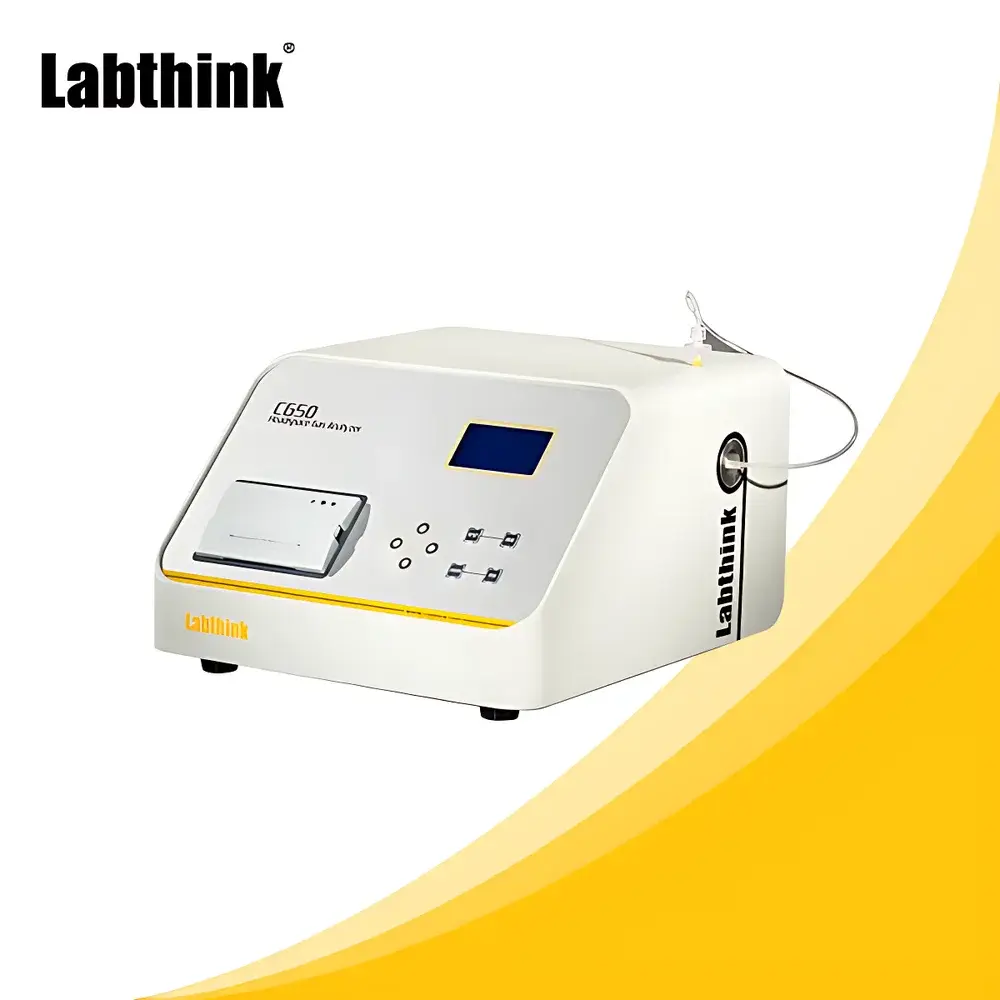
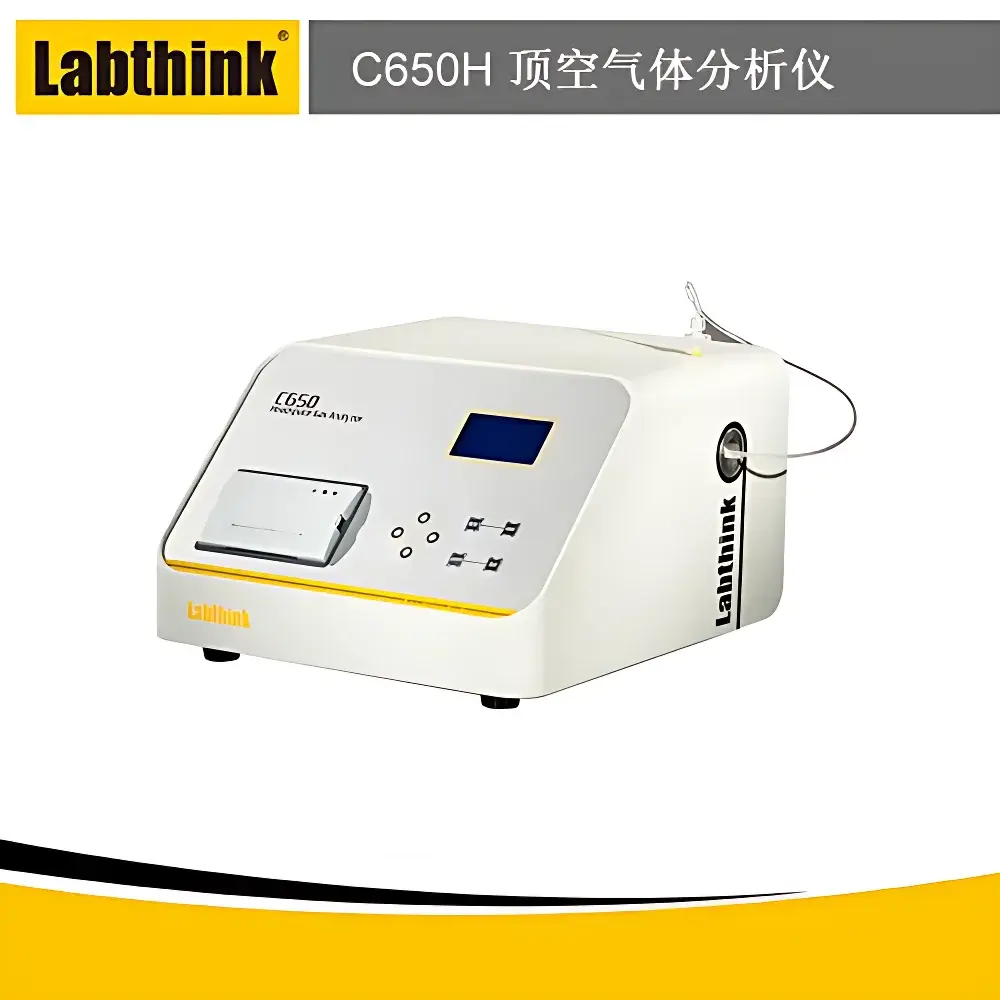
Labthink C650H Headspace Oxygen and Carbon Dioxide Analyzer for Pharmaceutical Packaging
| Brand | Labthink |
|---|---|
| Model | C650H |
| Measurement Gases | O₂ (standard), CO₂ (optional) |
| O₂ Range | 0.2–21% vol |
| O₂ Accuracy | ±0.2% vol |
| CO₂ Range | 2–100% vol |
| CO₂ Accuracy | ±2% vol |
| Sample Volume | ≥5 mL (O₂), ≥20 mL (CO₂) |
| Dimensions | 350 × 330 × 200 mm |
| Weight | 5.5 kg |
| Power | 220 VAC 50 Hz / 120 VAC 60 Hz |
| Sensor Type | Non-consumable ceramic electrochemical O₂ sensor |
| Compliance | Designed for ISO 8536-1/2, USP <1207>, ASTM F2476, and packaging integrity validation under GMP/GLP environments |
Overview
The Labthink C650H Headspace Oxygen and Carbon Dioxide Analyzer is a dedicated benchtop instrument engineered for precise, non-destructive quantification of residual oxygen (O₂) and optional carbon dioxide (CO₂) concentrations in the headspace of sealed pharmaceutical primary packaging—specifically vials, ampoules, and lyophilized (West) stoppered vials. It operates on the principle of electrochemical gas sensing: a controlled vacuum extraction draws headspace gas from the container through a calibrated sampling needle into a sealed measurement chamber, where a proprietary non-consumable ceramic O₂ sensor generates a linear current signal proportional to partial pressure. For CO₂ analysis, an optional infrared or electrochemical sensor module is integrated, enabling dual-gas evaluation without cross-interference. The system is designed to meet the analytical rigor required for stability-indicating packaging qualification, shelf-life studies, and post-sterilization residual gas verification in compliance with ICH Q5C, USP , and Annex 1 requirements for sterile product manufacturing.
Key Features
- Non-consumable ceramic electrochemical O₂ sensor with >2-year operational lifespan and <0.2% vol absolute accuracy across 0.2–21% range—eliminating routine calibration drift and sensor replacement costs.
- Modular architecture supporting field-upgradable CO₂ detection (2–100% vol, ±2% accuracy) via plug-in sensor cartridge, ensuring future-proof adaptability to evolving packaging gas specifications.
- Integrated microprocessor-controlled vacuum manifold with programmable draw rate and dwell time, optimized to prevent sample dilution or sensor saturation during low-volume headspace sampling (≥5 mL for O₂; ≥20 mL for CO₂).
- Full-color LCD interface with intuitive menu navigation, bilingual (English/Chinese) firmware, and real-time graphical display of gas concentration curves during acquisition.
- Onboard data logging capacity for ≥10,000 test records, including timestamp, operator ID, sample ID, environmental temperature/pressure, and raw sensor output—fully traceable per FDA 21 CFR Part 11 audit trail requirements when paired with Labthink’s validated software suite.
- Compact, portable chassis (350 × 330 × 200 mm; 5.5 kg) with RS232 serial interface and USB-to-serial adapter support for seamless integration into QC lab networks or mobile line-clearance verification workflows.
Sample Compatibility & Compliance
The C650H accommodates standard pharmaceutical containers via interchangeable sampling accessories: stainless-steel piercing needles for rubber-stoppered vials (e.g., 10–30 mL West-type vials), septum-piercing probes for ampoules (2–20 mL), and custom adapters for blow-fill-seal (BFS) units and aluminum-plastic blister cavities. All contact surfaces comply with USP Class VI biocompatibility standards. Method validation documentation—including specificity, linearity (R² > 0.999), repeatability (RSD < 1.5%), and robustness against ambient humidity fluctuations—is provided per ICH Q2(R2). The analyzer supports qualification protocols aligned with ASTM F2476 (for modified atmosphere packaging) and ISO 8536-1/2 (glass containers for injectables), and its data structure conforms to ALCOA+ principles for regulatory submissions.
Software & Data Management
Labthink’s Headspace Analysis Suite (v3.2+) enables full lifecycle data governance: method creation with user-defined pass/fail limits, automated report generation (PDF/CSV/XLSX), electronic signature capture, and role-based access control (RBAC). Audit logs record every parameter change, result modification, or user login event with immutable timestamps. Raw sensor voltage traces are archived alongside final concentration values, permitting retrospective reprocessing if updated calibration coefficients become available. The software is 21 CFR Part 11 compliant—supporting digital signatures, secure password policies, and encrypted database backups—and integrates with LIMS platforms via HL7 or ASTM E1384 interfaces.
Applications
- Residual oxygen verification in lyophilized drug products packaged under nitrogen or argon blankets—critical for oxidation-sensitive biologics and peptide APIs.
- Headroom gas composition monitoring in sterilized ampoules post-autoclaving or gamma irradiation to confirm inert gas retention and detect microleaks.
- Stability study support: longitudinal tracking of O₂ ingress in barrier-laminated sachets for oral solid dosage forms (e.g., moisture-sensitive tablets).
- Process validation of vial stoppering lines: correlation of capping torque, crimp height, and residual O₂ levels to establish control limits for continuous process verification (CPV).
- CO₂ headspace quantification in carbonated biologics or buffered liquid formulations where pH stability depends on dissolved CO₂ equilibrium.
FAQ
What sample volume is required for reliable O₂ measurement in a 10 mL vial?
A minimum of 5 mL of headspace gas at ambient pressure is drawn; this ensures sufficient signal-to-noise ratio without overloading the sensor chamber.
Can the C650H be used for helium or nitrogen blanketing verification?
No—the instrument measures only O₂ and optionally CO₂; inert gas concentration is inferred by difference (100% – [O₂ + CO₂]), requiring accurate atmospheric baseline subtraction.
Is sensor recalibration required before each test series?
Zero-point calibration using ambient air (20.9% O₂) is recommended daily; span calibration with certified 1% O₂/N₂ gas is advised weekly or after sensor module replacement.
Does the system support GLP-compliant electronic records?
Yes—when operated with validated software and configured with audit trail enabled, all data meet GLP requirements for nonclinical laboratory studies per OECD 1998 Principles.
How is leak detection performed using this analyzer?
It does not directly detect leaks; however, elevated O₂ levels in otherwise inert-packaged samples—especially when trending across production batches—serve as an indirect indicator of compromised seal integrity.





