
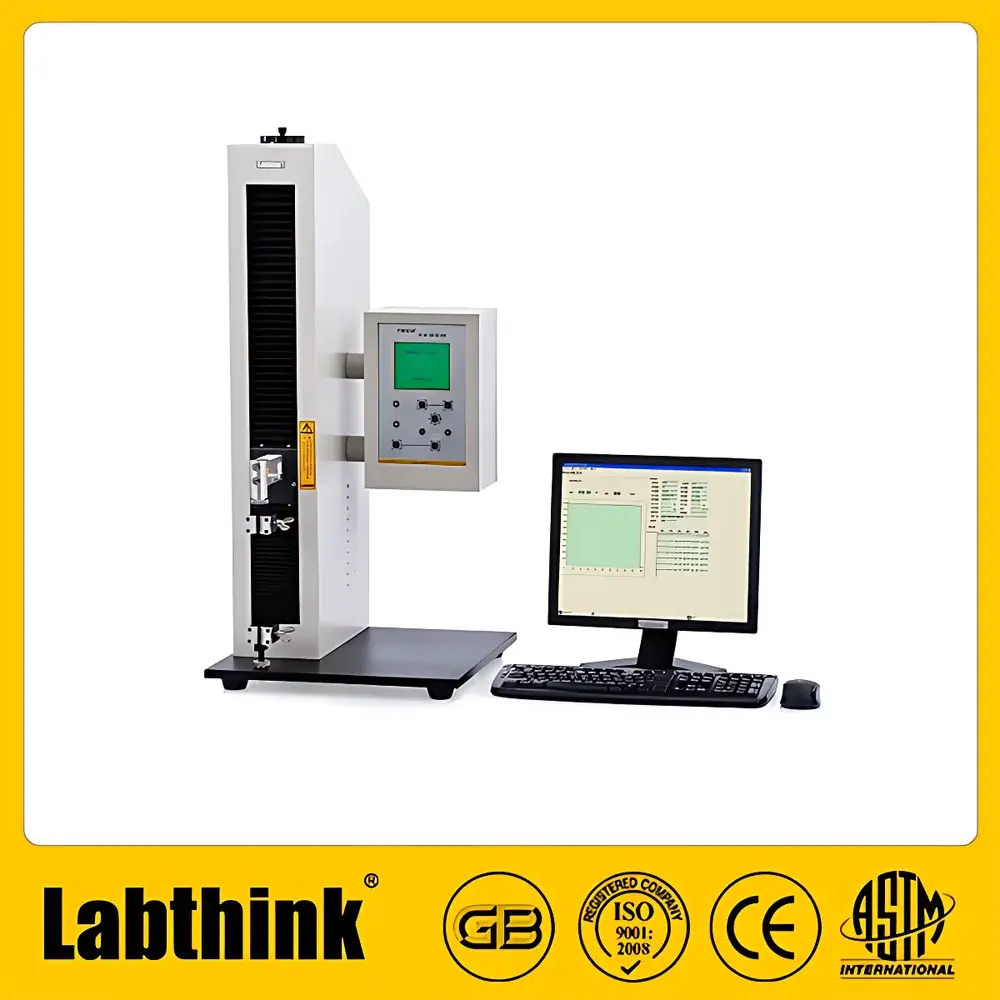
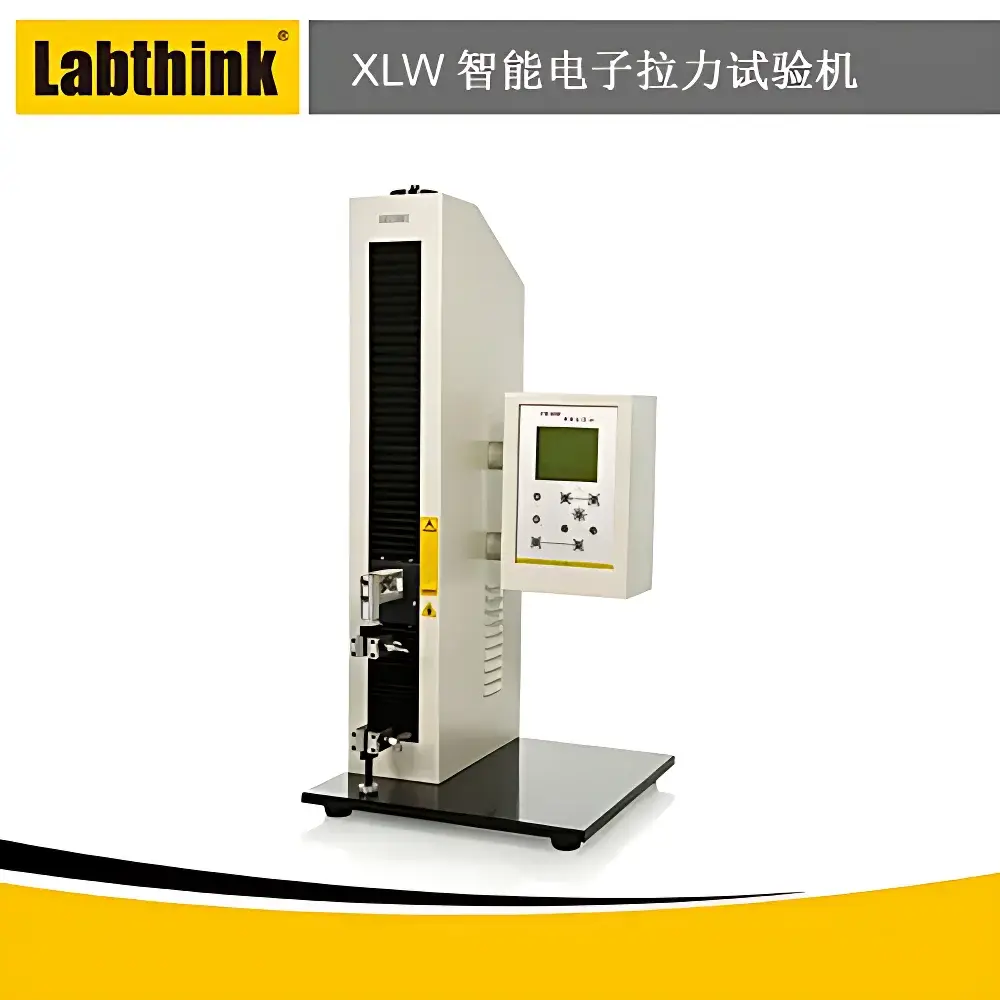
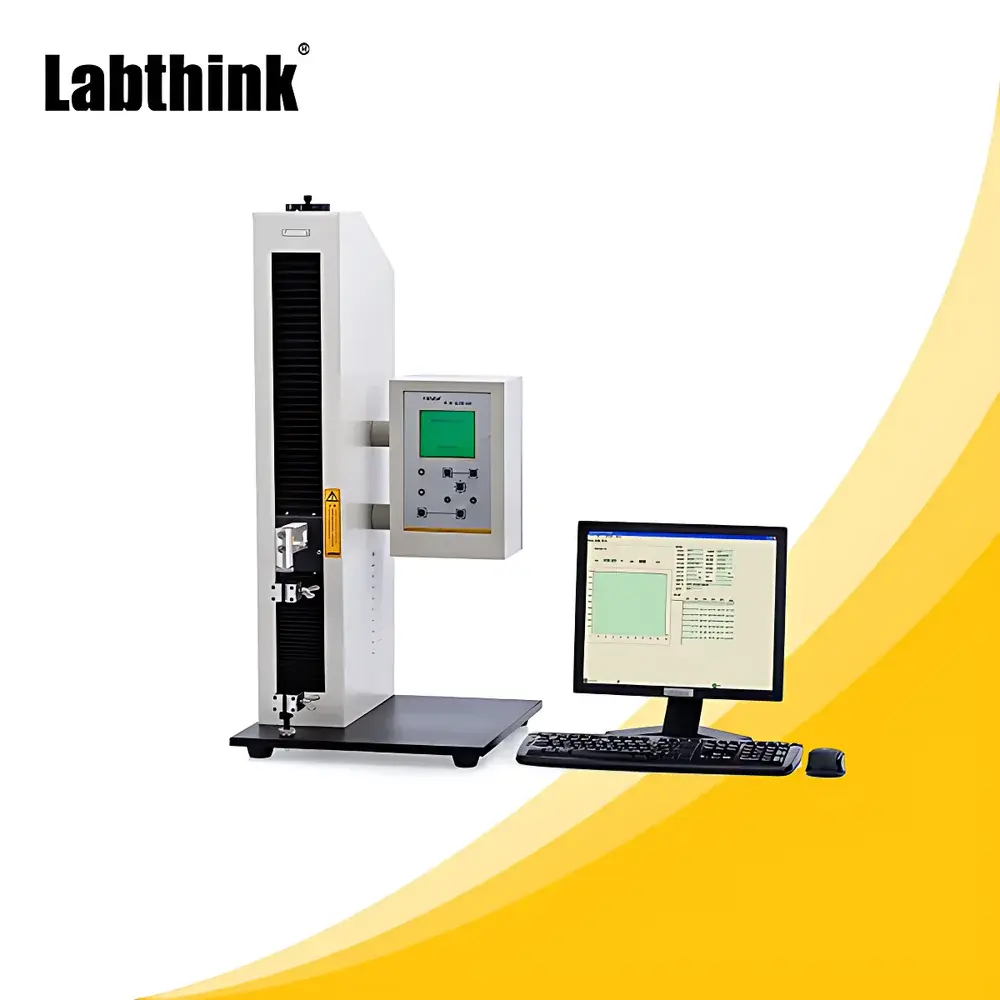
Labthink XLW Intelligent Electronic Tensile Testing Machine
| Brand | Labthink |
|---|---|
| Model | XLW |
| Origin | Shandong, China |
| Manufacturer | Labthink Co., Ltd. |
| Instrument Type | Electronic Tensile Testing Machine |
| Maximum Load Capacity | 1 kN |
| Force Accuracy Class | Class 1 (per ISO 7500-1 & ASTM E4) |
| Test Stroke | 600 mm |
| Standard Load Cell Options | 500 N (default) |
| Test Speeds | 50, 100, 150, 200, 250, 300, 500 mm/min (7 selectable speeds) |
| Specimen Width | 30 mm (standard fixture) |
| Clamping Method | Manual |
| Dimensions (L×W×H) | 450 × 450 × 980 mm |
| Weight | 65 kg |
| Power Supply | 220 VAC, 50 Hz / 120 VAC, 60 Hz |
| Compliance Standards | ISO 37, ISO 7500-1, ASTM D882, ASTM D1938, ASTM D3330, ASTM F88, ASTM F904, GB/T 1040.1–1040.5, GB/T 8808, GB/T 12914, GB/T 17200, GB/T 16578.1, JIS P8113, QB/T 2358, QB/T 1130 |
Overview
The Labthink XLW Intelligent Electronic Tensile Testing Machine is a precision-engineered universal testing system designed for the mechanical characterization of flexible materials in R&D laboratories and quality control environments. It operates on the fundamental principle of uniaxial tensile loading: a specimen is clamped between two parallel grips, and one grip moves at a controlled, constant rate while the other remains stationary or moves in opposition. Force is measured via a calibrated load cell mounted on the moving crosshead, while displacement is tracked using a high-resolution linear encoder. Real-time force–displacement data are acquired and processed to compute critical mechanical parameters—including tensile strength (MPa), elongation at break (%), Young’s modulus (MPa), yield point, and fracture energy—according to internationally recognized test standards. The system is purpose-built for nonwovens, wet wipes, medical fabrics, soft packaging films, adhesive tapes, laminates, rubber sheets, paper, and thin metallic foils where low-to-moderate force ranges (up to 1 kN) and high repeatability are essential.
Key Features
- Class 1 force accuracy per ISO 7500-1 and ASTM E4, ensuring traceable, reproducible measurement performance across the full load range.
- Seven pre-programmed test modes: tensile, peel, tear, seal strength, puncture, shear, and burst—each with dedicated algorithmic compensation for fixture geometry and specimen alignment effects.
- Seven discrete test speed settings (50–500 mm/min), enabling compliance with material-specific protocols such as ASTM D882 (plastic film) and ISO 37 (vulcanized rubber).
- Modular load cell architecture: standard 500 N sensor; optional lower-range cells (30–200 N) for high-sensitivity applications like medical tape adhesion; customizable higher-capacity cells (750–1000 N) for reinforced composites or thick nonwovens.
- Microprocessor-based controller with backlit LCD interface, intuitive PVC membrane keypad, and context-sensitive menu navigation—designed for minimal operator training and error-resistant operation.
- Integrated safety systems: mechanical limit switches, overload cut-off protection, automatic return-to-start positioning, and power-loss memory retention for interrupted tests.
Sample Compatibility & Compliance
The XLW accommodates specimens up to 600 mm in travel length and 50 mm in width (with optional fixtures), supporting standardized sample geometries defined in ISO 37, ASTM D882, and GB/T 1040 series. It is routinely deployed for evaluating disposable hygiene products—including spunbond-meltblown-spunbond (SMS) nonwovens, hydrophilic rayon/polyester blends, and embossed wet wipe substrates—under both dry and conditioned humidity states (per ISO 291). All test methods implemented comply with GLP-aligned data integrity requirements: audit trails, user access levels, electronic signatures, and raw-data export (CSV, XML) support alignment with FDA 21 CFR Part 11 and EU Annex 11 when integrated with validated Lystem™ Laboratory Data Management System.
Software & Data Management
The proprietary Labthink TSM software provides full test lifecycle management: method creation, parameter validation, real-time curve visualization, statistical analysis (mean, SD, CV%, confidence intervals), multi-curve overlay for comparative evaluation, and elastic modulus derivation via tangent or secant slope calculation. Raw datasets include timestamped force/displacement vectors with metadata (operator ID, instrument serial number, environmental conditions). Export formats conform to ASTM E1447 and ISO/IEC 17025 reporting guidelines. RS232 serial interface enables direct connection to external PCs or LIMS; optional thermal printer port supports on-device hardcopy generation of test reports with header/footer branding and compliance statement footers.
Applications
- Nonwoven fabric: tensile strength and elongation profiling of spunlace, needlepunch, and thermal-bonded substrates used in surgical gowns, face masks, and baby wipes.
- Wet wipe formulation development: correlation of fiber composition, binder content, and moisture retention with mechanical durability during simulated use.
- Medical packaging: seal strength verification of peelable pouches (ASTM F88), delamination resistance of blister lidding (ASTM F904), and puncture resistance of Tyvek®-based sterile barriers.
- Adhesive product qualification: 180° peel (ASTM D3330), loop tack (FINAT FTM 1), and shear hold (ASTM D3654) testing on pressure-sensitive labels and wound dressings.
- Regulatory submission support: generation of test records meeting ISO 13485, MDR Annex II, and USP requirements for container closure integrity and material biocompatibility assessments.
FAQ
What international standards does the XLW machine support?
It natively executes test protocols aligned with ISO 37, ISO 7500-1, ASTM D882, ASTM D1938, ASTM F88, GB/T 1040.1–1040.5, and over 15 additional national and industry-specific standards listed in its firmware library.
Can the system be validated for GMP-regulated environments?
Yes—when paired with IQ/OQ documentation packages and operated under Labthink’s validated Lystem™ data management platform, it satisfies FDA 21 CFR Part 11 and EU GMP Annex 11 requirements for electronic records and signatures.
Is calibration traceability provided?
All load cells are factory-calibrated against NIST-traceable reference standards; certificate of calibration (including uncertainty budget) is supplied with each instrument.
What sample preparation tools are recommended for nonwoven testing?
Standard 30 mm width die-cutters and pneumatic sample cutters (e.g., Labthink CSD-100) ensure consistent edge geometry; floating roller fixtures minimize slippage during high-elongation nonwoven tests.
How is thermal drift compensated during extended testing sessions?
The system employs temperature-stabilized signal conditioning circuitry and auto-zeroing routines before each test cycle, maintaining force measurement stability within ±0.2% FS over 8-hour continuous operation.



