
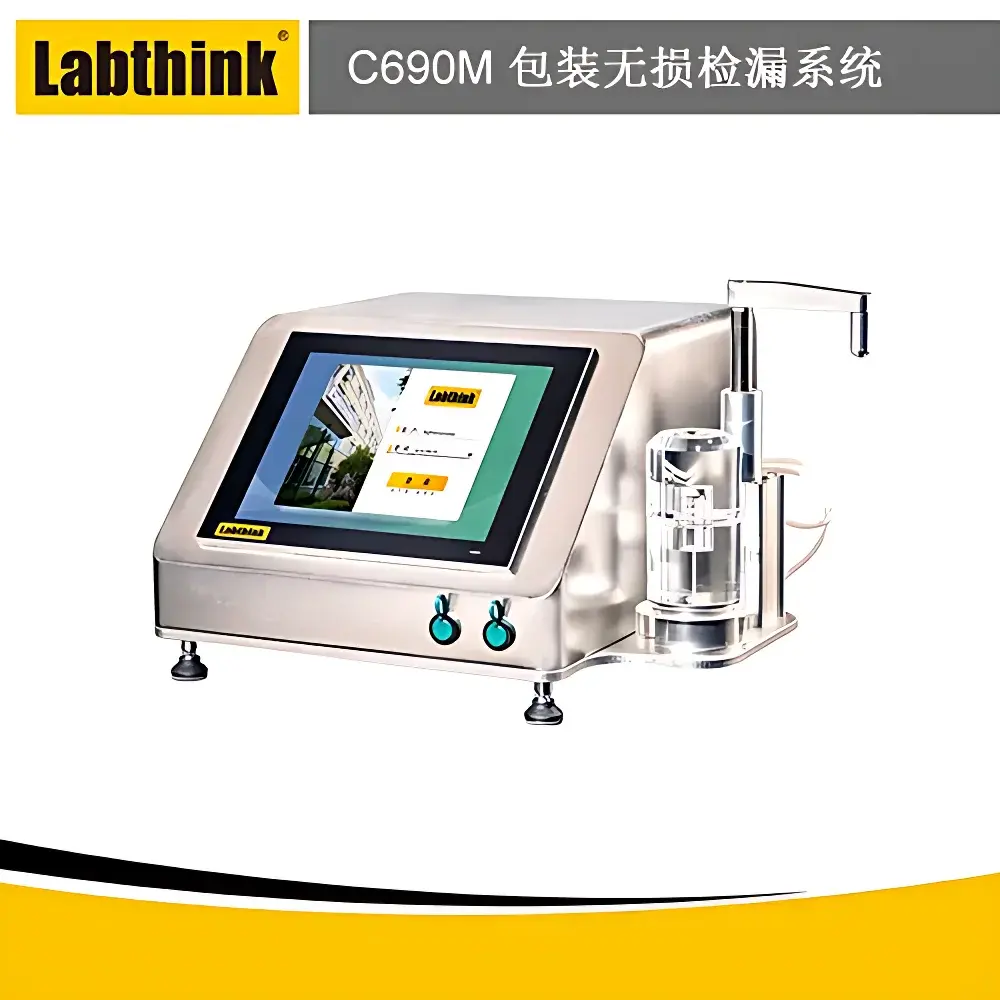
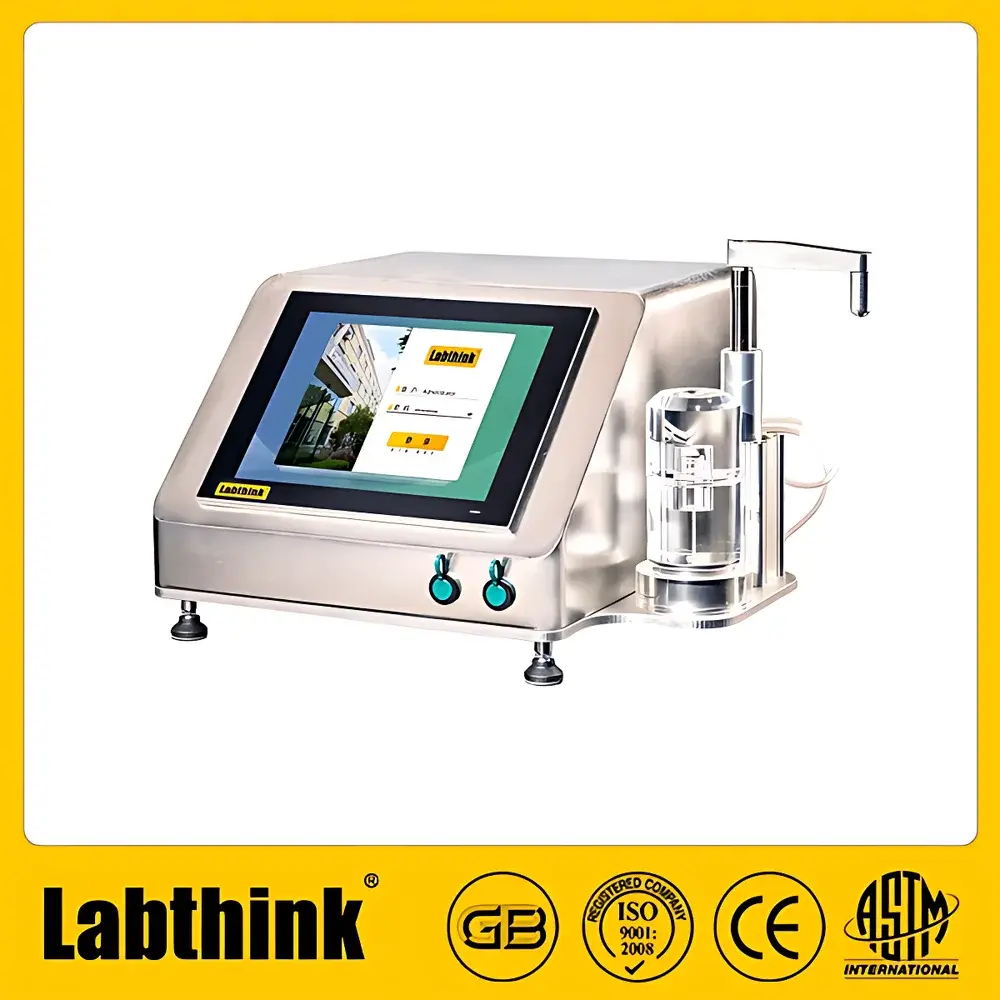
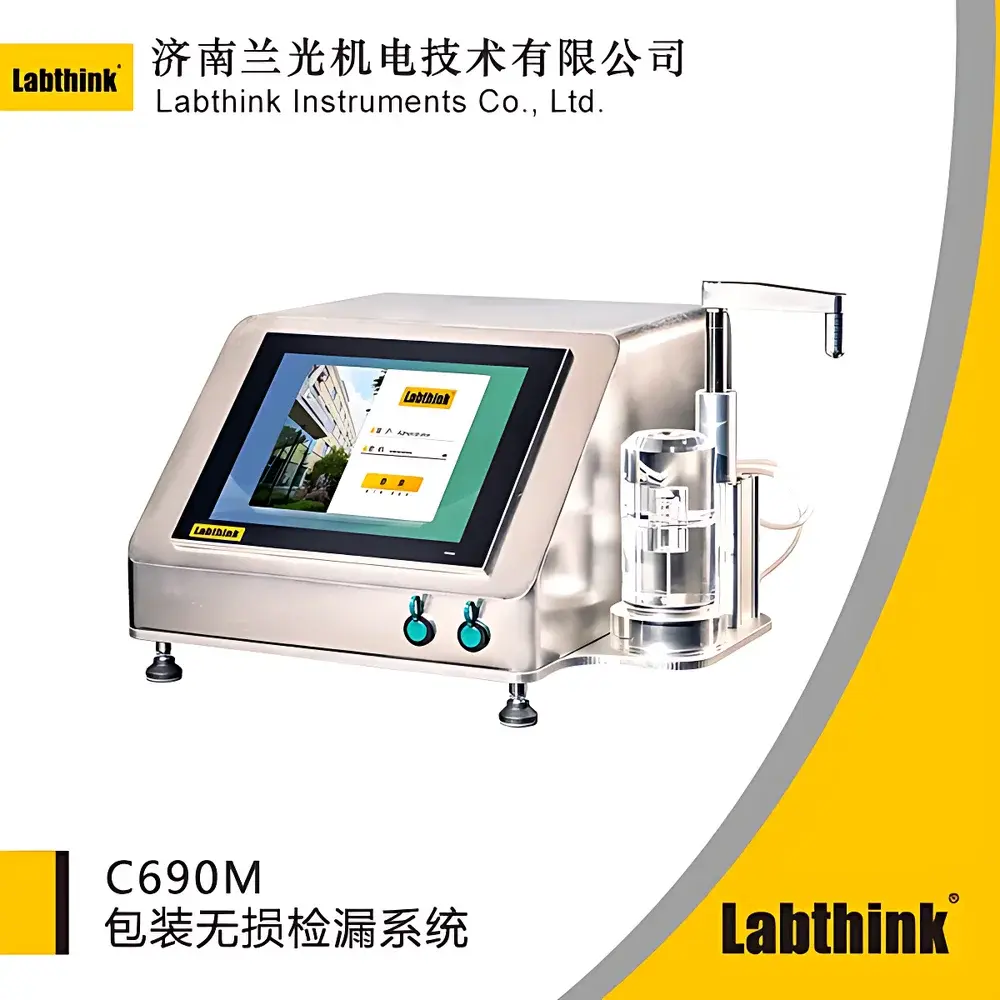
Labthink C690M Vacuum Decay Leak Tester for Non-Destructive Package Seal Integrity Testing
| Brand | Labthink |
|---|---|
| Origin | Shandong, China |
| Manufacturer Type | Direct Manufacturer |
| Country of Origin | China |
| Model | C690M |
| Pricing | Upon Request |
| Test Principle | Vacuum Decay Method (ASTM F2338 compliant) |
| Dual-Mode Operation | Vacuum & Positive Pressure |
| Test Chamber | Swing-arm Auto-Clamping with Rapid Interchange |
| Target Vacuum Level | User-Configurable |
| Viewing Window | Transparent Acrylic Test Chamber |
| Vacuum Source | Optional Oil-Free European Vacuum Pump (NIST-Traceable Calibration Supported) |
| Pressure Sensor Technology | High-Stability Digital Transducer |
| Microflow Control | Automated Precision Flow Regulation |
| Data Traceability | Full Audit Trail, NIST-Referenced Calibration |
| Compliance | 21 CFR Part 11 Electronic Signatures, GMP Data Integrity Requirements, USP <1207>, YY/T 0681.18 |
| Operating System | Embedded Windows on 12.1" Touchscreen |
| Test Resolution | 0.1 mPa·s equivalent (leak rate), ±1 µm equivalent leak size repeatability |
| Test Range | Equivalent to 2–8 µm laser-drilled reference leaks (per USP <1207> guidance) |
| Max Sample Dimensions | Ø45 mm × 80 mm |
| Pressure Range | –100 to +100 kPa |
| Power Supply | 120 VAC ±10%, 60 Hz OR 220 VAC ±10%, 50 Hz (configurable) |
| Net Weight | 26 kg |
| Footprint | 300 mm × 560 mm × 370 mm |
| Air Supply Requirement | Compressed air ≥500 kPa (72.5 PSI), Ø6 mm polyurethane tubing |
Overview
The Labthink C690M Vacuum Decay Leak Tester is an engineered solution for quantitative, non-destructive seal integrity verification of rigid and semi-rigid pharmaceutical primary packaging. It operates on the vacuum decay principle—a deterministic, pressure-based method standardized in ASTM F2338–22, USP , and YY/T 0681.18—where a sealed test chamber containing the sample undergoes controlled evacuation, followed by high-resolution monitoring of pressure recovery over time. The resulting pressure-time curve is mathematically modeled to compute volumetric leakage rate (in Pa·m³/s or equivalent µm reference leak size), enabling objective pass/fail assessment without physical sample destruction. Unlike dye ingress or bubble emission tests, vacuum decay delivers traceable, operator-independent results suitable for stability studies, process validation, and routine QC release testing under GMP-regulated environments.
Key Features
- Dual-mode operation (vacuum decay and positive-pressure decay) mitigates false negatives caused by transient pore occlusion in viscous or particulate-containing formulations.
- Swing-arm actuated test chamber ensures consistent clamping force and rapid tooling exchange—critical for high-mix, low-volume pharmaceutical packaging lines.
- User-defined target vacuum level allows method optimization across diverse container types (e.g., glass vials vs. polymer syringes) without hardware modification.
- Optically transparent acrylic chamber enables real-time visual inspection of sample deformation, cap lift, or gasket extrusion during pressurization.
- Integrated oil-free European vacuum pump (optional) eliminates hydrocarbon contamination risk and eliminates scheduled oil changes—supporting ISO 14644-1 Class 5 cleanroom integration.
- Microflow-controlled pressure regulation enables precise simulation of calibrated leak standards (2–8 µm equivalent per USP Annex B), eliminating manual flowmeter adjustments.
- Embedded 12.1″ Windows touchscreen provides deterministic UI navigation, real-time pressure curve rendering, and automatic statistical summarization (mean, SD, CV%) per test sequence.
Sample Compatibility & Compliance
The C690M accommodates standard parenteral containers up to Ø45 mm × 80 mm—including lyophilized vials (West, Datwyler), ampoules (Schott, Gerresheimer), cartridge systems (Becton Dickinson, SHL), and prefilled syringes (Nipro, Stevanato Group). Its mechanical design complies with ISO 13485:2016 manufacturing controls, while software architecture meets FDA 21 CFR Part 11 requirements for electronic records and signatures: role-based access control, audit trail with immutable timestamps, electronic signature capture, and configurable user permission tiers. All calibration data are NIST-traceable; system suitability checks include reference leak verification and pressure sensor linearity validation per ASTM E2500–22. Documentation packages support IQ/OQ/PQ execution and satisfy EU Annex 11 and PIC/S PI 011-3 expectations for computerized system validation.
Software & Data Management
Labthink’s proprietary SealScan™ software (v4.2+) runs natively on the embedded Windows platform and provides full lifecycle data governance. Each test generates a timestamped, digitally signed report containing raw pressure-time arrays, calculated leakage rates, pass/fail status against user-defined limits, and metadata (operator ID, sample ID, environmental conditions). Data export supports CSV, PDF, and XML formats compatible with LIMS and MES integration. Audit trails record all user actions—including parameter edits, report deletions, and calibration events—with hash-verified immutability. Remote firmware updates via Ethernet ensure continuous compliance with evolving regulatory interpretations of USP and ISO 11607–2:2019.
Applications
- Lyophilized drug product vials: Detection of micro-leaks compromising sterility maintenance during shelf life.
- Single-use bioprocess bags: Verification of weld integrity prior to media fill simulation.
- Prefilled syringe systems: Assessment of plunger stopper adhesion and barrel-crimp seal performance.
- Blow-fill-seal (BFS) containers: Quantitative evaluation of closure defects undetectable by visual inspection.
- Aluminum-sealed pouches: Validation of heat-seal process robustness under accelerated aging conditions.
FAQ
What regulatory standards does the C690M validate against?
ASTM F2338–22, USP , YY/T 0681.18, ISO 11607–2:2019, and EU Annex 1 requirements for sterile barrier systems.
Is the system qualified for GMP production environments?
Yes—fully documented IQ/OQ/PQ protocols, 21 CFR Part 11-compliant software, and NIST-traceable calibration certificates are provided as standard.
Can the C690M test multiple samples simultaneously?
No—it is a single-chamber system optimized for precision and regulatory traceability; however, rapid tooling changeover (<60 s) supports high-throughput batch testing.
Does the instrument require external compressed air?
Yes—clean, dry, oil-free compressed air at ≥500 kPa (72.5 PSI) is required for positive-pressure mode and purge cycles.
How is measurement uncertainty quantified?
Uncertainty budgets are derived per GUM (JCGM 100:2008) and include contributions from pressure transducer accuracy (±0.05% FS), temperature drift compensation, and reference leak calibration uncertainty (k=2, ≤1.2%).





