
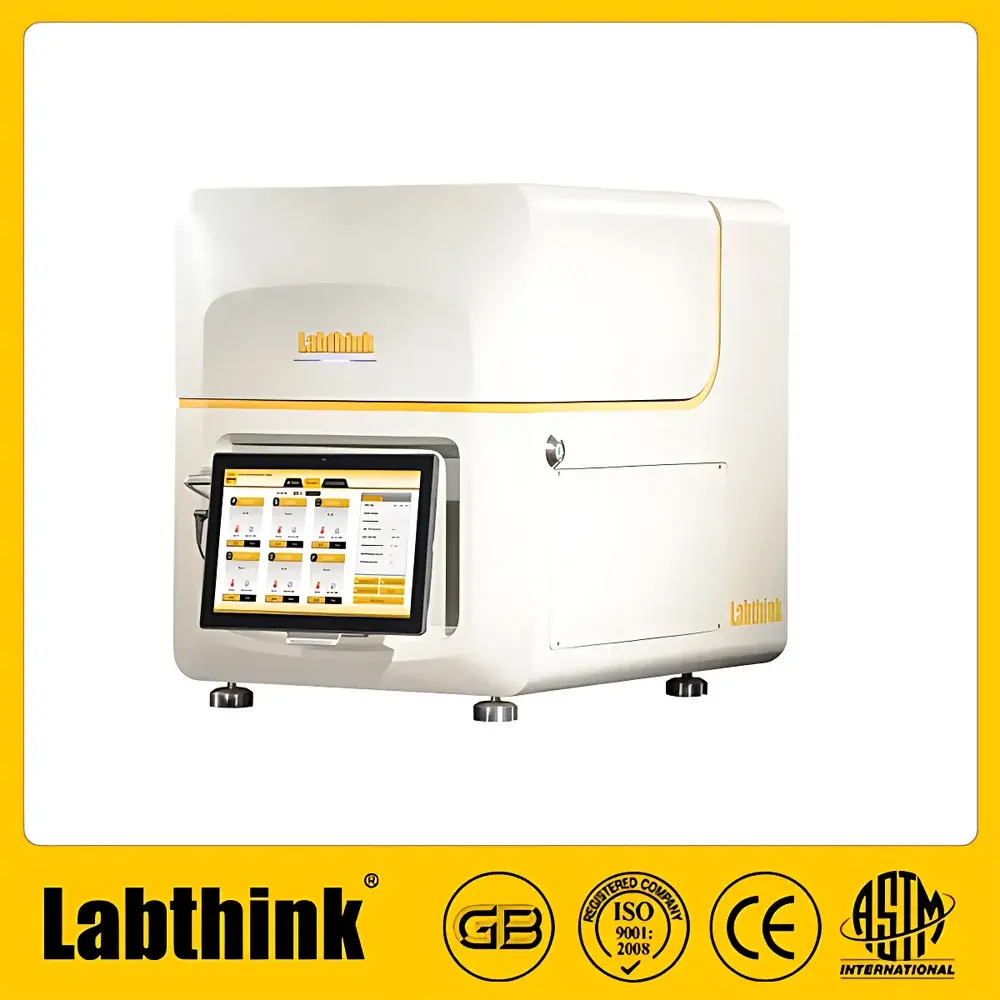
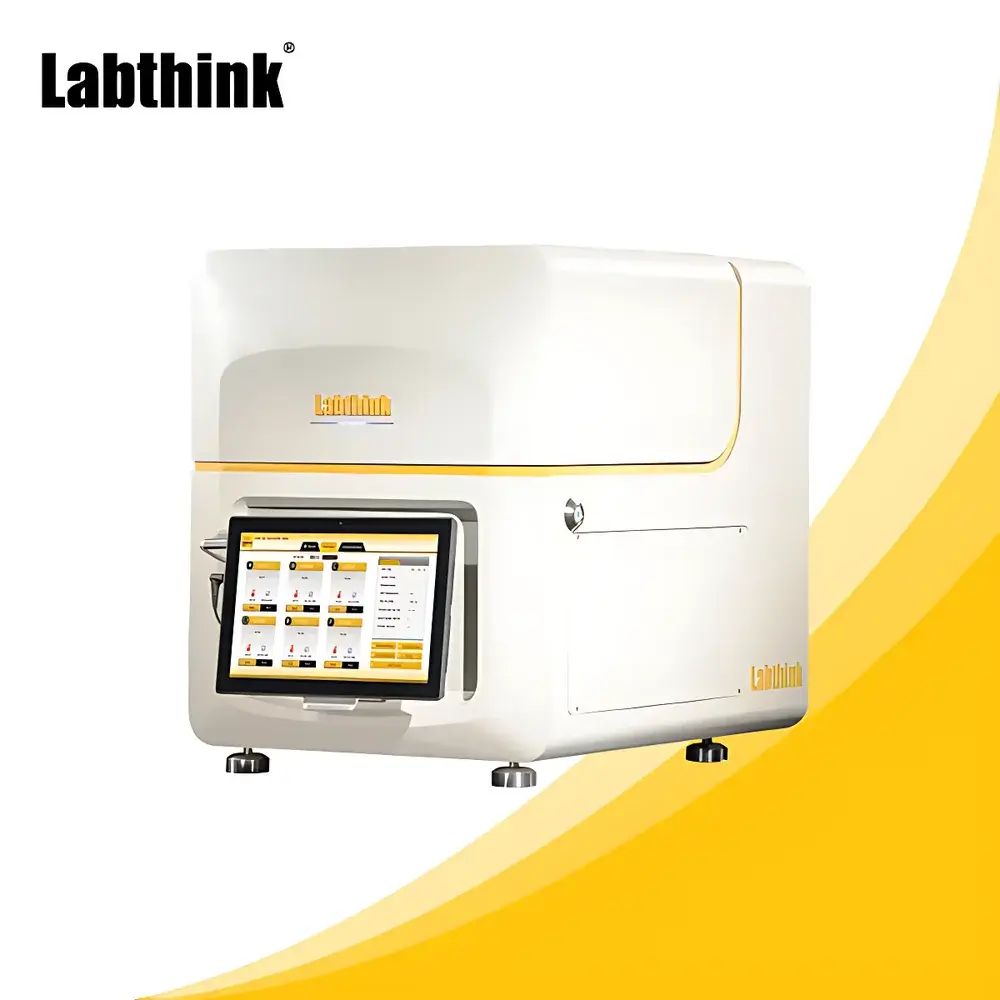
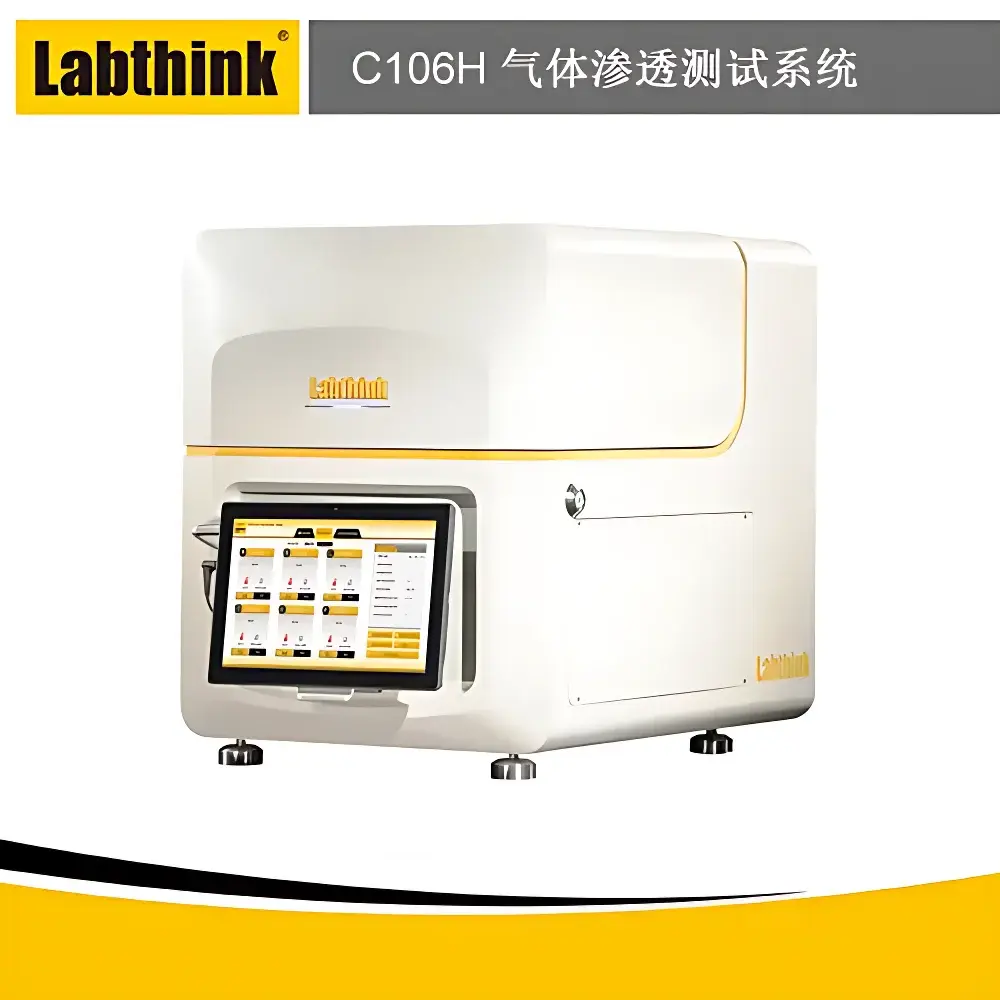
Labthink C106H High-Performance Gas Permeability Tester for Flammable and Explosive Gases (H₂, CH₄)
| Brand | Labthink |
|---|---|
| Origin | Shandong, China |
| Manufacturer | Yes |
| Country of Origin | China |
| Model | C106H |
| Test Principle | Differential Pressure Method (Manometric) |
| Measurement Range | 0.01–50,000 cm³/m²·24h·0.1MPa |
| Resolution | 0.001 cm³/m²·24h·0.1MPa |
| Temperature Range | 15–50 °C (5–60 °C optional) |
| Temp. Stability | ±0.15 °C |
| Vacuum Resolution | 0.01 Pa |
| Vacuum Accuracy | ±0.2% of reading (1–100% of sensor span) |
| Test Chamber Vacuum Level | ≤10 Pa |
| Chamber Count | 6 independent cavities |
| Standard Test Area | 38.48 cm² |
| Sample Size | 11.2 cm × 11.2 cm |
| Max. Sample Thickness | 3 mm |
| Test Gas Compatibility | H₂, CH₄, O₂, N₂, CO₂ (custom-configured for flammable gases) |
| Pressure Control Range | 10–150 kPa (adjustable, stability ±0.2 kPa) |
| Power Supply | 120 VAC±10% 60 Hz / 220 VAC±10% 50 Hz |
| Net Weight | 100 kg |
| Compliance | ISO 15105-1, ISO 2556, GB/T 1038-2000, ASTM D1434, JIS K7126-1, YBB 00082003 |
Overview
The Labthink C106H High-Performance Gas Permeability Tester is an engineered differential pressure (manometric) system designed for precise, repeatable quantification of gas transmission rates—particularly for flammable and explosive gases such as hydrogen (H₂) and methane (CH₄)—through polymeric films, laminates, foils, and rigid sheets. Operating on the fundamental principle of Fick’s first law of diffusion, the instrument establishes a controlled partial pressure gradient across a conditioned specimen sealed between two isolated chambers. The high-pressure (upstream) chamber is pressurized with the test gas, while the low-pressure (downstream) chamber is maintained under high vacuum. As gas molecules permeate through the material, their accumulation in the downstream chamber is measured via ultra-stable capacitive vacuum transducers. Real-time pressure rise data are mathematically integrated to calculate gas permeability (P), diffusion coefficient (D), solubility coefficient (S), and permeation rate (TR), all traceable to SI units and internationally harmonized reporting conventions.
Key Features
- Six independent, parallel test chambers—triple the throughput of conventional single- or dual-cavity instruments—enabling statistically robust inter-sample comparison under identical environmental conditions.
- Rainbow-bridge dual-chamber architecture with 360° circumferential air circulation ensures uniform thermal distribution; temperature stability maintained within ±0.15 °C across the full 15–50 °C operating range (5–60 °C available with extended thermal module).
- Imported high-accuracy vacuum sensors (0.01 Pa resolution) and a dedicated UK-sourced turbomolecular vacuum pump (ultimate vacuum ≤0.2 Pa) deliver exceptional sensitivity for ultra-high-barrier materials (e.g., SiOₓ-coated PET, AlOₓ laminates) down to 0.01 cm³/m²·24h·0.1MPa.
- Automated pressure regulation system with proprietary auto-compensation logic maintains upstream pressure deviation <0.2 kPa over extended test durations—critical for kinetic accuracy in low-flux measurements.
- Integrated pneumatic clamping mechanism applies consistent, calibrated force across all six chambers, eliminating operator-induced sealing variability and ensuring reproducible boundary conditions per ASTM D1434 Annex A2.
- 12-inch industrial-grade Windows touch panel interface supports both fully automated workflows (single-button start) and advanced manual control modes—including programmable temperature ramps, multi-step pressure profiles, and real-time curve overlay of TR, P, and T versus time.
Sample Compatibility & Compliance
The C106H accommodates flat, non-porous specimens up to 3 mm thick and 11.2 cm × 11.2 cm in dimension—including biaxially oriented polypropylene (BOPP), ethylene-vinyl alcohol (EVOH) coextrusions, metallized polyester (MPET), aluminum foil composites, fluoropolymer-coated papers, and ceramic-reinforced barrier films. Its modular gas-handling design permits safe integration of H₂ and CH₄ supply lines with redundant leak detection, explosion-proof solenoid valves, and pressure-relief interlocks—fully compliant with IEC 60079-0 and ATEX Category 2G requirements when configured per customer risk assessment. All measurement protocols adhere strictly to ISO 15105-1 (differential pressure method), ISO 2556 (gas transmission rate), ASTM D1434 (standard test method for gas permeability), and Chinese pharmaceutical packaging standard YBB 00082003. Data integrity meets FDA 21 CFR Part 11 requirements when equipped with optional CFR21Part11 software package—including electronic signatures, audit trails, and role-based access control.
Software & Data Management
Labthink’s proprietary PermeData™ v4.2 software provides comprehensive acquisition, visualization, and reporting capabilities. It records raw pressure vs. time datasets at 100 ms intervals, applies automatic baseline correction and linear/nonlinear regression models (per ISO 15105-1 Annex B), and exports certified reports in PDF/A-1b format with embedded metadata (operator ID, calibration certificate IDs, environmental logs). Batch processing supports statistical analysis across multiple lots, including mean, SD, RSD, and confidence intervals (95%). Optional DataShield™ encryption module enables AES-256 encrypted local storage and secure TLS 1.3 transmission to LIMS or ELN systems. All software modules undergo annual verification against NIST-traceable reference standards and are validated per GAMP5 guidelines for regulated environments.
Applications
- Pharmaceutical primary packaging: Quantifying H₂ permeation through blister lidding foils used in oxygen-sensitive biologics formulations.
- Fuel cell membrane development: Evaluating CH₄ and H₂ crossover rates in proton exchange membranes (PEMs) and solid oxide electrolyte substrates.
- Regulatory submission support: Generating GLP-compliant datasets for FDA IND/NDA filings, EMA CTD Module 3, and PMDA MHLW documentation.
<liFood packaging R&D: Benchmarking barrier performance of multilayer pouches containing modified atmosphere (MAP) gas blends (N₂/CO₂/O₂) under accelerated shelf-life conditions.
<liBattery separator qualification: Measuring gas evolution kinetics from lithium-ion pouch cells during thermal runaway simulation.
<liAerospace composites: Assessing outgassing profiles of phenolic resins and carbon-fiber prepregs under vacuum and elevated temperature per NASA ASTM E595.
FAQ
Does the C106H support hydrogen and methane testing out-of-the-box?
Yes—when ordered with the Flammable Gas Configuration Package, the system includes explosion-rated fittings, stainless-steel gas manifolds, Class I Div 1 electrical certification, and dedicated safety interlocks. Installation requires site-specific hazardous area classification review.
What is the minimum detectable permeation rate for H₂ at 23 °C?
Under optimized vacuum and thermal stabilization, the lower limit of quantitation (LOQ) for H₂ is 0.012 cm³/m²·24h·0.1MPa (k = 2, n = 6), verified using certified low-permeability reference films.
Can test data be exported to third-party statistical packages like JMP or Minitab?
Yes—raw time-series .CSV files and summary .XLSX reports are natively supported. PermeData™ also offers ODBC connectivity for direct database ingestion.
Is ISO/IEC 17025 calibration documentation provided with shipment?
Each unit ships with a factory calibration certificate traceable to NIM (China National Institute of Metrology), including uncertainty budgets for vacuum, temperature, and pressure subsystems. On-site accredited calibration services are available upon request.
How is system leak integrity verified prior to each test sequence?
An automated 30-minute leak-check protocol runs before every test cycle, monitoring downstream chamber pressure drift. Pass/fail criteria comply with ASTM D1434 Section 7.3 (≤0.5 Pa/min acceptable).






