
Labthink C106H Gas Permeation Analyzer for Pharmaceutical Aluminum Foil and Packaging Materials
| Brand | Labthink |
|---|---|
| Model | C106H |
| Measurement Principle | Differential Pressure Method (ASTM D1434, ISO 15105-1, GB/T 1038-2000) |
| Test Range | 0.01–50,000 cm³/m²·24h·0.1MPa |
| Resolution | 0.001 cm³/m²·24h·0.1MPa |
| Temperature Range | 15–50 °C (optional 5–60 °C) |
| Temp. Stability | ±0.15 °C |
| Vacuum Resolution | 0.01 Pa |
| Min. Detectable Permeation | 0.01 cm³/m²·24h·0.1MPa |
| Test Chambers | 6 independent chambers |
| Sample Area | 38.48 cm² |
| Max. Sample Thickness | 3 mm |
| Pressure Control Range | 10–150 kPa |
| Pressure Stability | ±0.2 kPa |
| Vacuum Level | ≤10 Pa (pump limit: 0.2 Pa) |
| Power Supply | 120 VAC ±10% 60 Hz / 220 VAC ±10% 50 Hz |
| Net Weight | 100 kg |
| Dimensions | 600 × 490 × 660 mm |
Overview
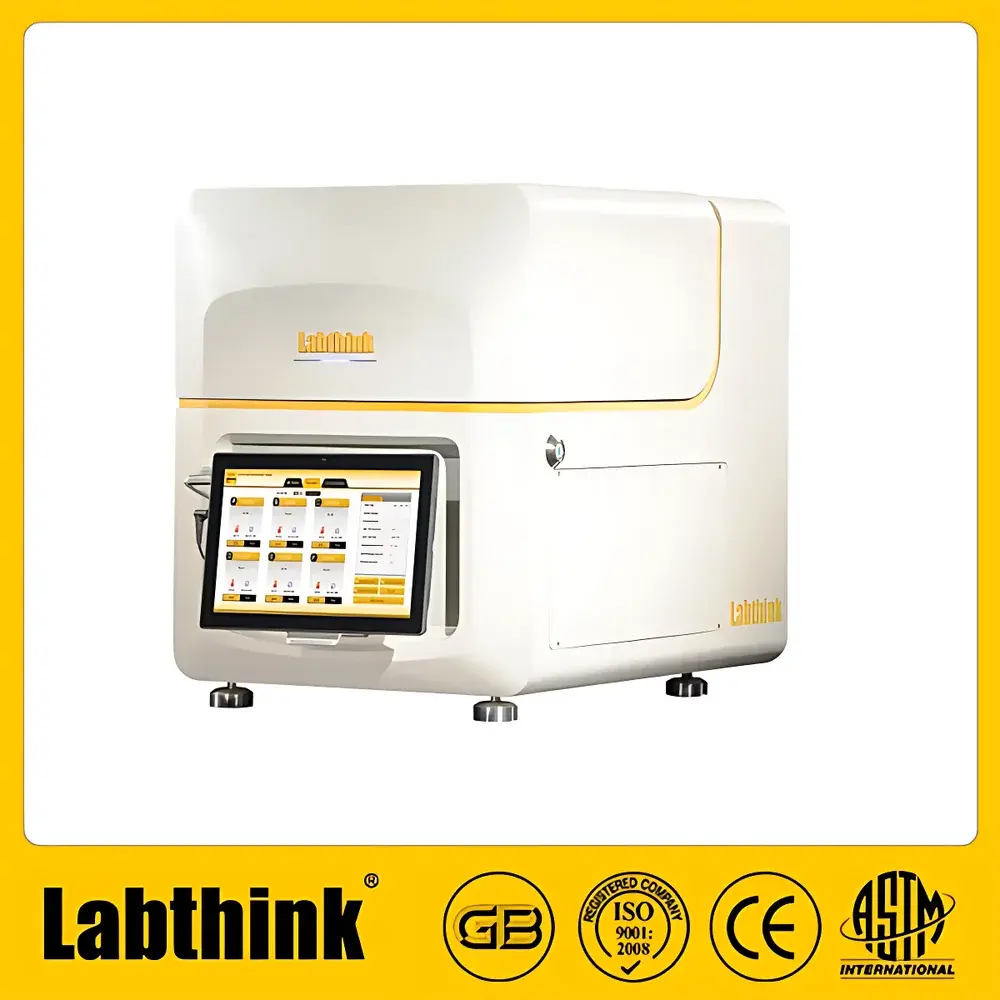
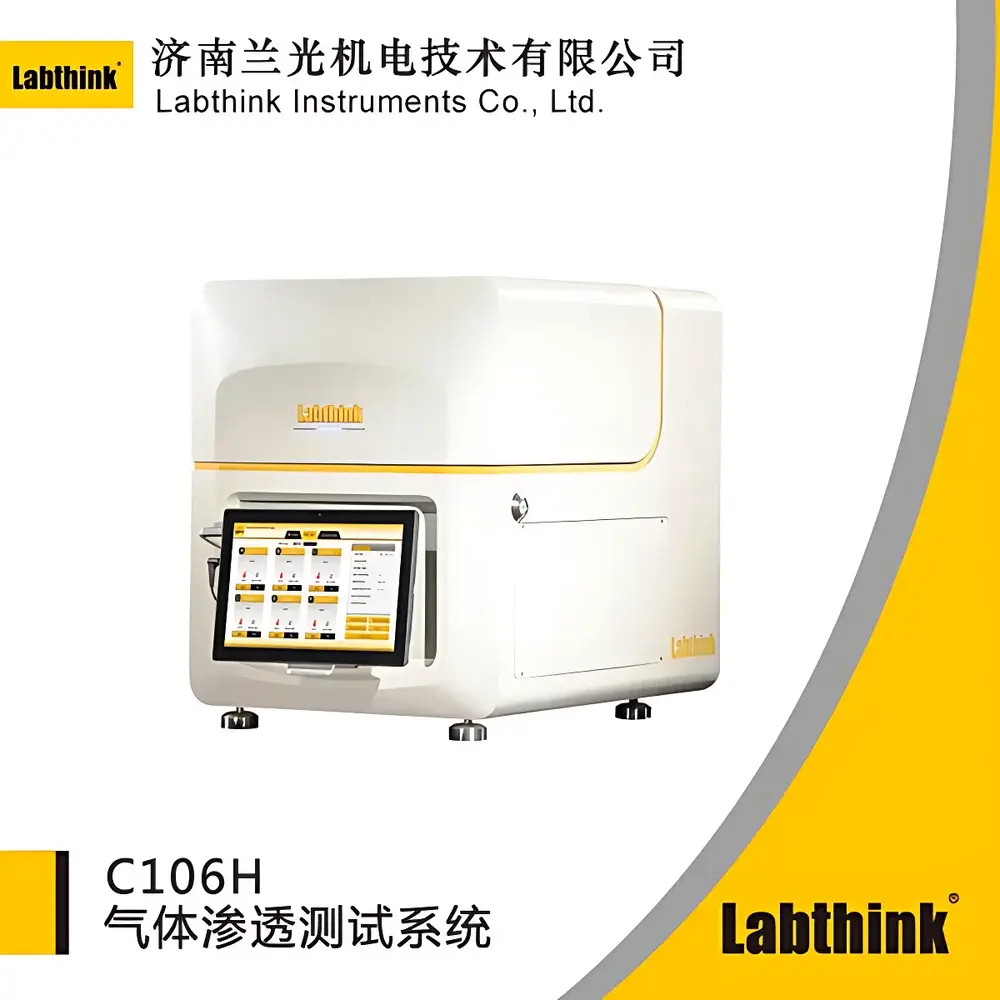
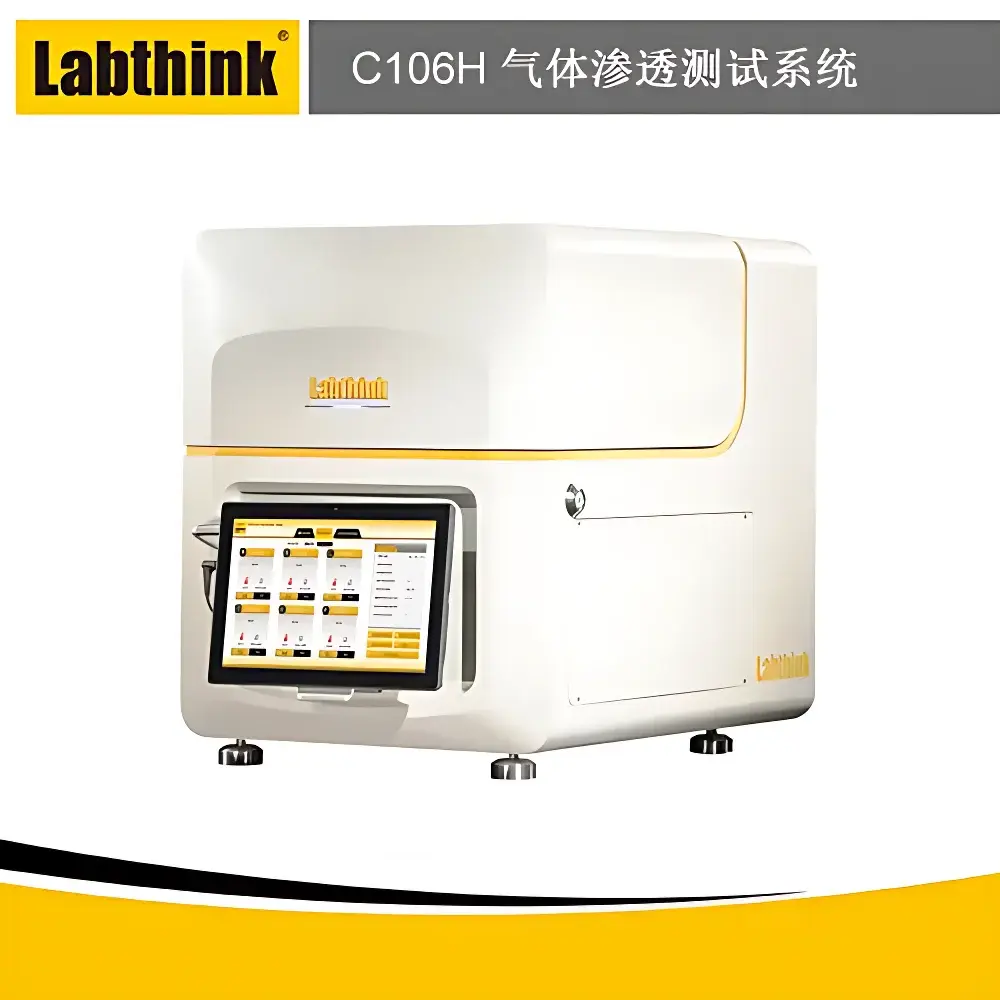
The Labthink C106H Gas Permeation Analyzer is an industrial-grade differential pressure method (DPM) instrument engineered for precise, reproducible quantification of gas transmission rates (GTR), permeability coefficients (P), diffusion coefficients (D), and solubility coefficients (S) in rigid and flexible packaging materials. Designed specifically for pharmaceutical packaging validation and regulatory compliance, the C106H applies a controlled transmembrane pressure gradient—typically between 10 kPa and 150 kPa—to drive gas molecules (O₂, N₂, CO₂, H₂, CH₄) across a conditioned specimen sealed between two isolated chambers. The rate of pressure rise in the evacuated low-pressure chamber is measured via high-stability vacuum transducers (0.01 Pa resolution), enabling calculation of permeation parameters per ISO 15105-1, ASTM D1434, and GB/T 1038-2000. Its architecture supports both routine QC testing and advanced barrier research—particularly critical for aluminum foil laminates, cold-form blister foils, PVDC-coated films, and high-barrier polymer composites used in sterile drug containment.
Key Features
- Six independent test chambers with standardized 38.48 cm² exposure area—triple the throughput of conventional single- or dual-chamber systems—enabling parallel analysis of six specimens under identical thermal and pressure conditions.
- Rainbow-bridge test chamber design with 360° circumferential air circulation ensures uniform thermal distribution; temperature stability maintained within ±0.15 °C across the full operating range (15–50 °C, extendable to 5–60 °C with optional chiller/heater).
- Imported ultra-high-resolution vacuum sensors (0.01 Pa) and precision pneumatic actuation system deliver sub-millitorr-level vacuum control and long-term sealing integrity—critical for measuring ultra-low permeation rates down to 0.01 cm³/m²·24h·0.1MPa.
- Automated vacuum pump management: system initiates, monitors, and terminates evacuation without manual intervention; ultimate vacuum capability ≤0.2 Pa with rapid pump-down kinetics.
- Real-time pressure compensation algorithm maintains constant upstream pressure differential (±0.2 kPa deviation), eliminating drift-induced measurement error during extended high-barrier tests.
- Motorized clamping mechanism applies consistent compressive force across all six chambers, ensuring repeatable seal formation on substrates up to 3 mm thick—including metallized foils, rubber sheets, and composite laminates.
- Integrated 12-inch Windows-based touch interface enables one-touch test initiation, customizable parameter entry (temperature, pressure, gas type), and live visualization of permeation curves, coefficient trends, and thermal profiles.
Sample Compatibility & Compliance
The C106H accommodates flat, non-porous sheet and film specimens up to 11.2 cm × 11.2 cm and 3 mm in thickness—including pharmaceutical-grade aluminum foil, PVC/PVDC blisters, AlOx/SiOx coated PET, PP and PE laminates, rubber gaskets, and silicon wafers. It meets essential regulatory requirements for packaging validation under USP , YBB 00082003 (China Pharmacopoeia), and ICH Q5C stability guidelines. All firmware and data handling workflows are compatible with 21 CFR Part 11-compliant audit trail configuration (available as optional module), supporting GLP/GMP documentation standards. Calibration traceability aligns with NIST-traceable pressure and temperature references; system performance verification follows ISO/IEC 17025–recommended protocols.
Software & Data Management
The embedded Windows OS hosts Labthink’s proprietary PermeationSuite™ software, offering three operational modes: Auto (fully scripted QC runs), Advanced (manual step control for method development), and Research (multi-variable parametric sweeps). Raw pressure vs. time datasets are automatically fitted using linear regression over the steady-state region per ASTM D1434 Annex A1. Output includes GTR (cm³/m²·24h·0.1MPa), P (cm³·mm/m²·day·kPa), D (cm²/s), and S (cm³/cm³·kPa), with uncertainty propagation calculated per GUM (JCGM 100:2018). Export formats include CSV, PDF reports with digital signatures, and XML for LIMS integration. Optional DataShield™ module adds role-based access control, electronic signatures, and immutable audit logs compliant with FDA 21 CFR Part 11 Subpart B.
Applications
- Pharmaceutical primary packaging: barrier validation of cold-form aluminum foil, push-through blister lidding, and desiccant-containing sachets.
- Medical device packaging: shelf-life modeling of Tyvek®/PET pouches and thermoformed trays exposed to sterilization cycles.
- Food packaging R&D: comparative assessment of bio-based barrier coatings versus traditional EVOH or SiOx layers.
- Electronics encapsulation: moisture and oxygen ingress analysis in OLED display edge seals and flexible battery laminates.
- Regulatory submission support: generation of full technical dossiers per EU Annex I and PMDA MHLW Notification No. 279.
FAQ
What gases can be tested with the C106H?
Standard configurations support O₂, N₂, and CO₂. H₂ and CH₄ testing is available with customized gas-handling modules and explosion-proof hardware per ATEX/IECEx directives.
Is the instrument suitable for testing metallized or aluminized films?
Yes—the six-chamber design and high-sensitivity vacuum detection enable reliable measurement of aluminum-coated PET, CPP, and paperboard substrates, even at ultra-low permeation levels (<0.1 cm³/m²·24h·0.1MPa).
How does the C106H ensure temperature uniformity across all six chambers?
Each chamber is thermally coupled to a shared, PID-controlled air bath with radial airflow distribution and real-time multi-point monitoring—verified by independent PT100 probes per chamber per IQ/OQ protocol.
Can test data be exported to enterprise quality systems?
Yes—CSV, PDF, and XML exports are natively supported; optional LIMS gateway and SQL Server connectivity enable direct ingestion into TrackWise®, MasterControl®, or Veeva Vault QMS.
What maintenance intervals are recommended for the vacuum pump and sensors?
Vacuum pump oil replacement every 2,000 operating hours; sensor calibration annually or after 500 test cycles—both tracked automatically in the system maintenance log.






