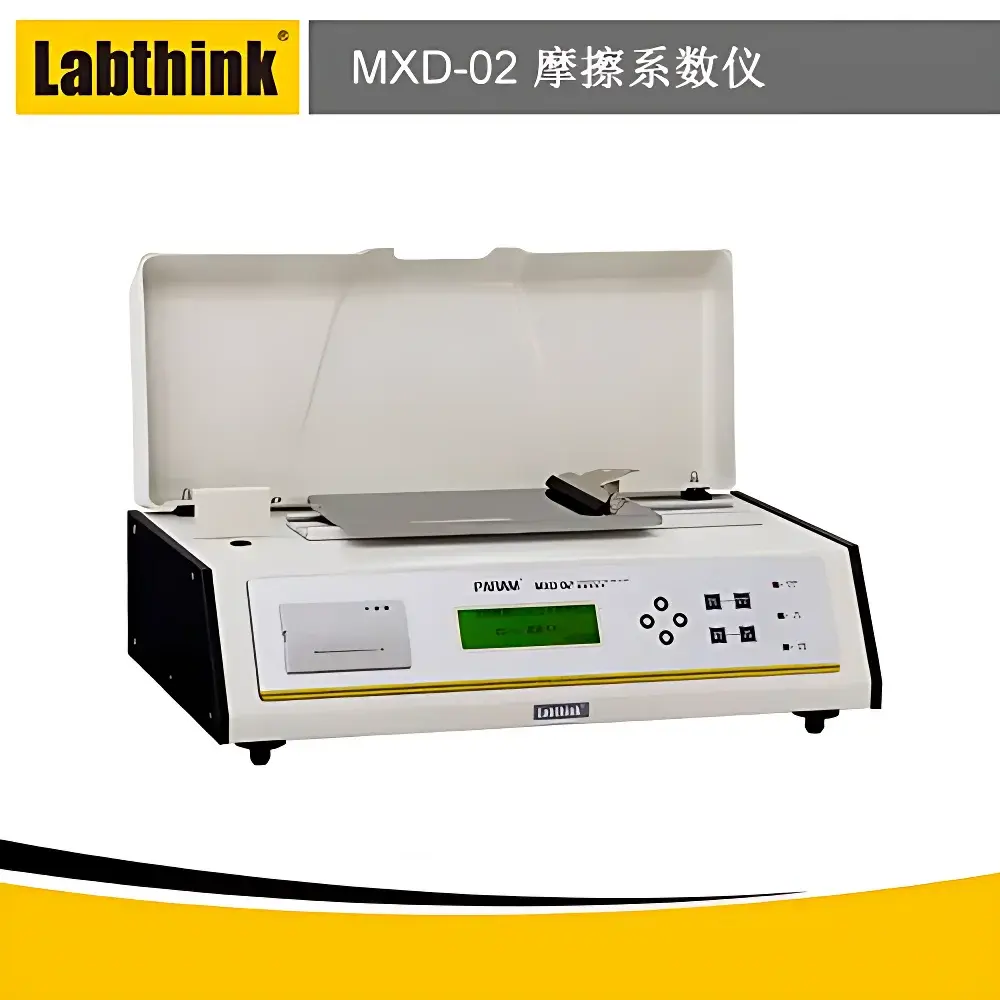
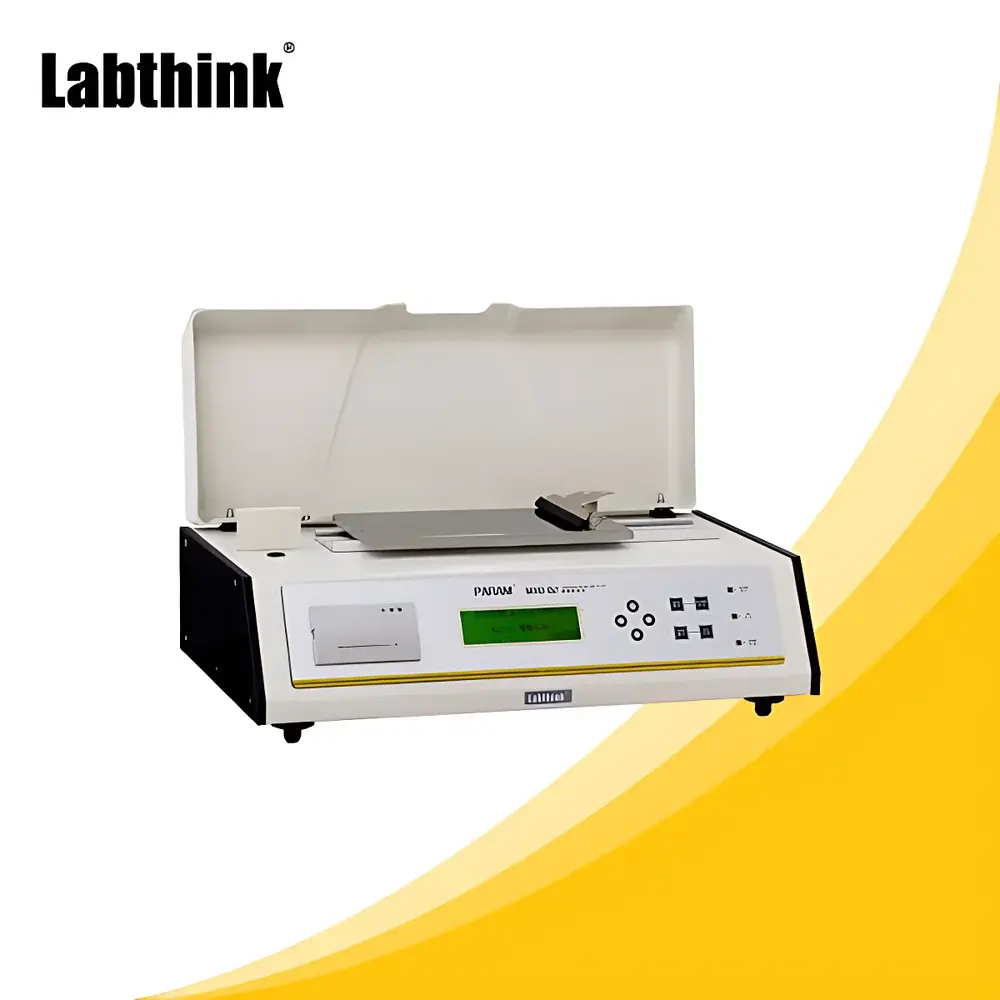
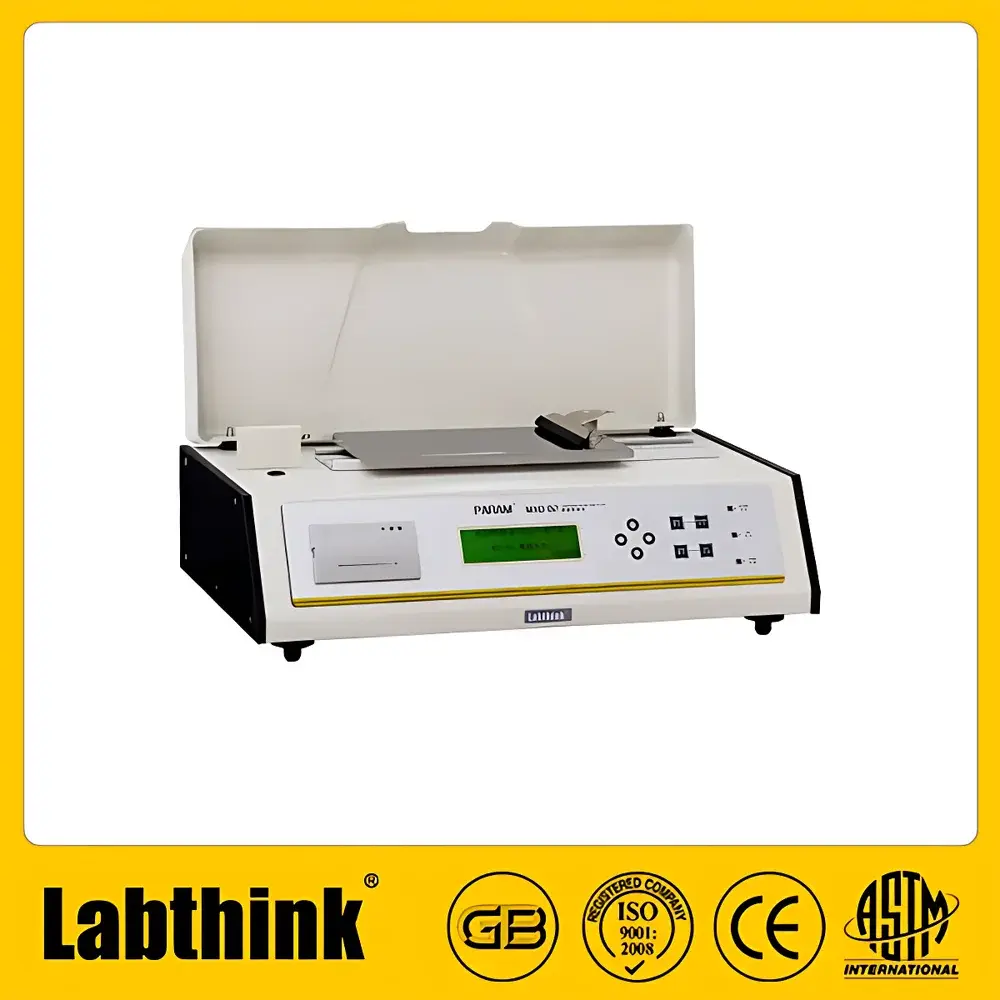
Labthink PARAM MXD-02 Fabric Surface Coefficient of Friction Tester
| Brand | Labthink |
|---|---|
| Origin | Shandong, China |
| Manufacturer Type | Manufacturer |
| Country of Origin | Domestic (China) |
| Model | PARAM MXD-02 |
| Price Range | USD 1,400 – 8,500 |
| Load Capacity | 0–5 N |
| Accuracy Class | 0.5 |
| Slider Mass | User-Configurable |
| Test Speeds | 48 ± 2 mm/min (custom), 100 mm/min, 150 mm/min |
| Power Supply | AC 220 V, 50 Hz |
| Dimensions (L×W×H) | 630 × 360 × 230 mm |
| Net Weight | 33 kg |
| Display | LCD graphical interface |
| Data Output | RS232 serial port |
| Software Support | PC-based analysis suite with curve overlay, statistical reporting, and multi-format export (Excel, HTML) |
Overview
The Labthink PARAM MXD-02 Fabric Surface Coefficient of Friction Tester is an electromechanical instrument engineered for precise quantification of static and kinetic coefficients of friction (COF) on textile surfaces—specifically woven and knitted dyed/finished outerwear fabrics—as defined by the Chinese national standard FZ/T 01054.2–1999 (replacing FJ 552.2). It operates on the fundamental principle of horizontal sliding resistance measurement: a standardized slider is placed atop the test specimen under controlled normal load; the force required to initiate motion (static COF) and maintain steady-state sliding (kinetic COF) is measured via high-resolution load cell transduction. The system complies with core mechanical metrology conventions for tribological testing in regulated textile quality control environments, where surface tactile properties—such as slipperiness, drag resistance, and handle—directly influence end-user perception, garment drape behavior, and industrial processing efficiency (e.g., automated cutting, sewing feed stability, and folding consistency).
Key Features
- Fully programmable microprocessor control with intuitive keyboard-driven operation and real-time graphical LCD display showing force-time curves, numerical COF values, and pass/fail status indicators
- Flexible drive mechanism ensuring low-vibration, constant-velocity translation—critical for minimizing inertial artifacts during static-to-kinetic transition detection
- Automated discrimination between “slip” and “stick-slip” surface behaviors, enabling objective classification of tactile response beyond scalar COF values
- Configurable test modes: static-only, kinetic-only, or combined static–kinetic sequence within a single run
- Statistical engine supporting batch analysis across up to 10 specimens per group, including mean, standard deviation, coefficient of variation, and outlier identification per ASTM E178 guidelines
- RS232 interface compliant with legacy lab infrastructure; supports bidirectional communication for remote parameter setting and raw data acquisition
Sample Compatibility & Compliance
The MXD-02 accommodates flat, flexible textile substrates—including bleached, dyed, printed, coated, and laminated fabrics—within standard specimen dimensions (e.g., 63 mm × 100 mm per ISO 8295 and GB/T 10006). Its modular slider design permits user-defined mass configurations, allowing adaptation to varying fabric stiffness and industry-specific test protocols. While calibrated and validated against FZ/T 01054.2–1999, the instrument’s mechanical architecture aligns with internationally recognized tribological frameworks: load cell linearity (0.5-class accuracy per JJG 391–2019), speed tolerance (±2% at 48 mm/min), and environmental robustness (operating temperature range: 10–35 °C, RH ≤ 80%). It supports GLP-aligned documentation workflows when paired with optional audit-trail-enabled software modules.
Software & Data Management
The dedicated PC application enables post-test reprocessing of time-resolved force data, overlay comparison of multiple COF curves, and generation of compliant reports in Excel (.xlsx), HTML, and PDF formats. All exported files retain embedded metadata—including operator ID, timestamp, instrument serial number, calibration certificate ID, and environmental monitoring logs (if integrated)—facilitating traceability per ISO/IEC 17025 requirements. Audit-ready features include electronic signatures, version-controlled report templates, and immutable raw-data archives. Data integrity is preserved via CRC-32 checksum validation during transfer and local storage encryption options.
Applications
- Quality assurance of finished apparel textiles for slip resistance compliance in sportswear, intimate wear, and medical garments
- R&D evaluation of soft-touch coatings, silicone finishes, and plasma treatments affecting surface energy and boundary lubrication
- Process validation for continuous dyeing and finishing lines where COF shifts indicate chemical exhaustion or curing inconsistencies
- Comparative benchmarking of sustainable alternatives (e.g., Tencel™, recycled polyester) against conventional fibers for functional performance parity
- Supporting ISO 12947 (Martindale abrasion) correlation studies where surface friction directly influences pilling propensity
FAQ
Does the MXD-02 comply with international standards such as ISO 8295 or ASTM D1894?
It is primarily validated to FZ/T 01054.2–1999, but its mechanical design and measurement methodology are functionally compatible with ISO 8295 and ASTM D1894 when configured with corresponding slider geometry and test parameters.
Can the instrument measure COF on non-textile materials like plastic films or paperboard?
Yes—provided specimens meet dimensional stability and flatness requirements; however, reference calibration using certified polymer standards is recommended for cross-material traceability.
Is firmware upgrade capability supported over RS232?
Firmware updates require local service intervention using proprietary diagnostic tools; remote updates are not implemented for metrological integrity assurance.
What is the calibration interval recommendation?
Annual recalibration against NIST-traceable force standards is advised, with intermediate verification using certified reference sliders performed before each daily test session.
Does the software support 21 CFR Part 11 compliance?
The base software does not include Part 11 features; however, an optional GxP-compliant version with electronic signatures, role-based access control, and full audit trail is available upon request.