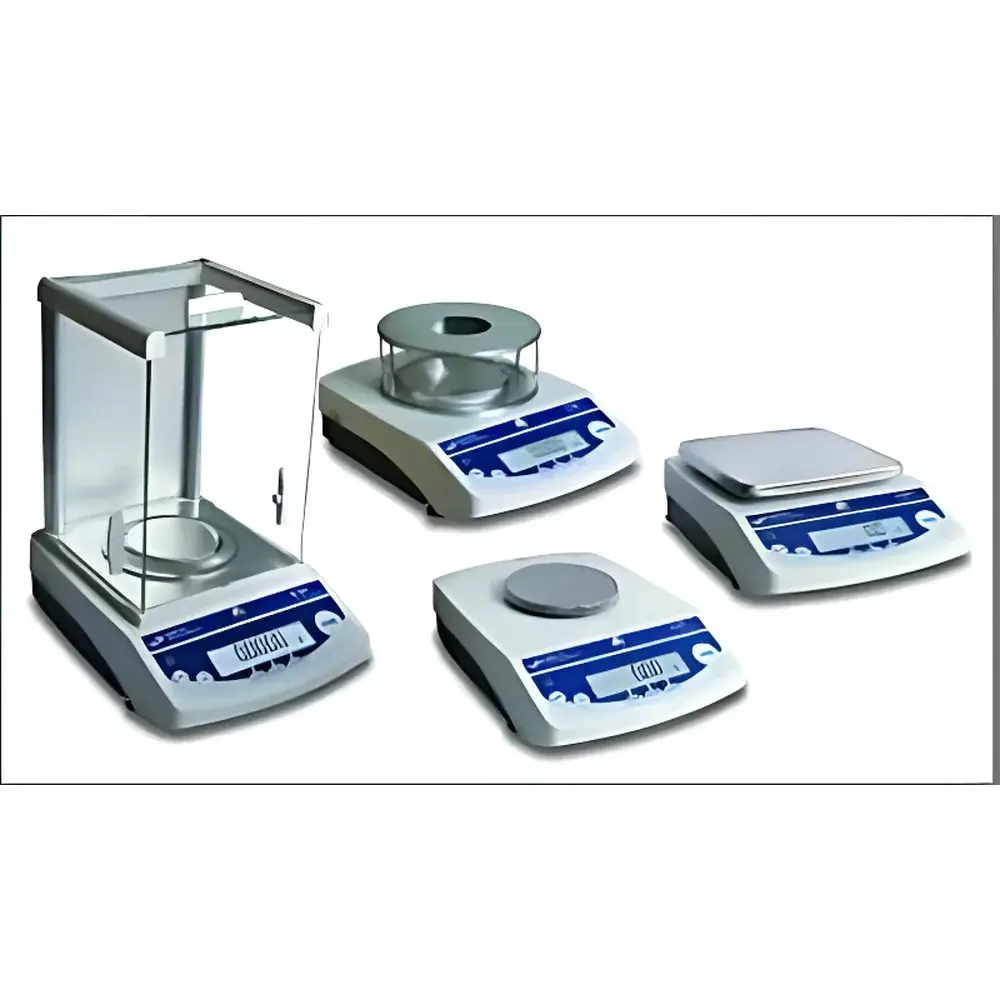
Denver SUMMIT SI Series Precision and Analytical Balances
| Brand | Denver |
|---|---|
| Origin | USA |
| Model | SUMMIT SI Series Electronic Balances |
| Capacity Range | 110–8000 g |
| Readability | 0.1 mg – 100 mg |
| Pan Size | Ø90 mm to 178×178 mm |
| Repeatability | ±0.1 mg to ±100 mg |
| Linearity | ±0.2 mg to ±200 mg |
| Stabilization Time | 1–2 s (analytical) / 1 s (precision) |
| Internal Calibration | Fully Automatic |
| Temperature Compensation | Full-Range |
| Processor | 80 MHz Renesas H8S MCU |
| Display | Backlit LCD with English/Code Menu Options |
| Connectivity | RS-232 |
| Draft Shield | Aluminum Anti-Static Rear Panel |
| Leveling | Front-Mounted Bubble Level |
| Real-Time Clock | Built-in with Operator ID & Timestamp Logging |
| Applications | Density Determination, Counting, Animal Weighing, Percentage Weighing, Formula Summation, Unit Conversion |
| Bottom Loading | Yes |
Overview
The Denver SUMMIT SI Series electronic balances are high-performance laboratory weighing instruments engineered for precision, speed, and operational reliability in regulated and research-intensive environments. Designed around a dual-stage integrated sensor architecture and quadruple intelligent digital filtering, the SI Series delivers exceptional stability under dynamic environmental conditions—including air currents, vibration, and thermal drift. These balances operate on the principle of electromagnetic force restoration (EMFR), where load-induced displacement of the weighing pan is counterbalanced by a precisely controlled electromagnetic current; the resulting current magnitude is linearly proportional to mass and digitally resolved with metrological traceability. The inclusion of full-range automatic temperature compensation ensures consistent accuracy across ambient shifts typical in multi-zone lab settings. With stabilization times as low as 1 second for precision models and 2 seconds for analytical variants, the SI Series supports high-throughput workflows without compromising repeatability or linearity—critical for QC laboratories adhering to ISO/IEC 17025, USP , and ASTM E898 standards.
Key Features
- Dual-stage monolithic sensor design with enhanced mechanical rigidity and reduced creep error
- Quadruple adaptive digital filtering algorithm dynamically adjusts response based on load stability and environmental noise
- Full internal calibration (AutoCal™) with motor-driven calibration mass deployment—no manual weights required
- Real-time clock with operator ID assignment, timestamped data logging, and configurable audit trail metadata
- Backlit graphical LCD display supporting both intuitive English menu navigation and compact numeric code input
- Front-mounted bubble level and adjustable leveling feet for rapid, repeatable instrument setup
- Anti-static aluminum draft shield rear panel minimizing electrostatic interference during low-mass measurements
- RS-232 serial interface compliant with standard ASCII command protocols for seamless integration into LIMS and ELN systems
- Bottom-loading capability for direct connection to automated sample handling or hopper-based dispensing systems
Sample Compatibility & Compliance
The SUMMIT SI Series accommodates diverse sample forms—from microgram-scale powders in analytical applications to kilogram-range bulk materials in formulation and quality control. All models feature corrosion-resistant stainless-steel pans and optional draft shields compatible with ISO 17025-compliant weighing practices. The series conforms to OIML R76-1 (2021) class II and III requirements for non-automatic weighing instruments and meets the essential performance criteria outlined in EURAMET cg-18 v4.0 for analytical balance verification. Internal diagnostics perform continuous self-checks for overload, sensor saturation, temperature excursion, and mechanical fault detection—generating actionable error codes aligned with GLP/GMP documentation expectations. Data integrity is preserved through deterministic timestamping and operator authentication, satisfying FDA 21 CFR Part 11 requirements when paired with validated third-party data acquisition software.
Software & Data Management
While the SI Series operates autonomously via its embedded firmware, it supports bidirectional communication via RS-232 using industry-standard command sets (e.g., “S” for stable weight, “W” for weight readout, “T” for tare). When connected to compliant laboratory informatics platforms—including LabWare LIMS, Thermo Fisher SampleManager, or custom Python/Node.js scripts—the balance exports weight values, timestamps, operator IDs, and status flags in structured ASCII format. Audit trails include event logs for calibration, tare, unit change, and parameter modification. Optional firmware updates (distributed via Denver’s secure customer portal) maintain alignment with evolving metrological guidelines and cybersecurity best practices (e.g., NIST SP 800-161).
Applications
- Density determination: Integrated density mode calculates solid/liquid density using Archimedes’ principle with buoyancy correction and temperature input
- Parts counting: Statistical averaging across user-defined sample counts enables high-accuracy piece-counting for pharmaceutical blister packs or electronic components
- Animal weighing: Dynamic averaging and motion compensation algorithms suppress instability from live subject movement
- Percentage weighing: Reference mass normalization for formulation checks and reagent dilution workflows
- Formula summation: Sequential accumulation of multiple weighed components with real-time subtotal display and error propagation tracking
- Unit conversion: On-the-fly conversion between g, mg, oz, ct, dwt, and grain—preserving significant figures and rounding per ISO 80000-1
FAQ
Does the SI Series support external calibration with traceable weights?
Yes—while AutoCal™ provides routine internal calibration, all models accept external calibration using certified Class E2 or F1 weights per ISO 9001 and ISO/IEC 17025 procedures.
Is the RS-232 interface compatible with modern Windows/macOS systems?
Yes—when used with a USB-to-RS-232 adapter (e.g., FTDI-based), the interface functions with standard terminal emulators and scripting environments without proprietary drivers.
Can the real-time clock be synchronized with a network time server?
No—the RTC is battery-backed and manually set; however, timestamps exported via RS-232 retain absolute time context for downstream synchronization in LIMS.
What is the warranty coverage and service support structure?
Denver offers a 2-year limited warranty covering parts and labor; extended service plans and on-site calibration certification are available through authorized Denver Service Partners in North America and EMEA.
Are firmware updates provided free of charge?
Yes—registered users receive notifications and authenticated firmware packages at no cost via Denver’s secure customer portal.