
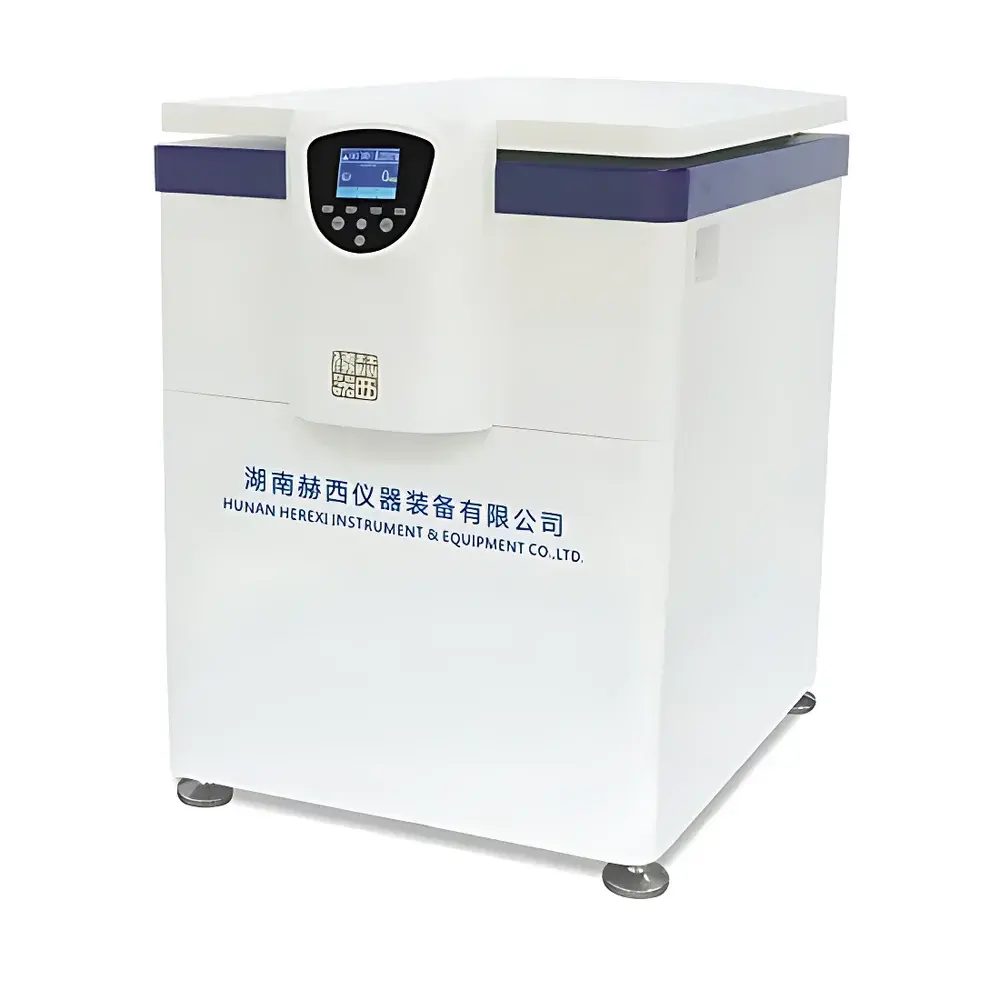
Hesley DD5M Vertical Low-Speed High-Capacity Centrifuge
| Brand | Hesley |
|---|---|
| Origin | Hunan, China |
| Model | DD5M |
| Type | Floor-Standing Centrifuge |
| Max Capacity | 6 × 500 mL |
| Max Speed | 5000 rpm |
| Max RCF | 4800 × g |
| Dimensions (L×W×H) | 740 × 620 × 900 mm |
| Weight | 85 kg (non-refrigerated) / 180 kg (refrigerated option) |
| Noise Level | ≤65 dB(A) |
| Power Supply | AC 220 V, 50 Hz |
| Motor | AC Brushless Inverter Motor |
| Control System | Microprocessor-Based with TFT-LCD Touchscreen Interface |
| Programmable Methods | 20 User-Defined Protocols |
| Acceleration/Deceleration | 10 Steps Each |
| Certifications | CFDA Registered, ISO 9001:2015 & ISO 13485:2016 Compliant |
| Refrigeration Option | Optional R404a Compressor System (Temp Range: –20°C to +40°C) |
Overview
The Hesley DD5M is a floor-standing, low-speed high-capacity centrifuge engineered for routine separation tasks in clinical laboratories, blood banks, bioprocessing facilities, and academic research settings. Designed around the principles of sedimentation-based separation under controlled gravitational force (RCF), the DD5M delivers stable, reproducible performance at rotational speeds up to 5000 rpm and maximum relative centrifugal forces of 4800 × g. Its vertical architecture optimizes footprint efficiency while accommodating large-volume sample processing—particularly suited for pelleting cells, precipitating macromolecules, clarifying lysates, and separating whole blood components. The unit integrates a brushless AC inverter motor coupled with precision microprocessor control, ensuring minimal mechanical drift, low operational noise (<65 dB[A]), and long-term torque consistency across repeated cycles.
Key Features
- Robust structural design featuring an austenitic 304 stainless steel centrifuge chamber, powder-coated steel housing, and triple-layer reinforced front panel for mechanical integrity and operator safety.
- Dual-mode operation interface: 7-inch TFT-LCD true-color touchscreen with physical shortcut keys—including dedicated RCF display button—supporting real-time parameter monitoring and on-the-fly adjustments without interrupting active runs.
- Comprehensive safety architecture: three-stage damping system, imbalance detection with automatic rotor deceleration, overspeed/overtemperature/under-voltage/over-voltage alarms, and automatic door interlock with silent electromagnetic latch mechanism.
- Optional refrigeration module using environmentally compliant R404a refrigerant and hermetic compressor, enabling temperature control from –20°C to +40°C with pre-cooling, standby cooling, and auto-defrost functions—critical for thermolabile biological samples.
- Biocontainment-compliant angular rotors sealed with RoHS 2015/863-certified silicone rubber gaskets to suppress aerosol generation during high-volume blood or pathogen-containing sample processing.
- Modular rotor compatibility including swing-bucket configurations supporting up to 6 × 500 mL tubes, as well as specialized carriers for vacuum blood collection tubes (up to 148 × 5/2 mL), microplates (2 × 96-well), and standard conical tubes (16–48 × 15/10 mL).
Sample Compatibility & Compliance
The DD5M accommodates a broad spectrum of sample types—including whole blood, serum, plasma, cell suspensions, bacterial cultures, tissue homogenates, and polymer solutions—across multiple container formats (polypropylene, polycarbonate, glass). Its rotor configurations meet standard biosafety requirements for CLIA, CAP, and ISO 15189-accredited laboratories. All mechanical and electrical subsystems conform to IEC 61010-1:2010 for laboratory equipment safety. Regulatory documentation includes CFDA registration (Class II medical device), ISO 9001:2015 quality management certification, and ISO 13485:2016 certification for medical device manufacturing. While not FDA 510(k)-cleared for U.S. clinical diagnostics, the system supports GLP/GMP-aligned workflows through audit-trail-capable parameter logging (when integrated with optional data export modules).
Software & Data Management
The embedded firmware supports 20 programmable methods with independent storage of speed, time, temperature (if equipped), acceleration/deceleration profiles, and rotor ID. Each protocol retains full traceability—including timestamped start/stop events and error logs—with non-volatile memory retention during power loss. USB export functionality enables CSV-formatted run reports compatible with LIMS integration. Language localization includes English, Chinese, Russian, and Portuguese UI options, facilitating multi-regional deployment. For advanced compliance needs, optional RS-232 or Ethernet interfaces support remote monitoring and centralized fleet management via third-party laboratory automation platforms.
Applications
- Clinical hematology: Routine separation of erythrocytes, leukocytes, and platelets from whole blood using standardized vacuum tube carriers.
- Vaccines & biologics manufacturing: Clarification of mammalian cell culture harvests and purification intermediates prior to chromatography steps.
- Academic life sciences: Isolation of nuclei, mitochondria, and large ribosomal subunits from tissue homogenates under low-shear conditions.
- Food & environmental testing: Sedimentation of suspended solids in water, milk, or fermentation broths for subsequent microbiological or physicochemical analysis.
- Blood banking: High-throughput processing of donor units with validated hold times and temperature stability during extended centrifugation cycles.
FAQ
Is the DD5M certified for use in regulated clinical environments?
Yes—the unit carries CFDA registration and ISO 13485:2016 certification, confirming its suitability for Class II medical device applications in diagnostic laboratories operating under national regulatory oversight.
Can the centrifuge operate without refrigeration?
Yes—standard configuration is air-cooled; refrigeration is an optional add-on module specified at time of order.
What rotor types are included by default?
The base configuration ships with a 6 × 500 mL swing-bucket rotor; additional rotors (e.g., microplate, vacuum tube, or fixed-angle variants) are available as accessories.
Does the system support electronic record keeping per FDA 21 CFR Part 11?
Out-of-the-box functionality does not include Part 11-compliant electronic signatures or audit trails; however, raw data export enables integration with validated LIMS or ELN systems meeting those requirements.
How is rotor imbalance detected and managed?
Vibration sensors continuously monitor dynamic load distribution; upon detecting asymmetry beyond ±5% mass tolerance, the system triggers immediate deceleration and displays a fault code to prevent mechanical damage or sample resuspension.



