
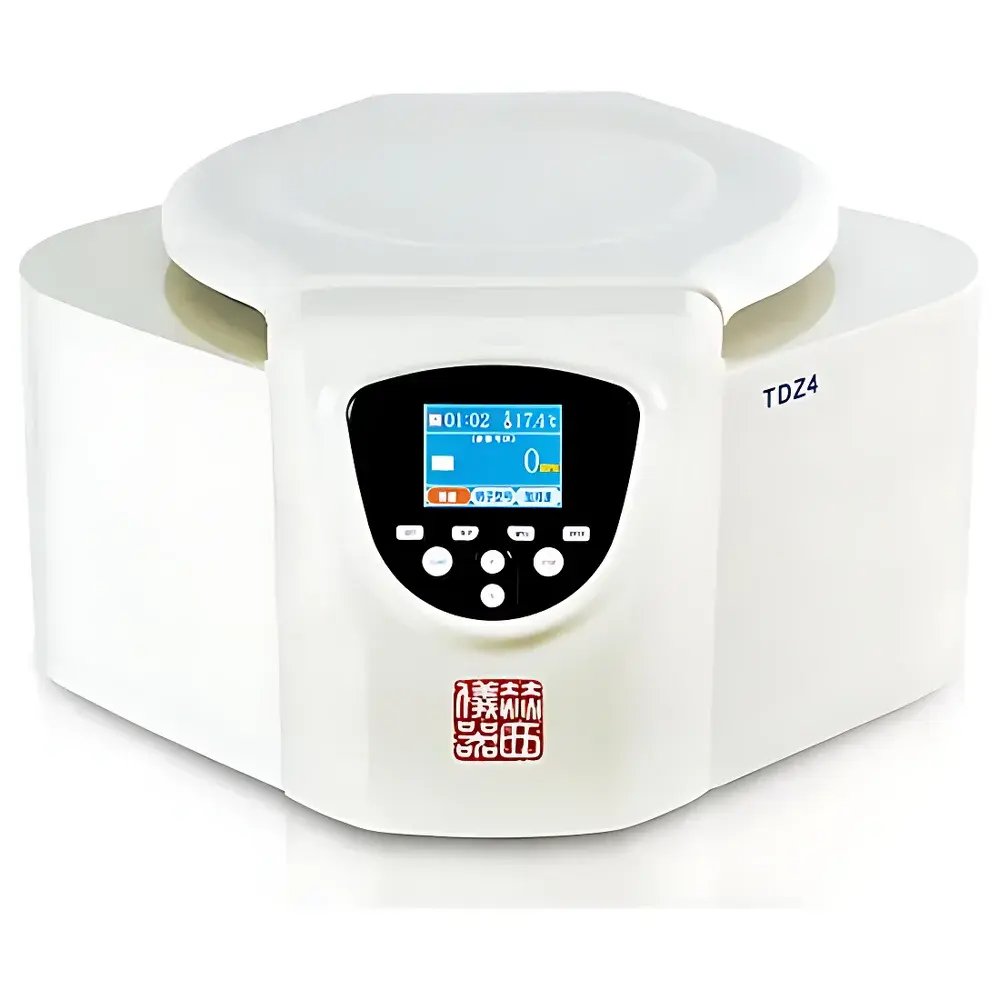
Herx TCT Liquid-Based Cytology Centrifuge TDZ4
| Brand | Herx |
|---|---|
| Origin | Hunan, China |
| Model | TDZ4 |
| Instrument Type | Benchtop Centrifuge |
| Speed Range | 0–4000 rpm |
| Max RCF | 2600 × g |
| Max Capacity | 12-slide carrier (TCT-specific cassette) |
| Rotor Type | Horizontal swing-out rotor for cytology cassettes |
| Speed Accuracy | ±50 rpm |
| Timer Range | 0–99 h 59 min |
| Noise Level | ≤60 dB(A) |
| Power Supply | AC 220 V, 50 Hz |
| Power Consumption | 120 W |
| Dimensions (L×W×H) | 500 × 450 × 280 mm |
| Net Weight | 20 kg |
| Construction | 304 Stainless Steel chamber, full-steel powder-coated housing, triple-layer safety enclosure |
| Drive System | Brushless frequency-controlled motor |
| Control Interface | 4.3″ TFT true-color touchscreen with dual-keypad + touch control |
| Safety Features | Electronic door lock, overspeed protection, automatic imbalance detection & compensation, real-time fault alarm, rotor recognition (cassette-specific), GLP-compliant audit trail logging |
Overview
The Herx TDZ4 is a purpose-engineered benchtop centrifuge designed exclusively for liquid-based cytology (LBC) specimen preparation in clinical pathology and diagnostic laboratories. Unlike general-purpose centrifuges, the TDZ4 implements a precisely calibrated low-speed sedimentation protocol optimized for preserving cellular integrity while separating debris, mucus, and inflammatory cells from target epithelial and nucleated cells in diverse body fluids—including cervical exfoliates, pleural effusions, ascites, cerebrospinal fluid (CSF), bronchial washings, synovial fluid, and urine sediments. Its operational principle relies on controlled gravitational sedimentation under defined RCF (relative centrifugal force) and time parameters—typically 2600 × g at 4000 rpm—to achieve uniform monolayer deposition onto glass slides without cell clumping or distortion. The instrument employs a brushless frequency-controlled motor to eliminate carbon brush wear, ensuring long-term torque stability, minimal particulate generation, and compliance with cleanroom-grade laboratory environments.
Key Features
- Specialized 12-position horizontal rotor compatible with standardized TCT (ThinPrep®-compatible) cytology cassettes—enabling parallel processing of up to 12 specimens per run.
- TFT 4.3-inch true-color touchscreen interface with dual-control logic (touch + physical keypad), supporting intuitive navigation and real-time parameter monitoring.
- Microprocessor-based control system with 20 programmable user protocols; auto-recall of last-used method upon power-up ensures workflow continuity and reduces operator error.
- Integrated active vibration damping and self-balancing mechanism compensates for minor load imbalances, enabling stable operation even with partially loaded rotors.
- Triple-layer mechanical safety architecture: 304 stainless steel centrifuge chamber, electrostatically coated steel housing, and reinforced front panel with impact-resistant polymer overlay.
- Comprehensive safety suite including electronic lid interlock, overspeed cutoff, real-time rotor imbalance detection, temperature-independent fault diagnostics, and audible/visual alarm escalation.
Sample Compatibility & Compliance
The TDZ4 accommodates all major LBC specimen collection media (e.g., PreservCyt®, SurePath™-compatible transport solutions) and processes samples contained in proprietary 12-slide TCT cassettes. It meets essential performance criteria outlined in CLSI EP05-A3 (Evaluation of Precision of Quantitative Measurement Procedures) and supports adherence to ISO 15189:2022 requirements for preanalytical phase standardization. While not FDA 510(k)-cleared as an IVD device, its design aligns with CAP (College of American Pathologists) checklist ANP.42700 (Centrifuge Performance Verification) and supports GLP/GMP documentation needs through timestamped audit logs accessible via USB export. All internal wetted surfaces are non-porous 304 stainless steel—resistant to common cytology fixatives (methanol, ethanol, formalin-based buffers) and compatible with routine decontamination using 70% isopropyl alcohol or hospital-grade disinfectants.
Software & Data Management
The embedded firmware supports traceable operation via built-in event logging: each run records date/time stamp, selected program ID, actual speed (rpm), applied RCF, duration, final brake status, and any triggered safety events. Logs are exportable in CSV format via USB-A port for integration into LIS (Laboratory Information Systems) or QMS (Quality Management Software). No cloud connectivity or remote access is implemented—ensuring full data sovereignty and alignment with HIPAA-compliant infrastructure requirements. Firmware updates are performed offline using signed binary files delivered via secure vendor channel, preserving regulatory integrity during software lifecycle management.
Applications
- Cervical cytology sample preparation for Pap smear analysis using liquid-based thin-layer technology.
- Body fluid cytology workflows including CSF, pleural, peritoneal, and synovial fluid analysis for malignancy screening and inflammatory cell differential.
- Urinary sediment cytology in urologic oncology settings where high-sensitivity detection of transitional cell carcinoma is required.
- Respiratory specimen processing (bronchoalveolar lavage, sputum supernatant) for tuberculosis and lung cancer biomarker studies.
- Research applications requiring reproducible, low-shear sedimentation of fragile primary cells prior to immunocytochemistry or molecular extraction.
FAQ
Is the TDZ4 compliant with FDA 21 CFR Part 11 for electronic records?
No—the TDZ4 does not implement Part 11-compliant electronic signatures or audit trail encryption; however, its timestamped CSV logs meet basic ALCOA+ principles (Attributable, Legible, Contemporaneous, Original, Accurate) when paired with institutional SOPs governing data handling.
Can the rotor be autoclaved?
No—the 12-position TCT rotor is not autoclavable; cleaning must be performed manually using lint-free wipes and 70% isopropyl alcohol between runs.
Does the instrument support variable acceleration/deceleration profiles?
No—it operates with fixed ramp-up and coast-down kinetics optimized for cell monolayer formation; no user-adjustable braking profiles are available.
What is the recommended maintenance interval?
Annual verification of speed accuracy (±50 rpm tolerance), RCF calibration, and door lock functionality is advised per manufacturer guidelines; no routine lubrication is required due to brushless motor design.
Is rotor imbalance correction automatic during operation?
Yes—the system continuously monitors vibrational harmonics and dynamically adjusts motor torque to suppress resonance; if imbalance exceeds safe thresholds, the unit halts and displays error code E03.



