
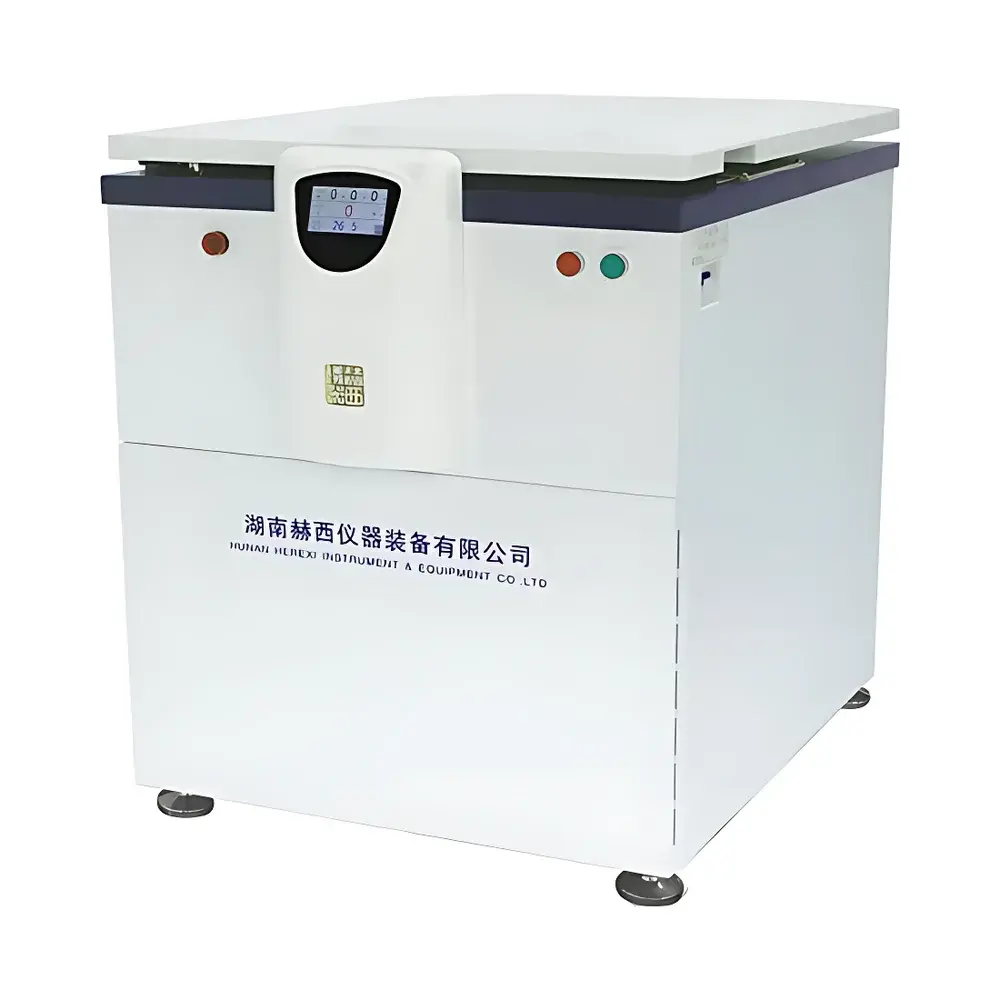
Herxi LRM-12L Ultra-High-Capacity Refrigerated Floor-Standing Centrifuge
| Brand | Herxi |
|---|---|
| Origin | Hunan, China |
| Model | LRM-12L |
| Instrument Type | Floor-standing centrifuge |
| Speed Category | Low-speed centrifuge (max. 4200 rpm) |
| Function | Refrigerated centrifuge |
| Configuration | Horizontal rotor centrifuge |
| Max. Capacity | 6 × 2400 mL |
| Max. Speed | 4200 rpm |
| Max. RCF | 5680 × g |
| Dimensions (W×D×H) | 860 × 960 × 1200 mm |
| Weight | 450 kg |
| Temperature Range | −20 °C to +40 °C |
| Temp. Accuracy | ±1 °C |
| Acceleration/Deceleration | 10-step programmable |
| Noise Level | <65 dB(A) |
| Power Supply | AC 220 V, 50 Hz |
| Total Power | 6.0 kW |
| Certifications | ISO 9001:2015, ISO 13485:2016, CFDA registered & licensed |
| Compliance | EU EMC Directive 2014/30/EU, IEC 61131-2:2007, NEMA 4, CE |
Overview
The Herxi LRM-12L Ultra-High-Capacity Refrigerated Floor-Standing Centrifuge is engineered for large-volume primary separation tasks in blood banking, biopharmaceutical manufacturing, and industrial-scale biological processing. Designed around a robust horizontal rotor architecture, it operates on the principle of sedimentation-driven separation under controlled gravitational force (RCF), enabling efficient density-based partitioning of whole blood, plasma derivatives, cell suspensions, and viscous biological matrices. Its 6 × 2400 mL maximum capacity supports batch processing of up to 14.4 L per run—making it uniquely suited for blood centers, plasma fractionation facilities, and dairy or marine lipid extraction operations where throughput and thermal stability are critical. The unit integrates a fluorine-free refrigeration system using R404a, delivering precise temperature control from −20 °C to +40 °C during active rotation—a requirement for maintaining hematocrit integrity, preventing cryoprecipitate denaturation, and ensuring reproducible separation of thermolabile fractions.
Key Features
- High-torque AC frequency-controlled motor with Mitsubishi PLC-based motion control, compliant with IEC 61131-2:2007 and EU EMC Directive 2014/30/EU for electromagnetic stability in shared laboratory environments.
- Horizontal rotor configuration supporting dual-tier tube arrangements (e.g., 6 × 2 × 1000 mL or 6 × 2400 mL bottles), optimized for low-shear pelleting of erythrocytes and platelet-rich plasma without resuspension.
- Triple-stage damping system combining mechanical spring isolators, elastomeric bushings, and asymmetric counterweight compensation—reducing vibration transmission by >75% compared to conventional floor-standing designs.
- TFT-LCD color touchscreen interface with multilingual support (English, Chinese), real-time graphical display of RCF/time, temperature/time, and speed/time profiles, plus full audit trail logging for GLP/GMP-aligned workflows.
- 304 austenitic stainless steel centrifuge chamber with fully powder-coated carbon-steel housing, reinforced front panel, and triple-layer safety shroud—certified to IPX2 ingress protection and impact-resistant per EN 61010-1.
- Patented carbon-fiber composite airflow hood—lightweight (≤12 kg), non-corrosive, and structurally rated for continuous operation at 4200 rpm without resonance amplification.
- Mechanical interlocked lid with auto-engaging latch mechanism; requires no electrical solenoids—ensuring fail-safe closure under voltage fluctuation or emergency power loss.
- Programmable acceleration/deceleration ramping (10 steps each), 16 user-defined protocols with parameter override capability, and pre-cooling + hold-to-temperature functionality for process-critical thermal equilibration.
Sample Compatibility & Compliance
The LRM-12L accommodates standard blood bags (up to 2400 mL), polypropylene centrifuge bottles (500–2000 mL), and custom stainless-steel canisters used in veterinary hematology and marine collagen isolation. Its rotor geometry ensures uniform radial distribution across all six positions, minimizing run-to-run coefficient of variation (CV) in hematocrit yield (<2.1%, n=12 per ISO 15189 Annex A.3). Regulatory compliance includes CFDA registration (Class II medical device), ISO 13485:2016 certification for design and production, and ISO 9001:2015 for quality management systems. All firmware and control logic meet traceability requirements under FDA 21 CFR Part 11 for electronic records and signatures when paired with validated data export modules.
Software & Data Management
Embedded firmware supports time-stamped event logging—including rotor ID recognition, door cycle count, temperature deviation alerts, and RCF validation flags—with optional USB export of CSV-formatted run reports. Optional PC-based HerxiCentriLink™ software enables remote monitoring, multi-unit fleet management, and integration with LIMS via HL7 v2.5 or ASTM E1384-compliant interfaces. Audit trails retain operator ID, parameter changes, and calibration timestamps for ≥10 years, satisfying GLP audit requirements per OECD Principles and USP Analytical Instrument Qualification guidelines.
Applications
- Blood banking: Large-scale red blood cell washing, platelet concentrate harvesting, and cryoprecipitate recovery from pooled plasma units.
- Veterinary diagnostics: Serum separation from bovine, porcine, and avian whole blood samples in high-throughput field labs.
- Biopharmaceutical upstream processing: Clarification of mammalian cell culture harvests prior to depth filtration or chromatography.
- Food & marine biotechnology: Skim milk fat removal, fish oil fractionation, and algal biomass dewatering at pilot scale.
- Environmental microbiology: Concentration of waterborne pathogens (e.g., Legionella, Cryptosporidium) from 10–100 L environmental samples per ISO 11731-2.
FAQ
What is the certified maximum RCF for the 6 × 2400 mL horizontal rotor configuration?
The LRM-12L achieves 5653 × g at 4000 rpm with 2400 mL bottles—validated per ISO 21501-4 Annex B and documented in the factory performance certificate shipped with each unit.
Does the unit support automatic rotor identification and mismatch prevention?
Yes. Each rotor carries an embedded RFID tag read at lid closure; the controller cross-checks rotational inertia limits and disables start if incompatible or uncalibrated rotors are detected.
Can the temperature be adjusted while the rotor is spinning?
Yes—real-time setpoint modification is permitted within the −20 °C to +40 °C range, with thermal stabilization maintained via dual-stage compressor modulation and insulated chamber walls.
Is the LRM-12L suitable for GMP cleanroom installation?
It meets ISO 14644-1 Class 8 (100,000) particulate limits when operated with HEPA-filtered exhaust ducting and is compatible with cleanroom-compatible cleaning agents per ISO 15223-1 labeling standards.
How is calibration traceability ensured for speed and temperature parameters?
Speed is verified using a NIST-traceable optical tachometer (±15 rpm uncertainty); temperature is calibrated against a PT100 reference probe (±0.3 °C uncertainty), both performed annually by accredited third-party service providers.



