
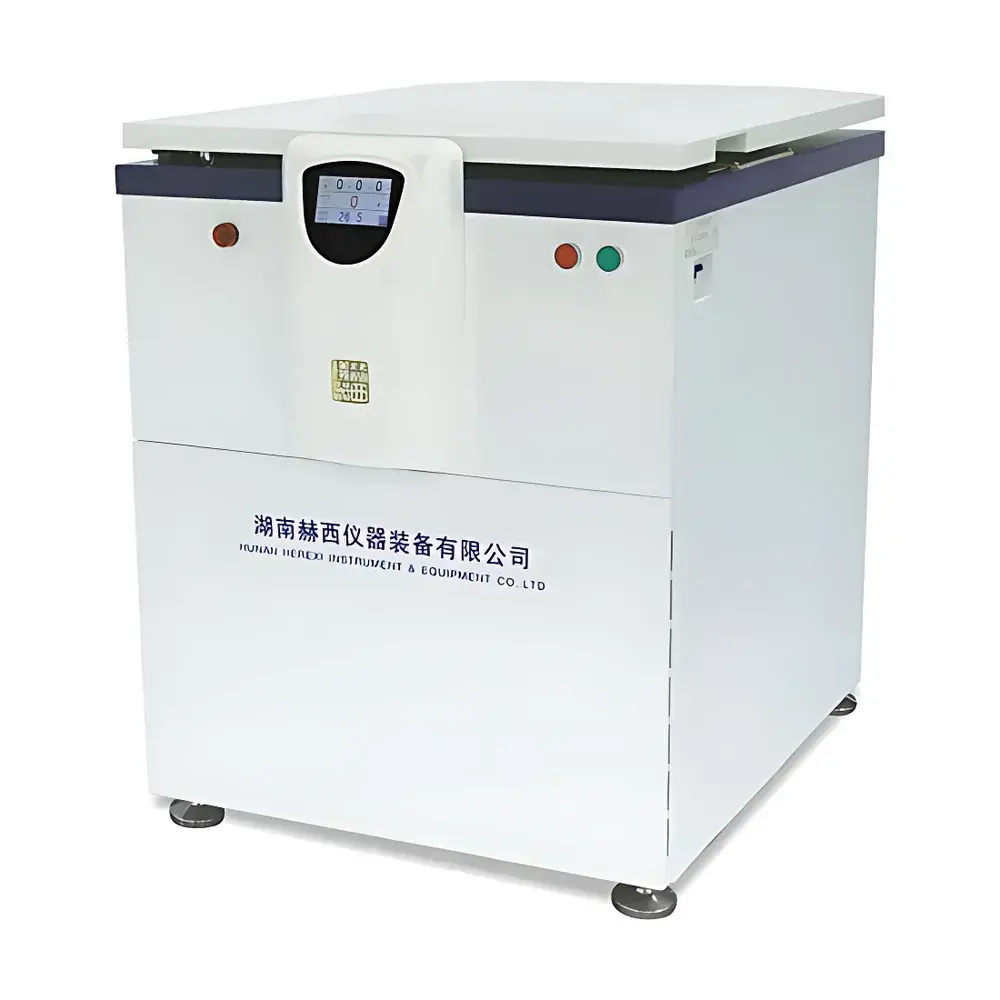
HEREXI HR21M High-Speed Refrigerated Centrifuge for Soil pF Curve Determination
| Brand | HEREXI |
|---|---|
| Origin | Hunan, China |
| Model | HR21M |
| Instrument Type | Floor-Standing Refrigerated Centrifuge |
| Speed Range | 0–10,000 rpm |
| Max RCF | 14,758 ×g |
| Max Capacity | 4 × 100 mL |
| Temperature Range | −20 °C to +40 °C |
| Temp. Accuracy | ±1 °C |
| Rotor Type | Horizontal Soil Dehydration Rotor (4 × φ50 × 51 mm containers) |
| pF Measurement Range | 2.0–4.2 (0.1–15 bar suction) |
| Speed Accuracy | ±50 rpm |
| Acceleration/Deceleration | 10 programmable ramp profiles |
| Programmable Protocols | 16 user-defined methods |
| Display | 4.3″ TFT color touchscreen with real-time curve plotting (speed, temperature, RCF, centrifugation integral) |
| Safety Features | Electronic door lock, overspeed protection, imbalance detection, overtemperature cutoff |
| Refrigerant | R404a (non-CFC) |
| Compressor | Imported Tecumseh (France) unit |
| Drive System | AC brushless frequency-converter motor |
| Dimensions (L×W×H) | 820 × 710 × 950 mm |
| Weight | 240 kg |
| Noise Level | ≤65 dB(A) |
| Power Supply | AC 220 V, 50 Hz, 30 A |
| Total Power Consumption | 4.0 kW |
Overview
The HEREXI HR21M is a purpose-engineered floor-standing refrigerated centrifuge designed exclusively for high-precision determination of soil water retention curves—commonly expressed as pF curves (pF = log₁₀[ψ], where ψ is soil matric potential in cm H₂O). Unlike general-purpose centrifuges, the HR21M integrates calibrated rotational control, precise low-temperature regulation, and specialized horizontal rotors to replicate defined matric suction levels (0.1–15 bar, corresponding to pF 2.0–4.2) across multiple soil samples simultaneously. Its operational principle relies on centrifugal force-induced water redistribution within saturated soil columns, enabling empirical derivation of volumetric water content (θ) at equilibrium under controlled centrifugal fields. This method aligns with ASTM D4546 and ISO 11274 protocols for soil hydraulic characterization and serves as a validated alternative to pressure plate apparatuses—offering broader suction coverage, reduced experimental duration, and improved reproducibility for routine soil physics laboratories.
Key Features
- High-torque AC brushless frequency-converter motor: Eliminates carbon brush wear and particulate contamination, ensuring long-term rotational stability and minimal maintenance.
- Imported Tecumseh refrigeration system with R404a refrigerant: Delivers consistent thermal control from −20 °C to +40 °C at ±1 °C accuracy, critical for minimizing evaporation artifacts during extended runs (up to 99 h 59 min).
- Dedicated horizontal soil dehydration rotor: Accommodates four standardized φ50 × 51 mm cylindrical containers—optimized for uniform sample geometry and repeatable hydraulic boundary conditions.
- Real-time multi-parameter visualization: 4.3″ TFT touchscreen displays concurrent plots of speed ramping profiles, temperature drift, cumulative centrifugation integral (RPM·min), and dynamic RCF evolution.
- Comprehensive safety architecture: Electronic lid interlock, automatic imbalance compensation, overspeed cutoff, and overtemperature shutdown conform to IEC 61010-2-20 and EN 61326-1 standards.
- Programmable workflow management: 16 stored protocols with editable parameters per rotor; 10-step acceleration/deceleration ramping for gentle sample handling and sediment integrity preservation.
Sample Compatibility & Compliance
The HR21M accepts standard cylindrical soil cores (diameter 50 mm, height 51 mm) prepared according to USDA NRCS and FAO soil survey guidelines. Each run processes four independent replicates under identical thermomechanical conditions—enabling statistical validation per GLP-compliant workflows. The instrument’s pF calibration traceability is established via gravimetric water loss measurement following centrifugation at discrete rotational speeds (converted to suction using the Campbell equation and rotor radius correction). It supports compliance with ISO 11274 (soil water retention), ASTM D4546 (centrifuge-based suction estimation), and national agricultural testing standards (e.g., NY/T 1121.15–2020). All firmware logs—including timestamped speed, temperature, duration, and rotor ID—are retained internally for audit-ready data lineage.
Software & Data Management
While the HR21M operates autonomously via its embedded microcontroller, raw operational metadata (start/stop times, setpoints, actual RPM/temperature traces, fault codes) are exportable via USB interface in CSV format. No proprietary software installation is required; exported datasets integrate directly into common scientific analysis environments (MATLAB, R, Python pandas). The system supports 21 CFR Part 11–compatible audit trails when paired with laboratory information management systems (LIMS) that ingest timestamped event logs. All parameter changes are recorded with operator ID (if network-authenticated) and version-stamped firmware identifiers—ensuring full traceability for QA/QC documentation and regulatory submissions.
Applications
- Soil hydraulic property mapping for hydrological modeling (e.g., HYDRUS-1D input parameterization)
- Calibration of pedotransfer functions (PTFs) linking texture, organic matter, and water retention behavior
- Evaluation of soil structural stability under freeze-thaw or wet-dry cycling
- Agricultural irrigation scheduling support through field capacity and permanent wilting point estimation
- Climate resilience studies assessing drought response thresholds in managed ecosystems
- Validation of neutron probe and TDR sensor calibrations across matric potential gradients
FAQ
What pF range can the HR21M accurately resolve?
The HR21M achieves reliable pF determinations between 2.0 and 4.2 (0.1–15 bar suction), covering the majority of agriculturally and ecologically relevant moisture regimes—from near-saturation to the permanent wilting point.
Is rotor balancing required before each run?
Yes. The horizontal rotor must be loaded symmetrically with four matched soil cores (±0.5 g mass tolerance) to prevent vibration-induced RCF deviation and ensure thermal uniformity across samples.
Can the HR21M be integrated into automated lab networks?
It features RS-485 Modbus RTU capability for remote status polling and emergency stop signaling, though full protocol-level automation requires external PLC-level orchestration due to its embedded control architecture.
Does the instrument meet CE or UL certification requirements?
The HR21M complies with CE marking directives (EMC 2014/30/EU, LVD 2014/35/EU) and carries factory-issued conformity declarations; UL listing is not applicable as it is supplied for research use only under non-medical regulatory frameworks.
How is pF value calculated from centrifuge data?
pF is derived from measured angular velocity (ω), rotor radius (r), and gravitational acceleration (g) using the relation: pF = log₁₀[(ω²r)/(100g)], corrected for sample height and meniscus position per ISO 11274 Annex B methodology.



