
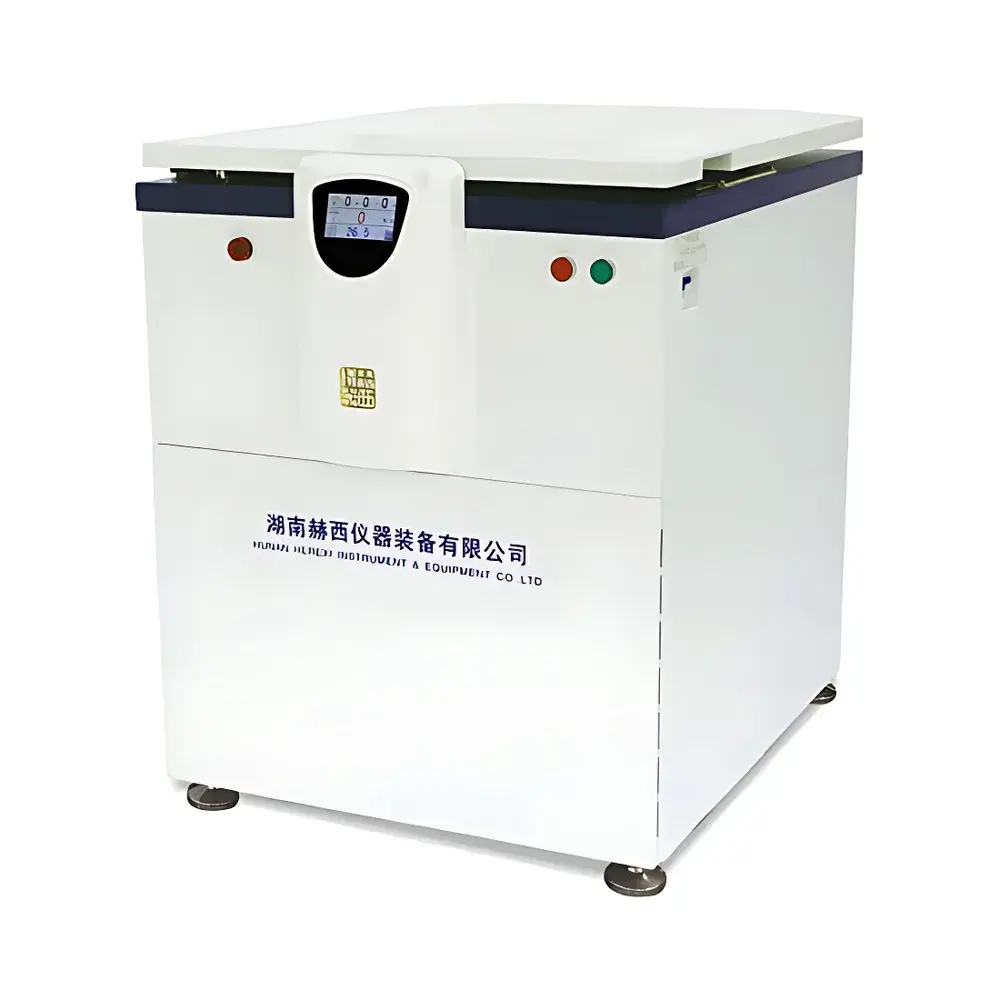
Herx LR8M High-Capacity Refrigerated Centrifuge
| [Brand | Herx |
|---|---|
| Origin | Hunan, China |
| Model | LR8M |
| Type | Floor-Standing Refrigerated Centrifuge |
| Max Capacity | 4 × 150 mL (horizontal) / 6 × 1000 mL (horizontal) |
| Max Speed | 8,000 rpm |
| Max RCF | 11,377 × g |
| Temperature Range | −20 °C to +40 °C |
| Temp. Accuracy | ±1 °C |
| Acceleration/Deceleration | 10-step programmable |
| Programs Stored | 16 user-defined |
| Display | TFT-LCD touch interface with multilingual support (EN/CN) |
| Noise Level | <65 dB(A) |
| Dimensions (W×D×H) | 840 × 730 × 950 mm |
| Weight | 270 kg |
| Power Supply | AC 220 V / 50 Hz |
| Total Power | 4.0 kW |
| Compliance | ISO 9001:2015, ISO 13485:2016, CFDA registered |
| Refrigerant | R404a (non-ozone-depleting) |
| Motor | High-torque AC frequency-controlled motor |
| Control System | Mitsubishi PLC (IEC 61131-2:2007 compliant), Weinview HMI (NEMA4, CE certified)] |
Overview
The Herx LR8M is a floor-standing, high-capacity refrigerated centrifuge engineered for reproducible, low-speed separation of large-volume biological and industrial samples under precise thermal control. Operating on the principle of sedimentation force generation via rotational acceleration, the LR8M delivers stable RCF up to 11,377 × g at 8,000 rpm—optimized for applications requiring gentle yet effective pelleting of cells, organelles, precipitates, and emulsions without shear-induced damage. Its dual-role design supports both horizontal rotor configurations (up to 6 × 1000 mL) and angular rotors (6 × 500 mL), enabling flexibility across clinical, research, and production-scale workflows. The system integrates a non-ozone-depleting R404a refrigeration circuit with active pre-cooling, standby cooling, and auto-defrost functionality—ensuring sample integrity during extended runs and ambient temperature fluctuations.
Key Features
- High-torque AC frequency-controlled motor coupled with Mitsubishi PLC-based motion control (compliant with IEC 61131-2:2007 and EU EMC Directive 2014/30/EU) for exceptional speed stability and low acoustic emission (<65 dB[A]).
- Advanced thermal management: −20 °C to +40 °C operating range with ±1 °C accuracy; real-time temperature setpoint adjustment during operation; pre-cool and standby cooling modes to minimize sample thermal drift.
- Multi-layer safety architecture: mechanical door lock with positive engagement, triple-layer stainless steel (AISI 304) centrifuge chamber, reinforced steel front panel, and integrated imbalance, overspeed, overtemperature, and voltage fluctuation detection.
- TFT-LCD touchscreen interface supporting English and Chinese language options; simultaneous display of setpoints and real-time parameters (speed, RCF, time, temperature, acceleration/deceleration curves, and cumulative centrifugation integral).
- Programmable deceleration and acceleration profiles (10 steps each); 16 user-storable protocols with editable rotor-specific parameters; graphical visualization of run dynamics including temperature vs. time and RCF accumulation.
- Modular mobility system: heavy-duty casters with carbon-steel leveling feet for vibration-dampened positioning on standard laboratory flooring.
Sample Compatibility & Compliance
The LR8M accommodates a broad spectrum of sample containers—including polypropylene and polycarbonate bottles (up to 1000 mL), blood bags, conical tubes, and custom vessels—within horizontally configured rotors designed for uniform sedimentation and minimal resuspension risk. Its construction and operational logic align with internationally recognized quality and safety frameworks: certified to ISO 9001:2015 (Quality Management Systems) and ISO 13485:2016 (Medical Device Quality Management), and registered with China’s National Medical Products Administration (NMPA, formerly CFDA). While not FDA 510(k)-cleared or CE-marked for IVDR/IVDD compliance, its electromagnetic compatibility (CE), NEMA4-rated HMI enclosure, and adherence to IEC 61010-1:2012 for laboratory electrical safety support integration into GLP- and GMP-aligned environments where instrument qualification (IQ/OQ/PQ) is performed per internal SOPs.
Software & Data Management
The LR8M operates via embedded firmware with no external PC dependency. All run logs—including start/stop timestamps, rotor ID, speed/RCF profiles, temperature history, and fault events—are timestamped and stored internally for audit-ready retrieval. The system supports manual export of session data via USB interface in CSV format for downstream analysis in LIMS or statistical software. While it does not implement FDA 21 CFR Part 11-compliant electronic signatures or role-based access control, its deterministic PLC-driven control loop and immutable parameter logging meet foundational data integrity expectations for non-regulated research and routine QC use. Protocol cloning, parameter locking, and password-protected editing modes are available to enforce procedural consistency across multi-user labs.
Applications
- Clinical Diagnostics: Processing whole blood, serum, plasma, and CSF in hospital core labs, blood banks, and CDC-affiliated reference laboratories—particularly for platelet-rich plasma (PRP) isolation and viral load sample preparation.
- Biotherapeutics Manufacturing: Harvesting mammalian or microbial cell cultures, clarifying lysates, and separating lipid nanoparticles (LNPs) or exosome fractions prior to chromatographic purification.
- Food & Dairy Industry: Standardized fat separation in milk, cream, and plant-based emulsions; starch and protein recovery from cereal and legume extracts.
- Agricultural & Veterinary Research: Isolation of plant protoplasts, pollen, and pathogen spores; processing of livestock semen and tissue homogenates.
- Chemical & Petrochemical QA: Solid-liquid phase separation in catalyst slurries, polymer suspensions, and crude oil/water emulsion studies.
FAQ
What is the maximum permissible sample volume per run?
The LR8M supports up to 6 × 1000 mL using the horizontal rotor (total 6 L), or 4 × 150 mL with optional swing-bucket configurations—always respecting rotor-specific load balancing requirements.
Does the unit support rotor auto-recognition?
No. Rotor identification is manually selected via the touchscreen interface prior to run initiation; users must confirm rotor type and max rated speed before starting.
Can the temperature be adjusted while the rotor is spinning?
Yes. The refrigeration system permits dynamic temperature setpoint modification during active rotation within the −20 °C to +40 °C range.
Is remote monitoring or network connectivity available?
No. The LR8M lacks Ethernet, Wi-Fi, or RS-232 interfaces; all operation and data access occur locally via the built-in HMI or USB export.
What maintenance intervals are recommended?
Compressor performance verification every 12 months; rotor inspection and balance certification every 6 months or after 500 runs—per ISO 15837:2020 guidelines for centrifuge rotor lifecycle management.



