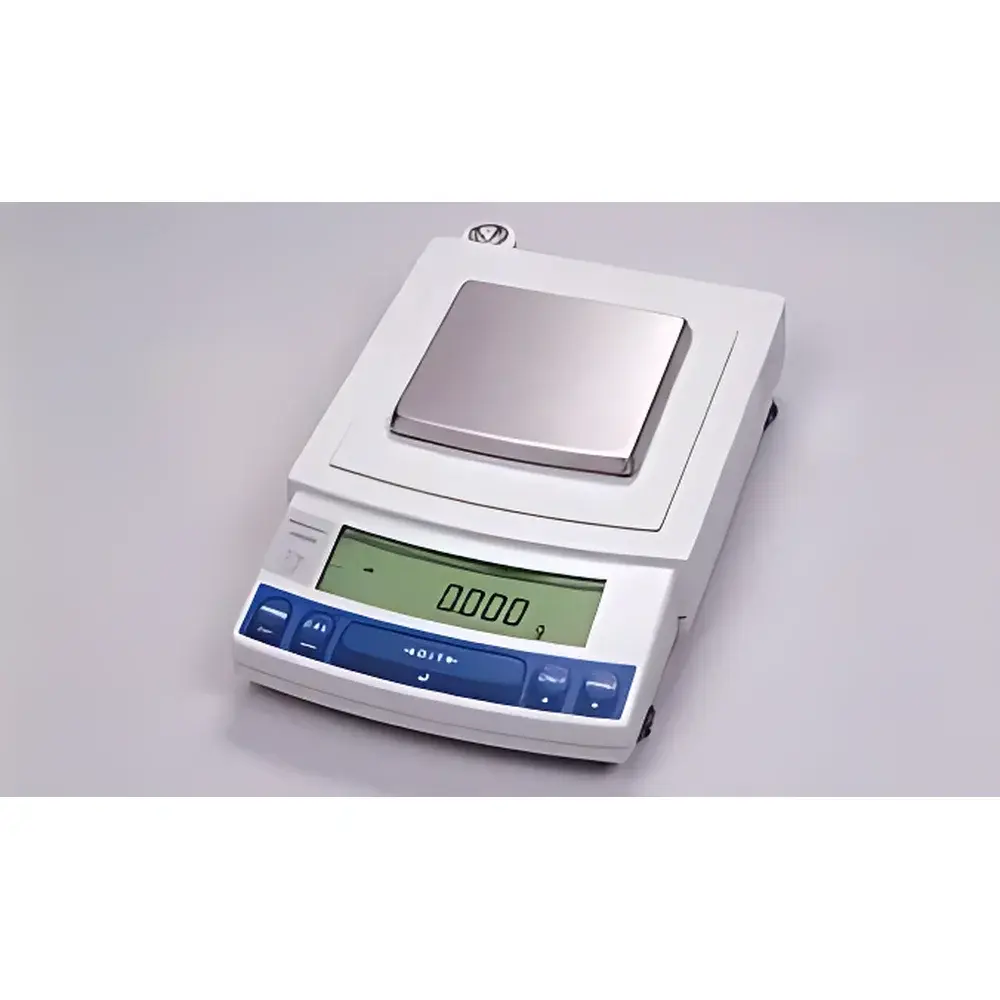
Shimadzu UX Series Electronic Top-Loading Balances
| Brand | Shimadzu |
|---|---|
| Origin | Japan |
| Product Line | UX Series |
| Measurement Principle | Electromagnetic Force Compensation (EMFC) |
| Response Time (UX-S models) | 0.7 s |
| Display Resolution | 0.001 g to 0.1 g |
| Weighing Pan Dimensions | 108 × 105 mm or 170 × 180 mm |
| Power Consumption | ≤12 VA |
| Unit Modes | g, ct, %, pcs, dwt, oz, lb, etc. |
| Compliance | ISO 9001–certified manufacturing |
Overview
The Shimadzu UX Series Electronic Top-Loading Balances are precision laboratory instruments engineered for high-throughput weighing tasks in quality control, research, education, and industrial production environments. Utilizing Shimadzu’s proprietary Uni Bloc electromagnetic force compensation (EMFC) sensor technology, the UX Series delivers exceptional stability, repeatability, and thermal resilience—critical attributes for applications requiring consistent performance across variable ambient conditions. Unlike traditional strain-gauge or load-cell-based platforms, the Uni Bloc monolithic sensor architecture minimizes mechanical hysteresis and eliminates micro-friction points, resulting in rapid stabilization (as fast as 0.7 seconds for UX-S models) and long-term drift suppression. The balance’s internal temperature compensation algorithm actively corrects for thermal expansion effects, enabling reliable measurements with minimal time-dependent deviation—even during extended operation cycles. Designed for regulatory compliance, each unit integrates a real-time clock that automatically embeds date and time stamps into every recorded weight value, satisfying traceability requirements under ISO/IEC 17025, USP , and FDA 21 CFR Part 11 when paired with validated data capture software.
Key Features
- Uni Bloc EMFC sensor platform: High-resolution, low-drift mass measurement with inherent resistance to mechanical shock and vibration.
- Sub-second stabilization: 0.7 s settling time (UX-S models), optimized for rapid sample turnover in QC labs.
- Real-time clock (RTC): Embedded timestamping ensures full audit trail integrity for GLP/GMP workflows.
- DirectView™ interface: Single-cable RS-232C connectivity enables seamless integration with LIMS, Excel, or custom acquisition software—no drivers required.
- Backlit graphical LCD: Clear, high-contrast display with analog-style bar graph for intuitive target alignment during dynamic or tare-heavy operations.
- Multi-unit weighing modes: Supports g, mg, ct (carat), % (percentage), pcs (piece counting), dwt (pennyweight), oz, lb, and others—configurable per application protocol.
- Density determination capability: When used with optional SMK-101 (large pan) or SMK-102 (small pan) density kits, the UX Series functions as a calibrated solid-density analyzer per ASTM D792 and ISO 1183.
- Extended battery operation: Optional rechargeable battery pack (P/N 321-61691-02) supports up to 8 hours of portable use—ideal for field testing or mobile lab deployments.
Sample Compatibility & Compliance
The UX Series accommodates diverse sample geometries and environmental constraints through modular pan configurations (108 × 105 mm and 170 × 180 mm options) and optional draft shields—including WBC-102 (glass) and WBC-502 (large acrylic)—designed to meet ISO 17025 environmental classification requirements for Class II and III weighing. All models comply with international metrological standards including OIML R76 and NIST Handbook 44 for legal-for-trade applications where certified calibration is applied. While the UX Series does not include internal motorized calibration weights, it supports external calibration using Class E2 or better reference masses traceable to national standards (e.g., NMIJ/JCSS in Japan, NIST in the U.S.). Firmware supports user-defined calibration intervals and pass/fail thresholds for preventive maintenance logging.
Software & Data Management
Data export is natively supported via RS-232C using ASCII-based command protocols compatible with industry-standard terminal emulators (e.g., Tera Term, PuTTY) and spreadsheet applications. With the optional EP-80 printer (P/N 321-62675), users generate ISO-compliant hardcopy records containing weight, unit, timestamp, operator ID (via manual entry), and calibration status. For electronic record retention, the DirectView™ interface allows bidirectional communication: real-time streaming to databases or LIMS, automatic file archiving, and CSV/TSV export with configurable delimiters and metadata fields. When integrated with validated third-party software (e.g., LabArchives, Benchling), the UX Series meets ALCOA+ principles—ensuring data is Attributable, Legible, Contemporaneous, Original, Accurate, Complete, Consistent, Enduring, and Available.
Applications
- Pharmaceutical formulation: Precise active ingredient dispensing and blend uniformity checks per USP .
- Materials science: Bulk density, tapped density, and powder flow analysis using optional accessories.
- Jewelry & gemology: Carat-weight verification and piece-counting for inventory management.
- Academic teaching labs: Introductory metrology instruction with visual analog feedback and multi-unit flexibility.
- Food & beverage QA: Net content verification, yield calculation, and recipe scaling.
- Environmental testing: Soil/sediment moisture loss-on-drying (LOD) protocols with tare memory and % mode.
FAQ
Does the UX Series support internal calibration?
No—the UX Series lacks built-in motorized calibration weights. External calibration using traceable standards is required and recommended at defined intervals per ISO/IEC 17025.
Can the balance operate without AC power?
Yes—when equipped with the optional rechargeable battery pack (P/N 321-61691-02), the UX Series functions autonomously for up to 8 hours.
Is density measurement fully automated?
Density determination requires manual input of reference liquid density and sample dimensions; however, the balance automates buoyancy correction calculations per Archimedes’ principle when used with SMK-101/102 kits.
What is the maximum permissible error (MPE) for UX models?
MPE values follow OIML R76 Class II specifications and vary by model capacity and readability—detailed tolerances are provided in the calibration certificate supplied with each unit.
How is firmware updated?
Firmware upgrades are performed via RS-232C using Shimadzu-provided utility software; no internet connection is required on the balance itself.