
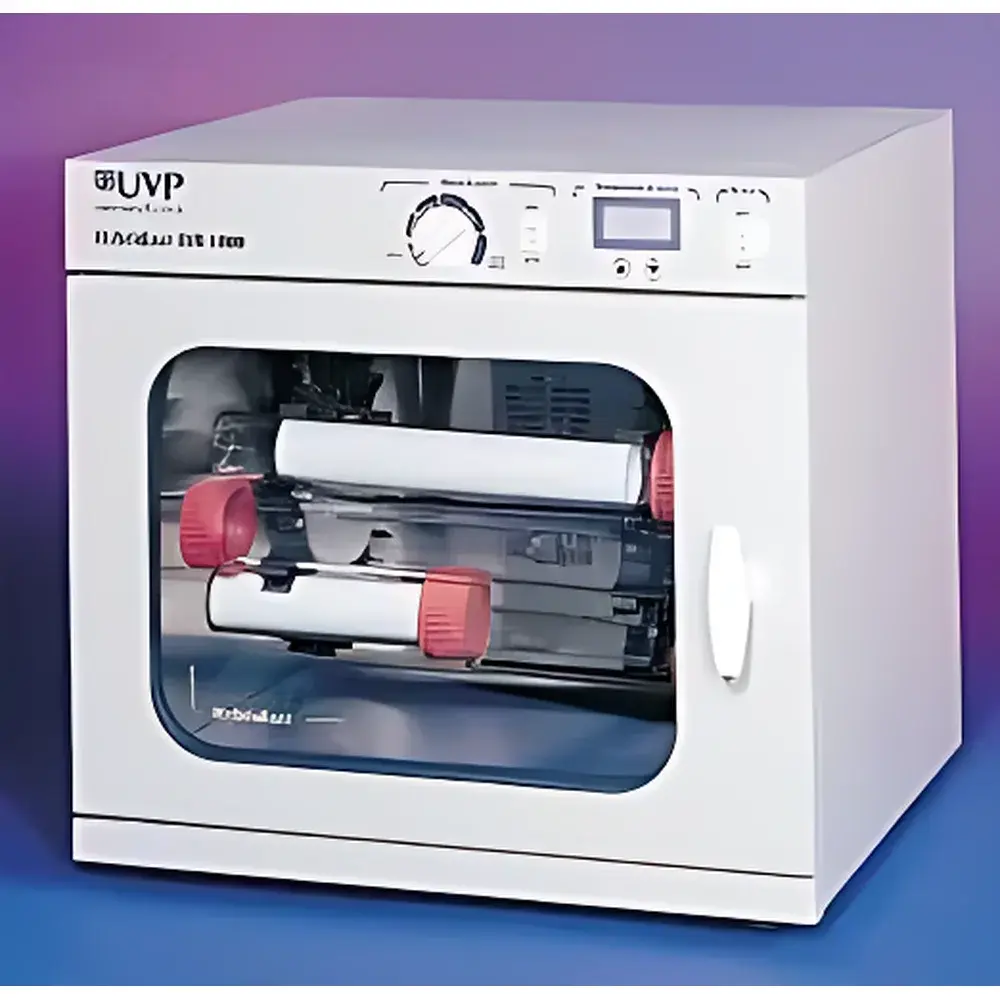
UVP HB-1000 Economical Molecular Hybridization Oven
| Brand | UVP |
|---|---|
| Origin | USA |
| Model | HB-1000 |
| Instrument Type | Nucleic Acid Hybridization Oven |
| Temperature Range | Ambient to 99.9°C |
| Temperature Control Accuracy | ±0.1°C |
| Temperature Uniformity | ±0.3°C (chamber), ±0.1°C (within tube) |
| Rotation Speed | 10–15 rpm |
| Power Consumption | 1250 W |
| Capacity | 20 × 35×150 mm tubes or 10 × 35×300 mm tubes |
| Dimensions (W×H×D) | 445×406×381 mm |
| Net Weight | 19.5 kg |
| Standard Configuration | Main unit + one 35×300 mm hybridization tube |
Overview
The UVP HB-1000 Economical Molecular Hybridization Oven is a benchtop incubation system engineered for reproducible, low-to-moderate throughput nucleic acid hybridization workflows. It operates on the principle of controlled thermal convection combined with gentle orbital rotation—ensuring uniform heat transfer and consistent reagent mixing across multiple samples simultaneously. Unlike static hybridization ovens or water baths, the HB-1000 eliminates thermal gradients and minimizes evaporation through its sealed chamber architecture and precise PID temperature regulation. Designed for laboratories performing Southern/Northern blotting, DNA/RNA probe hybridizations, and post-PCR detection assays, it delivers ISO/IEC 17025-aligned thermal stability without requiring external cooling or complex calibration routines.
Key Features
- Microprocessor-controlled temperature regulation with ±0.1°C setpoint accuracy and real-time LED display for immediate verification
- Uniform thermal distribution: ±0.3°C across the chamber interior and ±0.1°C within individual hybridization tubes—validated per ASTM E2251-22 for laboratory oven performance
- Gentle rotational agitation at selectable speeds (10–15 rpm) to prevent membrane drying while promoting probe-target binding kinetics
- Modular tube support system accommodating either twenty 35×150 mm or ten 35×300 mm hybridization tubes—compatible with standard glass or polypropylene formats
- Optional swing-platform accessory enables rocking motion (±5° amplitude) for applications requiring directional fluid movement, such as in situ hybridization or antibody-based detection steps
- Robust stainless-steel chamber construction with insulated double-wall housing, minimizing external heat emission and energy consumption (1250 W max)
Sample Compatibility & Compliance
The HB-1000 supports a wide range of nucleic acid hybridization formats including nylon and nitrocellulose membranes, microarray slides, and solution-phase hybridization in sealed tubes. Its chamber geometry and airflow design conform to CLSI EP23-A guidelines for incubator uniformity assessment. All operational parameters—including time, temperature, and rotation status—are manually logged per GLP requirements. While the instrument does not include built-in electronic audit trails or 21 CFR Part 11 compliance features, its analog control interface and stable thermal profile make it suitable for QC/QA environments where procedural documentation is maintained externally. The device meets UL 61010-1 and IEC 61010-1 safety standards for laboratory electrical equipment.
Software & Data Management
The HB-1000 operates via an embedded analog/digital hybrid controller with no onboard software, firmware, or network connectivity. This architecture ensures deterministic operation—eliminating boot delays, firmware version conflicts, or cybersecurity vulnerabilities common in connected instruments. All settings are entered directly via front-panel rotary encoder and confirmed visually on the high-contrast LED display. For labs requiring traceable parameter recording, users may integrate external data loggers (e.g., Omega OM-DAQPRO-5300) via the optional analog output port (0–5 V DC proportional to chamber temperature). Method protocols—including ramp rates, dwell times, and rotation schedules—are documented in SOPs rather than stored digitally, supporting paper-based or LIMS-integrated quality systems.
Applications
- High-fidelity DNA-DNA and DNA-RNA hybridization in Southern and Northern blotting workflows
- Pre-hybridization blocking and stringent post-hybridization washes under controlled thermal conditions
- Non-radioactive probe detection using chemiluminescent or colorimetric substrates
- Low-cost alternative to robotic hybridization stations for academic core facilities and teaching laboratories
- Validation studies requiring repeatable thermal profiles across multiple replicates (e.g., ISO 13485-compliant assay development)
FAQ
Does the HB-1000 support programmable multi-step temperature ramps?
No—the HB-1000 features single-setpoint temperature control only. Multi-stage protocols must be executed manually by adjusting the setpoint between stages.
Can I use non-UVP hybridization tubes?
Yes—any 35 mm diameter tube up to 300 mm in length is mechanically compatible; however, thermal response validation is recommended when substituting materials (e.g., borosilicate vs. polypropylene).
Is the chamber accessible during operation?
The door latch includes a safety interlock that suspends rotation and reduces heating power upon opening, but full access requires manual shutdown per ANSI Z215.1-2021 lab equipment safety practice.
What maintenance is required?
Annual verification of temperature uniformity using NIST-traceable calibrated probes is recommended; no routine lubrication or filter replacement is specified.
Does UVP provide IQ/OQ documentation?
UVP supplies factory test reports and dimensional specifications; site-specific IQ/OQ protocols must be developed by the end user per GAMP 5 guidance.
Related Products




