
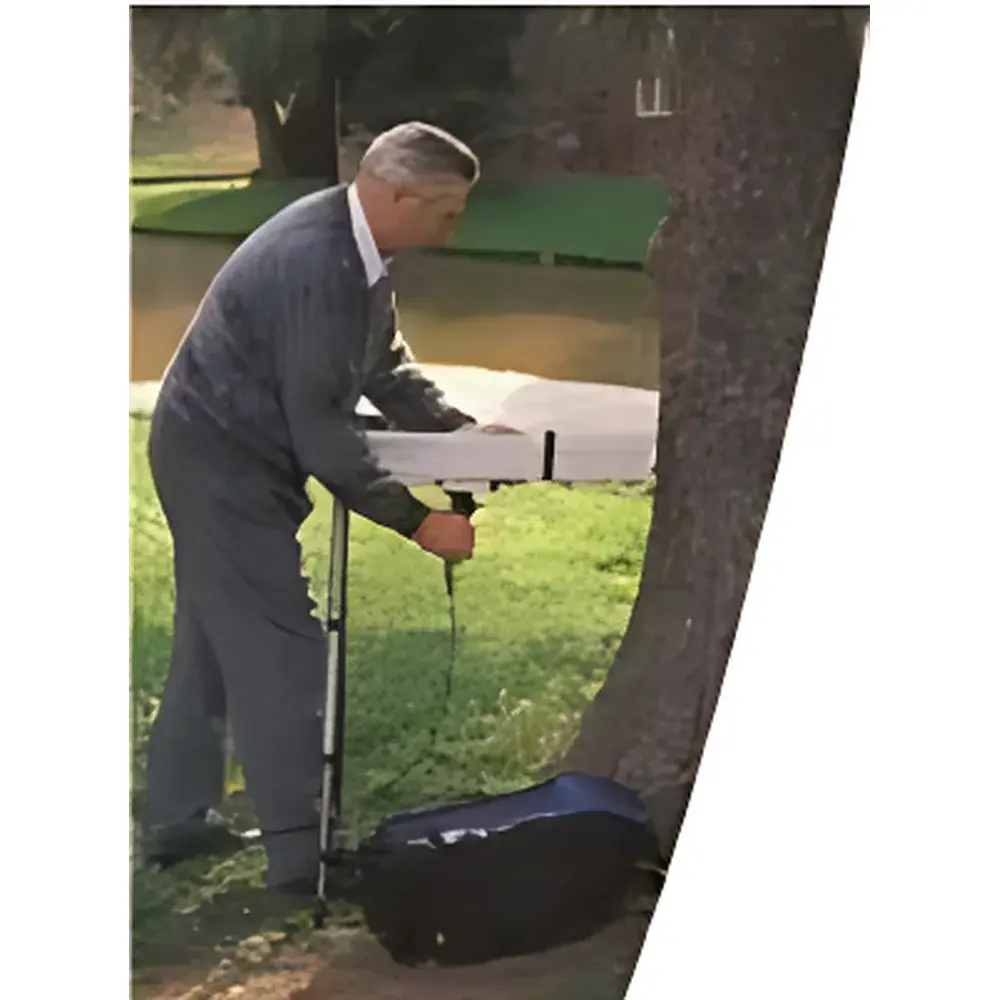
B-Series High-Precision Tree Micro-Drill Resistograph
| Origin | Germany |
|---|---|
| Manufacturer Type | Authorized Distributor |
| Origin Category | Imported |
| Model | B-Series High-Precision Tree Micro-Drill Resistograph |
| Pricing | Upon Request |
| Detection Depth | 300 / 400 / 1000 mm |
| Penetration Speed | 6–50 cm/min |
| Resolution | 0.04 mm |
| Data Storage Capacity | 256 kB (≈8 m) / 512 kB (≈18 m) / 1 MB (≈38 m) |
| Drill Needle Lifetime | ~200 insertions |
| Power Supply | 36 V NiCd rechargeable battery |
| Charger Input | 110–220 V AC |
| Operating Temperature | 0–50 °C |
Overview
The B-Series High-Precision Tree Micro-Drill Resistograph is a non-destructive, resistance-based dendrological diagnostic instrument engineered for in-situ assessment of woody tissue integrity. It operates on the principle of micro-drilling resistography: a calibrated, ultra-fine tungsten carbide needle (diameter ≤ 3 mm) is advanced into the trunk or branch at a precisely controlled linear speed, while continuously measuring real-time mechanical resistance—primarily reflecting local wood density, moisture content, decay-induced softening, and structural anomalies such as cavities or fungal degradation zones. The resulting resistance profile is a high-resolution (0.04 mm) depth-resolved trace that correlates directly with anatomical features—including annual ring boundaries, reaction wood formation, and decay gradients. Unlike ultrasonic or radar-based methods, resistography provides direct mechanical feedback tied to cell wall integrity, making it especially valuable for arboricultural risk assessment, historic timber evaluation, and dendrochronological sampling where minimal intervention is mandated.
Key Features
- Sub-millimeter axial resolution (0.04 mm) enables reliable detection of individual growth rings—even in dense hardwoods—and precise localization of decay interfaces.
- Motorized, variable-speed penetration (6–50 cm/min) ensures optimal force modulation across species with differing density profiles (e.g., low-density conifers vs. high-density oaks), minimizing needle deflection and measurement artifacts.
- Integrated thermal line printer delivers immediate, tamper-evident analog output on continuous paper tape—critical for field audits, regulatory documentation, and GLP-compliant reporting where digital storage may be unavailable or restricted.
- Self-retracting drill mechanism automatically withdraws the needle while simultaneously backfilling the borehole with displaced wood fibers, reducing wound surface area by >90% compared to conventional coring tools and supporting rapid callus formation.
- Modular hardware architecture includes interchangeable depth modules (300/400/1000 mm), hot-swappable NiCd battery packs, and ruggedized aluminum housing rated IP54 for outdoor use in rain, dust, and temperature extremes (0–50 °C).
Sample Compatibility & Compliance
The B-Series Resistograph is validated for use on standing trees, felled logs, structural timbers, and heritage wooden artifacts. It accommodates diameters from 15 cm to >200 cm via adjustable tripod mounting with telescopic legs and dual-axis leveling. All probe materials comply with EN 16027:2011 (Determination of wood density by micro-drilling resistance) and support methodologies referenced in ISO 11268-2 (Soil quality — Effects of pollutants on earthworms — Part 2: Determination of effects on reproduction) for root zone integrity mapping. Data acquisition workflows are compatible with ISO/IEC 17025:2017 laboratory accreditation requirements when paired with B-Tools Pro software’s audit trail and electronic signature functionality.
Software & Data Management
Raw resistance profiles are exported via USB or RS-232 to Windows-based B-Tools or B-Tools Pro software. B-Tools Pro implements FDA 21 CFR Part 11–compliant features including user role management, immutable data logging, timestamped operator authentication, and version-controlled report generation. Algorithms include automatic ring boundary detection (based on first-derivative thresholding), cross-dating alignment (COFECHA-compatible), decay severity indexing (DSI), and spatial overlay with GIS coordinates when used with optional GNSS module. Export formats include CSV, PDF/A-2b, and XML for integration into LIMS or municipal tree asset management systems.
Applications
- Arboricultural hazard assessment per ISA A300 (Part 3) standards for internal decay detection prior to pruning or removal decisions.
- Dendroarchaeological analysis of historic timber framing, shipwrecks, and museum artifacts—enabling minimally invasive dating without sample removal.
- Forestry research on climate-driven growth anomalies, drought stress response, and pathogen progression (e.g., Fomes fomentarius, Ganoderma adspersum) in urban and peri-urban stands.
- Quality control in veneer and laminated timber production—verifying core integrity before lamination or machining.
- Long-term monitoring of veteran trees under EU Habitats Directive (92/43/EEC) conservation programs.
FAQ
How does resistographic resolution translate to dendrochronological accuracy?
A 0.04 mm resolution corresponds to ~1–3 cells in most temperate hardwoods, permitting unambiguous identification of latewood/earlywood transitions and intra-annual density fluctuations—sufficient for cross-dating at regional scale when combined with statistical validation (e.g., Gleichläufigkeit ≥ 75%).
Can the system distinguish between heart rot and sapwood desiccation?
Yes: heart rot typically exhibits a sustained, low-resistance plateau (<20% of sound wood baseline) over multiple centimeters, whereas desiccation shows a gradual, linear decline correlated with radial moisture gradient—differentiable via second-derivative analysis in B-Tools Pro.
Is calibration required between measurements?
No routine recalibration is needed; factory calibration is traceable to PTB (Physikalisch-Technische Bundesanstalt) standards. However, daily verification using the included reference wood block (certified density ±0.02 g/cm³) is recommended per ISO/IEC 17025 clause 7.7.
What maintenance is required for the drill needle?
Needles are consumables rated for ~200 insertions in medium-density wood (e.g., Fagus sylvatica). Dullness is indicated by increased torque variance (>15% coefficient of variation); replacement is tool-free and takes <60 seconds.
Does the system meet GDPR or HIPAA data handling requirements?
Data files contain no personally identifiable information (PII). When deployed on institutional networks, B-Tools Pro supports AES-256 encryption, anonymized export modes, and configurable data retention policies aligned with GDPR Article 5 and HIPAA §164.306.
Related Products





