
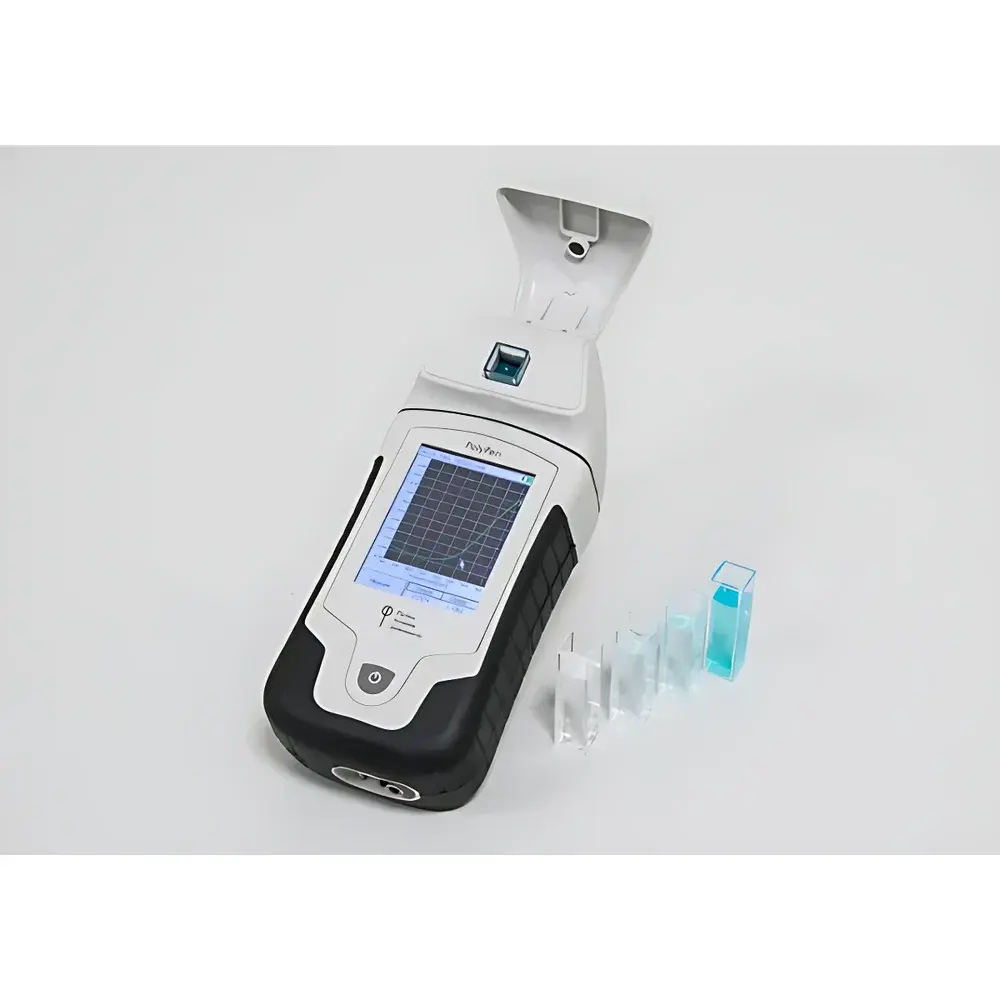
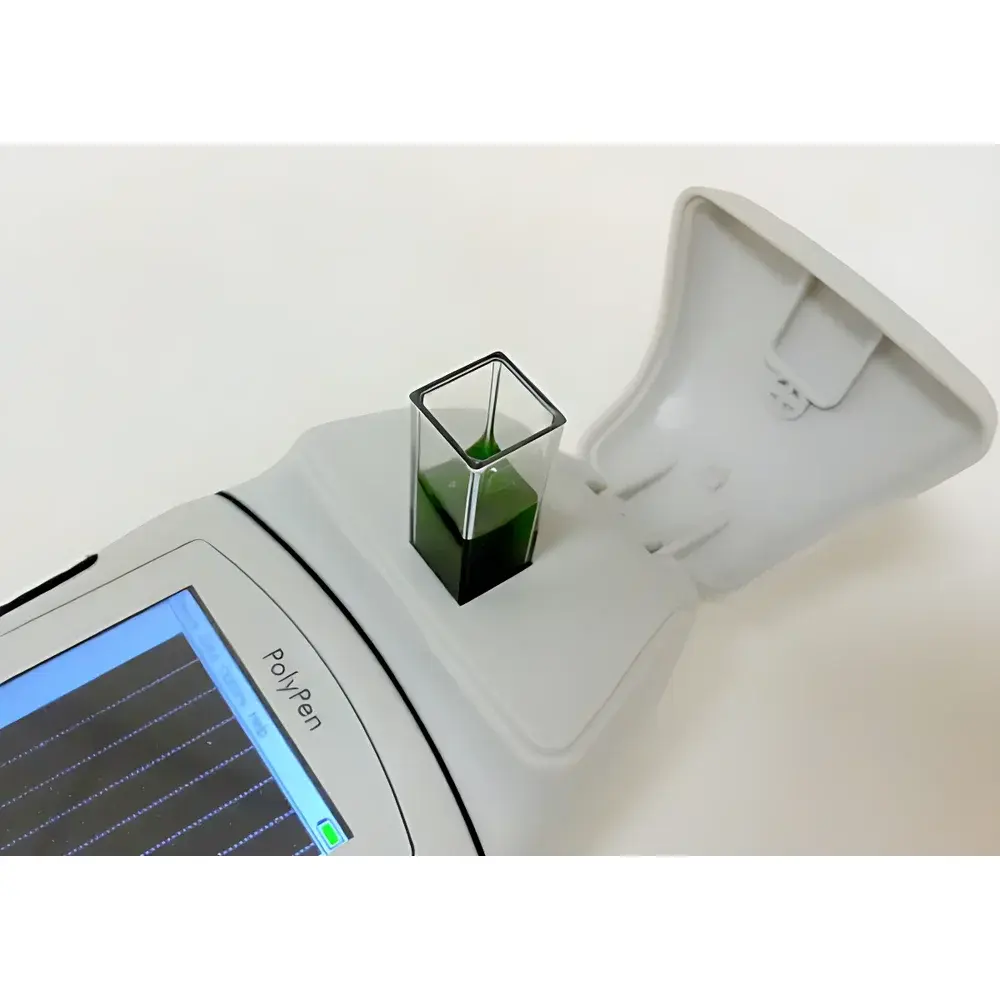
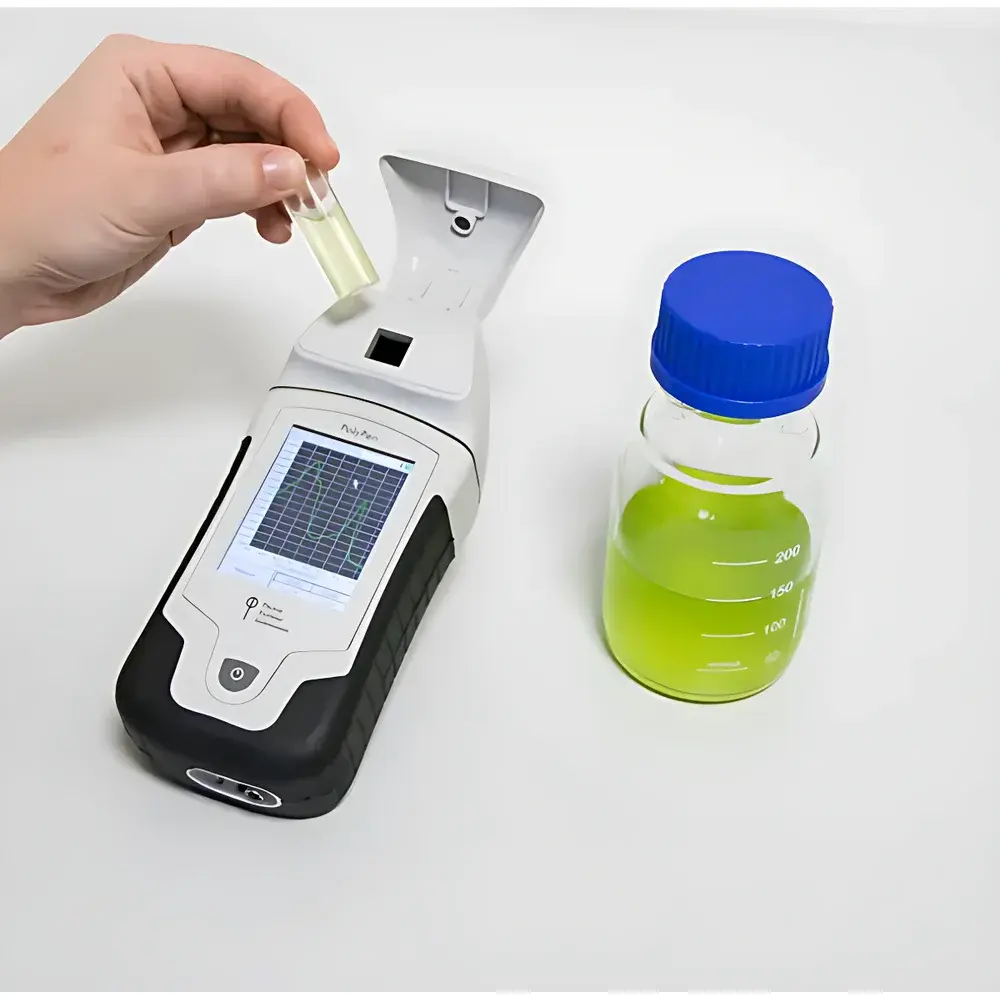
PolyPen Aqua PA210 Handheld Solution & Suspension Spectrophotometer
| Brand | PSI (Czech Republic) |
|---|---|
| Origin | Czech Republic |
| Model | PolyPen Aqua PA210 |
| Spectral Range (UVIS) | 380–790 nm |
| Spectral Range (NIR) | 640–1050 nm |
| Optical Resolution (FWHM) | 8 nm |
| Stray Light | −30 dB |
| Optical Aperture | 7 mm |
| Measurement Chamber Volume | 4 mL |
| Light Source | Pulsed Xenon Lamp |
| OD Wavelengths (UVIS) | 600, 680, 735, 750 nm |
| OD Wavelengths (NIR) | 680, 735, 750 nm |
| Display | 240 × 320 px TFT touchscreen (65,535 colors) |
| Onboard Memory | 16 MB (≥4,000 spectra) |
| ADC | 16-bit |
| Dynamic Range | 1:4,300 (high gain), 1:13,000 (low gain) |
| Scan Time | ~100 ms per spectrum |
| GPS Accuracy | <1.5 m (CE-certified module) |
| Dimensions | 150 × 75 × 40 mm |
| Weight | 300 g |
| Enclosure | IP54-rated splash-resistant housing |
| Battery | Rechargeable 2600 mAh Li-ion (USB charging) |
| Operating Time | Up to 48 h continuous measurement |
| Operating Temp. | 0–55 °C |
| Storage Temp. | −10–60 °C |
| Relative Humidity | 0–95% RH (non-condensing) |
Overview
The PolyPen Aqua PA210 Handheld Solution & Suspension Spectrophotometer is a field-deployable, high-fidelity spectral measurement system engineered for quantitative and qualitative optical characterization of liquid-phase samples—including aqueous solutions, microbial suspensions, cell cultures, and colloidal dispersions. Unlike conventional benchtop spectrophotometers, the PA210 integrates a pulsed xenon broadband light source, precision optics, and a thermally stabilized linear CCD array detector into a compact, battery-powered form factor. Its core measurement principle relies on single-beam transmittance spectroscopy with real-time reference compensation, enabling accurate absorbance (A = log10(I0/I)) and transmittance (T = I/I0) calculations across its full spectral range. The instrument operates in two interchangeable optical configurations: UVIS (380–790 nm) and NIR (640–1050 nm), each optimized for distinct biochemical targets—chlorophyll-a, phycocyanin, carotenoids, cytochromes, and NAD(P)H in the UVIS band; and phycoerythrin, water absorption features, and secondary metabolites in the NIR band. Designed for reproducibility under variable ambient conditions, the PA210 employs internal dark-current correction, wavelength calibration via onboard spectral reference, and automatic gain switching to maintain linearity across optical densities from 0.05 to 3.5.
Key Features
- Integrated pulsed xenon lamp providing stable, flash-based illumination with minimal thermal drift—ideal for repeated measurements without sample heating
- Dual-spectral-mode capability: Interchangeable UVIS (380–790 nm) and NIR (640–1050 nm) optical heads, each with 8 nm FWHM resolution and −30 dB stray light rejection
- Self-contained operation: 240 × 320 px color touchscreen, 16 MB non-volatile memory (≥4,000 full spectra), and 2600 mAh Li-ion battery supporting up to 48 h of continuous field use
- Onboard calculation engine delivering real-time absorbance/transmittance spectra, optical density (OD) at user-selectable wavelengths (including 600, 680, 735, and 750 nm), and derived parameters such as specific growth rate estimates and pigment ratios
- IP54-rated enclosure with sealed optical path and splash-resistant front panel—certified for outdoor deployment in humid, dusty, or variable-temperature environments (0–55 °C operating range)
- Built-in CE-compliant GPS module (<1.5 m horizontal accuracy) for geotagging spectral acquisitions—critical for ecological transects, limnological profiling, and longitudinal monitoring studies
Sample Compatibility & Compliance
The PA210 accommodates standard 4 mL cuvettes (10 mm pathlength) and supports direct insertion of low-turbidity suspensions, clarified extracts, and filtered culture broths. It is routinely validated for use with cyanobacterial and microalgal cultures (e.g., Synechocystis, Chlamydomonas), yeast fermentations (Saccharomyces cerevisiae), bacterial growth assays (E. coli, Bacillus subtilis), and protein solutions (BSA, lysozyme). All firmware and data logging routines comply with GLP-aligned traceability requirements: each spectrum carries timestamp, GPS coordinates, instrument serial number, calibration ID, and operator-defined metadata tags. Raw spectral data are stored in open-format ASCII (.txt) and CSV files, ensuring compatibility with third-party analysis platforms (e.g., MATLAB, R, Python SciPy) and regulatory workflows requiring audit-ready records. While not FDA 21 CFR Part 11–certified out-of-the-box, the PA210’s immutable data structure, checksummed storage, and USB export protocol support integration into validated laboratory information management systems (LIMS) under ISO/IEC 17025 or ASTM E2500 frameworks.
Software & Data Management
No external PC is required for acquisition or visualization: all operations—including parameter setup, spectral preview, OD selection, and report generation—are executed via the integrated touchscreen interface. Upon USB connection, the device mounts as a mass-storage class drive, enabling drag-and-drop transfer of timestamped spectral datasets. PSI provides the free PolyPen Control Suite (Windows/macOS/Linux), which imports native .ppd files and supports batch processing, spectral normalization (e.g., vector normalization, baseline correction), derivative spectroscopy, and multivariate regression (PLS, PCA) for pigment quantification. Export formats include PNG, SVG, CSV, and Excel-compatible XLSX. Firmware updates are delivered via signed .bin packages with SHA-256 verification, and all configuration changes are logged in a tamper-evident system journal accessible through the software.
Applications
- Microbial Growth Kinetics: Real-time tracking of OD600 and OD680 in photobioreactors and shake flasks; differentiation of chlorophyll- vs. phycobiliprotein-dominant strains via spectral deconvolution
- Aquatic Ecology: In situ assessment of phytoplankton community composition in lakes, reservoirs, and estuaries using diagnostic absorption peaks (e.g., 435 nm for diatoms, 620 nm for cryptophytes)
- Bioprocess Monitoring: Non-destructive sampling of fermentation broths to estimate viable cell density, metabolic state (NADH/NAD+ ratio), and product accumulation (e.g., recombinant protein expression)
- Pigment Biochemistry: Quantification of chlorophylls, carotenoids, and phycobilins in plant extracts and algal biomass—aligned with ASTM D6886 and ISO 10260 methodologies
- Environmental Forensics: Detection of dissolved organic matter (DOM) spectral slope (S275–295) and humification index (HIX) for watershed source tracking
FAQ
Does the PolyPen Aqua PA210 require external calibration standards for routine use?
No—each unit ships with factory-applied wavelength and intensity calibration coefficients embedded in firmware. A user-performed dark scan (cap-covered) and air-reference scan (open beam) are sufficient for daily operation.
Can the instrument measure turbid suspensions without centrifugation?
Yes—the 7 mm optical aperture and high dynamic range (1:13,000) enable reliable transmission measurements up to OD600 ≈ 2.8 in moderately turbid cultures; for OD > 3.0, dilution is recommended to remain within Beer-Lambert linear range.
Is spectral data export compatible with LIMS integration?
Yes—CSV exports contain header metadata (timestamp, GPS, OD values, spectral vectors) and conform to ASTM E1382-22 data interchange conventions for analytical instrumentation.
What is the warranty and service coverage for field-deployed units?
PSI provides a 24-month limited warranty covering parts and labor; extended calibration validation services (including NIST-traceable lamp and detector verification) are available annually through authorized service centers in EEA, North America, and APAC regions.





