
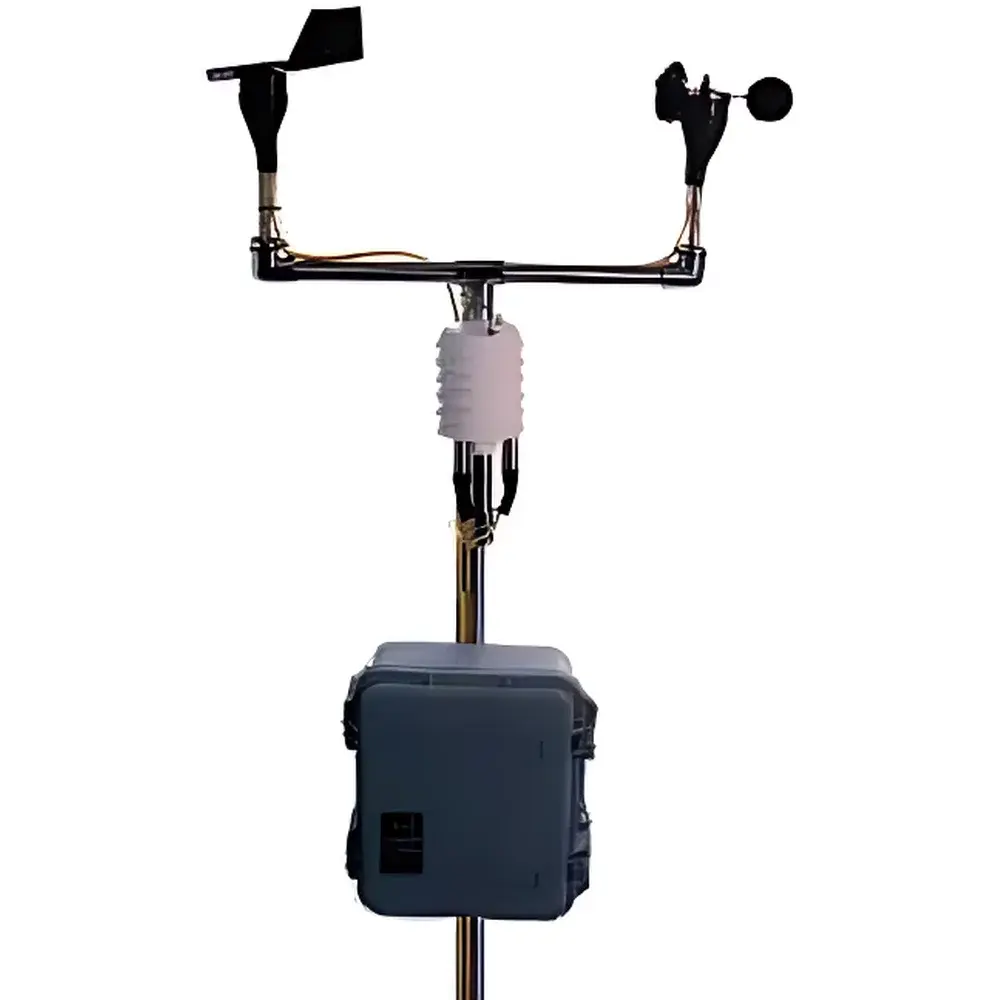
GW WE800 Portable Weather Station
| [Brand | GW |
|---|---|
| Origin | USA |
| Model | WE800 Portable Weather Station |
| Wind Speed Range | 0–50 m/s |
| Wind Speed Accuracy | ±0.09 m/s |
| Wind Direction Range | 0–360° |
| Wind Direction Accuracy | ±1% of full scale |
| Temperature Range | −50 to +50 °C |
| Temperature Accuracy | ±0.1 °C |
| Relative Humidity Range | 0–100 %RH |
| RH Accuracy | ±2 %RH |
| Data Logger | 7-channel analog (4–20 mA, optional 0–5 VDC), 2-channel pulse input (≤24 VDC / 100 Hz), sampling up to 10 Hz, 40,879-record internal memory |
| Power Supply | 12 VDC / 2 Ah rechargeable battery (optional solar panel support) |
| Enclosure Rating | IP67-equivalent sealed electronics |
| Operating Environment | −40 to +55 °C, 0–100 %RH |
| Communication | RS-232 standard |
Overview
The GW WE800 Portable Weather Station is a field-deployable, self-contained environmental monitoring system engineered for high-reliability meteorological data acquisition in remote, unattended, or mobile applications. Built on a modular architecture, it integrates calibrated industrial-grade sensors—including cup anemometer, vane-type wind direction sensor, platinum RTD temperature probe, capacitive relative humidity sensor, and optional add-ons such as barometric pressure transducers, pyranometers, tipping-bucket rain gauges, and soil moisture probes—into a single synchronized data logging platform. Its measurement methodology adheres to widely accepted physical principles: wind speed via rotational cup dynamics calibrated per IEC 61400-12-1; temperature and humidity via traceable NIST-traceable RTD and capacitive sensing elements; solar radiation via thermopile-based broadband detection (when equipped); and precipitation via mechanical tipping-bucket actuation with pulse counting. Designed for long-term autonomy, the station operates continuously for months on its internal 12 VDC / 2 Ah rechargeable battery, with optional photovoltaic charging enabling multi-year deployment in off-grid locations.
Key Features
- Industrial-grade sensor suite with factory calibration certificates traceable to NIST standards
- IP67-level sealed electronics enclosure meeting MIL-STD-810G environmental ruggedness requirements for marine, desert, and arctic deployments
- High-resolution data acquisition: 10 Hz sampling rate, programmable sampling modes (fixed interval, logarithmic, exception-triggered, and burst)
- Expandable analog and pulse input architecture supporting up to 7 analog channels (4–20 mA default, configurable for 0–5 VDC) and 2 high-speed pulse inputs (≤100 Hz, ≥2 ms pulse width)
- Onboard non-volatile memory storing up to 40,879 timestamped records with real-time clock synchronization
- Flexible power architecture: integrated rechargeable battery with smart charge management; optional solar panel integration compliant with IEEE 1547 interconnection guidelines
- Modular mounting system featuring 1-inch stainless steel mast (1.8 m height), 0.9 m cross-arm, and corrosion-resistant hardware suitable for rapid installation on tripods, poles, or vehicle mounts
Sample Compatibility & Compliance
The WE800 is compatible with a broad range of environmental sensor types beyond its standard configuration—including differential pressure-based barometers (e.g., Honeywell ABP series), silicon photodiode or thermopile pyranometers (ISO 9060:2018 Class C or better), heated tipping-bucket rain gauges (WMO No. 8 guide compliant), leaf-wetness sensors (capacitive or resistive), and EC/TDR soil moisture probes. All sensor interfaces comply with standard 4–20 mA current loop signaling (IEC 61000-4-5 surge immunity) and pulse output protocols used in hydrological and agrometeorological networks. The system supports audit-ready data integrity through time-stamped logging, firmware version tracking, and sensor-specific calibration metadata storage—facilitating compliance with ISO/IEC 17025 laboratory accreditation requirements and GLP-aligned field data collection workflows.
Software & Data Management
GW’s proprietary WE-Log software provides full local configuration, real-time telemetry visualization, and post-processing capabilities. It supports dual-unit engineering conversions (e.g., m/s ↔ mph, hPa ↔ inHg), user-defined site identifiers, multi-sensor linearization and offset calibration, and automated report generation in CSV, Excel, and PDF formats. Data export includes UTC timestamps, sensor status flags, and diagnostic codes for quality assurance. For networked operation, optional telemetry modules enable secure data transmission via cellular LTE-M/NB-IoT, LoRaWAN gateways, or Iridium Short Burst Data (SBD) satellite links—each supporting TLS 1.2 encryption and configurable retry logic. Firmware updates are delivered over-the-air (OTA) with SHA-256 signature verification, ensuring traceability and cybersecurity alignment with NIST SP 800-193 guidelines.
Applications
- Agricultural microclimate monitoring for irrigation scheduling, frost prediction, and pest modeling (aligned with FAO CropWat and USDA-ARS protocols)
- Environmental impact assessment (EIA) and baseline studies for renewable energy projects, landfill gas monitoring, and wastewater treatment facilities
- Hydrological research including evapotranspiration estimation (Penman-Monteith), snowmelt runoff modeling, and watershed-scale water balance analysis
- Educational field labs in atmospheric science, geography, and environmental engineering curricula
- Disaster response and temporary climate observation during wildfire, flood, or hurricane events (FEMA P-361 and NOAA NWS emergency deployment standards)
- Long-term ecological research (LTER) sites requiring low-maintenance, solar-powered instrumentation with minimal site footprint
FAQ
What is the maximum recommended deployment duration without maintenance?
Typical field deployment exceeds six months on battery alone; with a properly sized solar panel (≥10 W, 12 V nominal) and clear-sky exposure, operational life extends to 24+ months without manual intervention.
Can the WE800 meet regulatory reporting requirements for air quality or weather service submissions?
While not certified as a primary WMO reference station, its sensor accuracy and data traceability support supplementary reporting under EPA Method TO-15, ASTM D5197, and national meteorological agency secondary network guidelines when deployed with appropriate QA/QC protocols.
Is firmware upgrade supported remotely?
Yes—via RS-232, USB, or OTA through compatible telemetry modules, with full rollback capability and cryptographic signature validation.
Does the system support MODBUS or SDI-12 communication protocols?
MODBUS RTU over RS-485 is available as a custom firmware option; SDI-12 is not natively supported but can be interfaced via third-party protocol converters with analog/pulse passthrough.
How is sensor calibration maintained over time?
Each sensor ships with individual calibration certificate; field recalibration is performed using GW’s portable reference standards or via return-to-factory service—calibration intervals follow ISO/IEC 17025 recommended practices (typically annually for critical parameters).







