
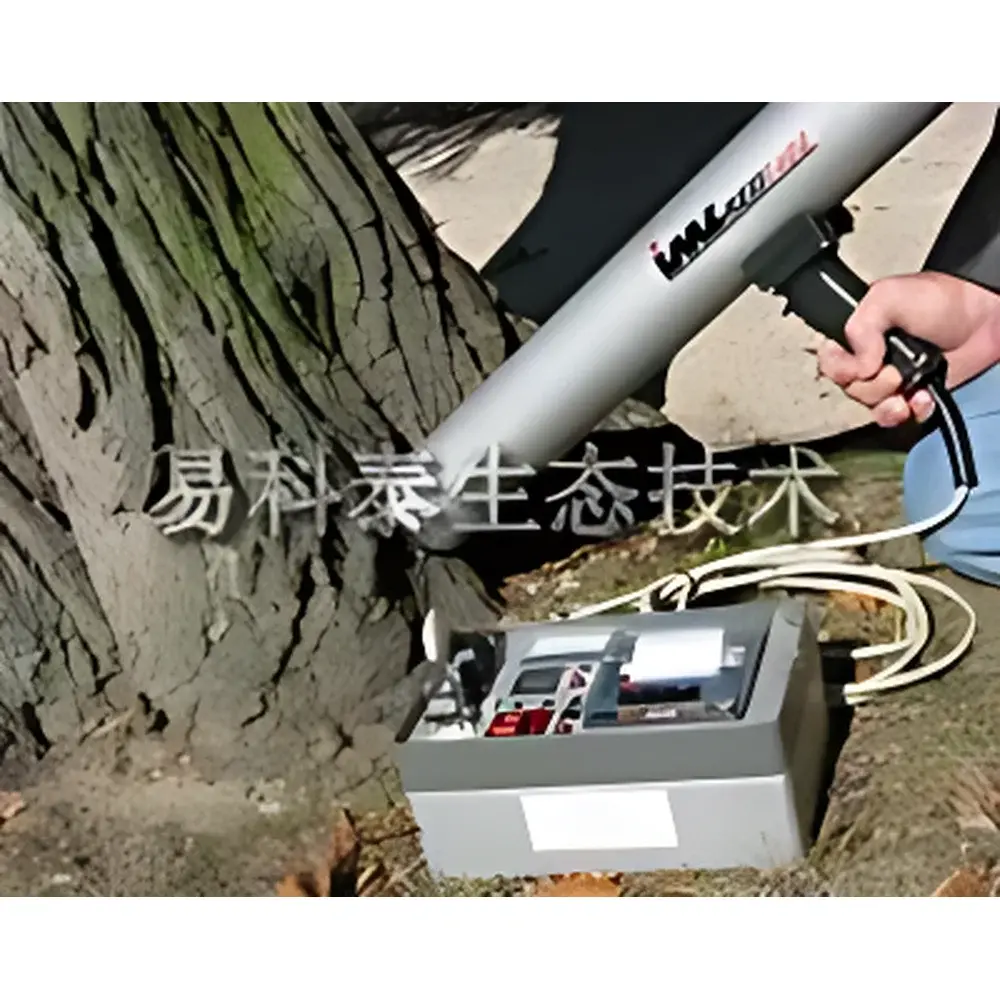
Resistograph® E-Series Field-Portable Tree Diagnostic Drill Probe
| Origin | Germany |
|---|---|
| Manufacturer Type | Authorized Distributor |
| Origin Category | Imported |
| Model | E-Series Field-Portable Tree Diagnostic Drill Probe |
| Pricing | Available Upon Request |
| Penetration Depth | 300/400 mm |
| Penetration Speed | 10–45 cm/min |
| Spatial Resolution | 0.1 mm |
| Data Storage Capacity | 256 KB (~20 m), 512 KB (~40 m), or 1 MB (~90 m) |
| Probe Lifetime | 200–300 insertions in softwood, 50–100 in hardwood |
| Data Output | Real-time thermal strip printing + USB download to PC |
| Charger Input | 110 V / 220 V AC |
| Battery | 7.2 V, 1.7 Ah / 2.0 Ah NiCd |
| Operating Temperature | 0–50 °C |
Overview
The Resistograph® E-Series Field-Portable Tree Diagnostic Drill Probe is an electromechanical resistance drilling instrument engineered for non-destructive assessment of woody tissue integrity in situ. It operates on the principle of measuring real-time mechanical resistance encountered by a standardized 3 mm diameter micro-drill probe as it advances axially into trunk or log material at a controlled, programmable speed. Variations in torque and feed force—converted to electrical impedance signals—are digitized at 0.1 mm spatial resolution and correlated with anatomical features including decay zones, cavities, reaction wood, density gradients, and annual growth ring boundaries. Unlike destructive coring or imaging modalities (e.g., X-ray CT or ground-penetrating radar), the E-Series delivers quantitative, depth-resolved resistance profiles with minimal tissue disruption—probe withdrawal simultaneously reinserts displaced xylem fibers, preserving structural integrity and physiological continuity. Designed for arborists, forest health specialists, urban forestry departments, and timber quality inspectors, the system enables rapid, repeatable, and field-deployable diagnostics compliant with ISO 15685:2017 (Wood — Determination of density and moisture content by resistographic methods) and aligned with ASTM D143 and EN 384 sampling protocols.
Key Features
- Field-rugged, battery-powered architecture with integrated thermal strip printer—generates 1:1 scale analog resistance curves during probe advancement, enabling immediate visual interpretation without post-processing.
- Three selectable memory configurations (256 KB, 512 KB, 1 MB) support extended profiling up to 90 meters per session, accommodating multi-trunk assessments or longitudinal log scans.
- Programmable penetration speed (10–45 cm/min) ensures optimal signal-to-noise ratio across species ranging from balsa (<300 kg/m³) to tropical hardwoods (>1,100 kg/m³).
- Ergonomic hand-held drill unit with integrated cable management and tactile feedback controls minimizes operator fatigue during prolonged surveys.
- Probe life monitoring algorithm tracks cumulative insertion cycles and alerts users prior to performance degradation—critical for maintaining measurement consistency across large-scale inventories.
- NiCd battery pack (7.2 V, 1.7/2.0 Ah) supports ≥8 hours of continuous operation under typical field conditions; dual-voltage charger (110/220 V AC) facilitates global deployment.
Sample Compatibility & Compliance
The E-Series is validated for use on standing trees (diameter at breast height ≥15 cm), felled logs, structural timbers, and historic wooden artifacts. It accommodates variable bark thicknesses and surface irregularities via self-centering probe guidance. All measurements adhere to GLP-aligned data capture standards: each printed strip includes timestamp, probe ID, operator code, location metadata (manually entered), and calibration reference markers. Digital files exported via USB retain full audit trail integrity—including raw impedance values, speed profile logs, and battery voltage history—supporting compliance with ISO/IEC 17025:2017 requirements for testing laboratories and enabling traceability in municipal tree risk assessment programs governed by ANSI A300 Part 3 (Tree Risk Assessment).
Software & Data Management
Data acquisition and post-processing are supported by E-Tools and E-Tools Pro software suites (Windows-compatible). These applications enable batch alignment of multiple resistance profiles, overlay comparison against reference libraries (e.g., decay severity thresholds per species), automated cavity detection using first-derivative inflection analysis, and export of calibrated resistance indices (kΩ·cm) compatible with GIS integration. Both versions enforce user-level access control, electronic signature logging, and immutable file hashing—meeting FDA 21 CFR Part 11 criteria for electronic records in municipal arboriculture reporting frameworks.
Applications
- Urban tree hazard evaluation—identifying internal decay preceding external symptom expression.
- Forest health monitoring—mapping spatial distribution of fungal rot in conservation stands.
- Timber grading and salvage logging—quantifying soundwood volume in wind-thrown or lightning-damaged stems.
- Historic preservation—assessing structural viability of load-bearing beams in heritage buildings without invasive sampling.
- Dendroarchaeological core validation—correlating resistographic density patterns with radiocarbon-dated ring sequences.
- Research applications in xylem hydraulics—investigating correlations between resistance profiles and embolism vulnerability curves.
FAQ
How does the E-Series differentiate between decayed and sound wood?
It detects reductions in mechanical resistance corresponding to loss of cellulose-lignin matrix integrity; decayed zones exhibit sustained low-impedance plateaus distinct from abrupt transitions at growth ring boundaries.
Is calibration required before each use?
A factory-calibrated reference probe is supplied; field verification uses a certified hardwood calibration block included in the kit—no user recalibration is necessary under normal operating conditions.
Can data be integrated with GIS platforms?
Yes—E-Tools Pro exports georeferenced CSV and Shapefile formats containing depth-resolved resistance values, enabling spatial interpolation and hotspot mapping in ArcGIS or QGIS.
What maintenance is required for long-term reliability?
Probe tips should be cleaned after each use with ethanol; NiCd batteries require full discharge/recharge cycling every 3 months to prevent memory effect—full service intervals are specified at 500 insertions or annually.
Does the system meet European CE or North American FCC regulatory requirements?
Yes—the entire system complies with CE marking directives (EMC Directive 2014/30/EU and Low Voltage Directive 2014/35/EU) and FCC Part 15 Class B emission limits for portable industrial equipment.





