Regent WinSEEDLE Seed and Needle Image Analysis System
| Brand | Regent |
|---|---|
| Origin | Canada |
| Model | WinSEEDLE |
| Hardware Required | Optional Flatbed Scanner |
| Compliance | Designed for GLP/GMP-adjacent research environments |
| Operating System | Windows 10/11 (64-bit) |
| Minimum PC Requirements | Intel Core i5, 8 GB RAM, 2 GB GPU VRAM, 10 GB free disk space |
Overview
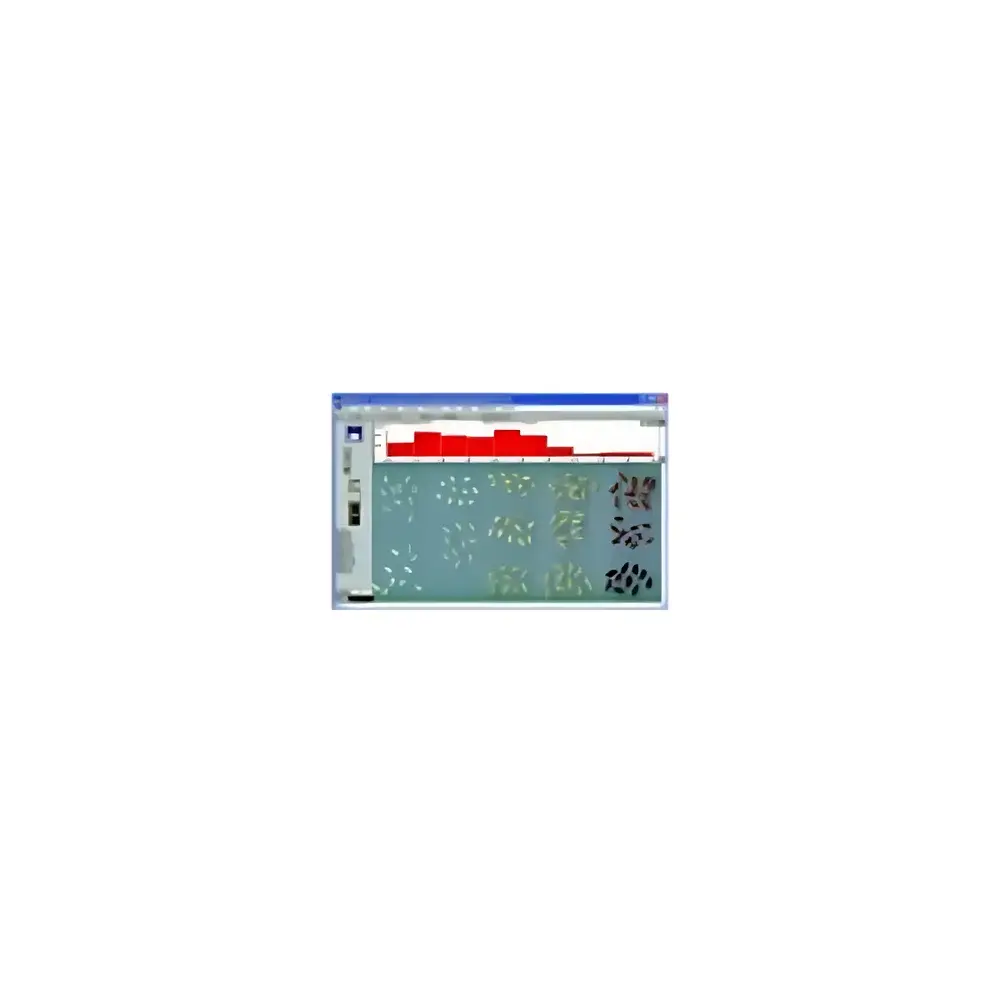
Regent WinSEEDLE is a dedicated digital image analysis platform engineered for quantitative morphometric and pathological assessment of seeds and conifer needles. Built upon robust computer vision algorithms calibrated specifically for botanical macrostructures, the system implements pixel-based binary segmentation, edge detection, and region-growing techniques to extract biologically relevant geometric and chromatic descriptors. Unlike generic image analysis tools, WinSEEDLE’s algorithmic pipeline incorporates species-informed thresholds for seed boundary delineation—particularly critical for irregularly shaped or overlapping specimens—and employs adaptive contrast normalization to mitigate illumination variability inherent in flatbed scanning workflows. The system operates on static high-resolution grayscale or RGB images acquired via standard A4/A3 flatbed scanners (not included), enabling reproducible, non-destructive phenotyping under controlled laboratory conditions. Its architecture supports traceable measurement workflows aligned with ISO 21569:2020 (methods for detection of genetically modified organisms) and ASTM D7250 (standard practice for determining area and perimeter of planar objects via digital imaging), making it suitable for regulatory-adjacent seed quality control, germplasm screening, and ecological needle senescence studies.
Key Features
- Modular software licensing: Three tiers—Basic, Reg (Standard), and Pro—differ in analytical depth, not core functionality; all versions share identical image import, preprocessing, and export pipelines.
- Automated seed counting with overlap resolution: Uses watershed segmentation and convex hull refinement to distinguish touching or partially occluded seeds without manual intervention.
- Morphometric parameter suite: Computes 14 standardized descriptors per object—including projected area, major/minor axis length, Feret diameter, convex perimeter, circularity, solidity, and curvature—calculated in SI units (mm², mm, mm⁻¹) with user-defined pixel-to-mm calibration.
- Color quantification engine: In Pro version, performs HSV and CIELAB space decomposition to quantify discoloration zones (e.g., fungal lesions, chlorosis, necrosis) by area fraction, mean hue angle, and chroma distribution across user-defined ROIs.
- Batch processing & metadata tagging: Supports folder-based queueing with CSV/XLSX export of all measurements plus embedded acquisition timestamps, scanner model ID, and operator-defined sample IDs.
- No proprietary hardware dependency: Fully compatible with commercially available CIS- or CCD-based flatbed scanners (≥1200 dpi optical resolution recommended); no vendor-locked peripherals required.
Sample Compatibility & Compliance
WinSEEDLE accepts digitized images of intact, dry, or air-dried seeds (angiosperm and gymnosperm) and detached conifer needles (e.g., Picea glauca, Pinus strobus, Abies balsamea). Specimens must be placed monolayer on scanner glass with minimal shadowing or reflection artifacts. The system does not support live or hydrated tissue imaging, nor microscopic-scale features (<50 µm). For regulatory use, audit trails are generated automatically for all measurement sessions (including parameter settings, calibration files, and export logs), supporting alignment with FDA 21 CFR Part 11 requirements when deployed on validated Windows workstations with enabled system logging. All geometric outputs comply with ISO 5725 (accuracy and precision of measurement methods) and are traceable to NIST-traceable calibration targets.
Software & Data Management
WinSEEDLE runs natively on Windows OS and stores project data in encrypted SQLite databases with optional password protection. Measurement results export to industry-standard formats: tab-delimited TXT, Excel-compatible XLSX, and comma-separated CSV—with column headers conforming to MIAPPE 1.1 (Minimum Information About a Plant Phenotyping Experiment) metadata schema. Raw image archives (TIFF/JPEG2000) retain EXIF metadata from the source scanner. Version-controlled configuration files (.ini) allow replication of analysis protocols across laboratories. No cloud storage or telemetry is enabled by default; all data remains on-premise unless explicitly exported by the user. Software updates are distributed via secure HTTPS download with SHA-256 checksum verification.
Applications
- Seed lot purity and viability assessment per ISTA Rules (International Seed Testing Association)
- Conifer needle aging and stress response quantification in climate change field trials
- Phenotypic screening of mutant or transgenic lines for seed size/shape QTL mapping
- Post-harvest quality monitoring in cereal and oilseed supply chains
- Herbarium specimen digitization and comparative morphology studies
- Teaching laboratories for plant morphology and digital image analysis curricula
FAQ
Is a scanner included with WinSEEDLE?
No. A high-resolution flatbed scanner (recommended ≥1200 dpi optical resolution) must be procured separately and configured via TWAIN or WIA drivers.
Can WinSEEDLE analyze images from digital cameras or smartphones?
Yes—provided images meet minimum resolution (≥3000 × 2000 pixels), uniform lighting, orthogonal capture angle, and include a scale reference (e.g., ruler or calibration target) for spatial calibration.
Does WinSEEDLE support batch analysis of multiple image folders?
Yes. The Batch Processor allows recursive folder scanning, automated file naming conventions, and consolidated report generation across heterogeneous sample sets.
How is measurement accuracy validated?
Users perform daily calibration using NIST-traceable grid targets; software includes built-in repeatability assessment tools that compute CV% across replicate analyses of identical images.
Is technical support available outside North America?
Yes. Regent Instruments provides remote diagnostics, protocol consultation, and software training via secure screen-sharing sessions with English-language documentation and video tutorials.