
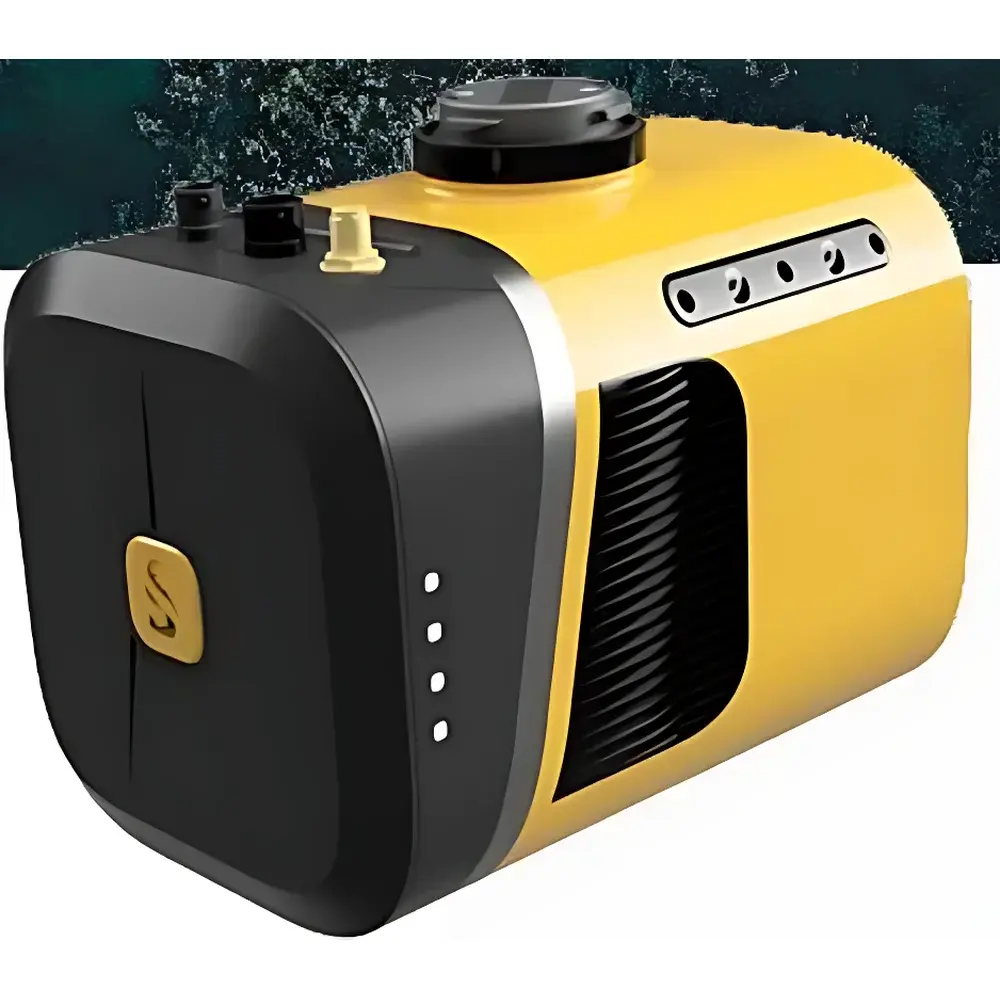
YellowScan Mapper+ UAV-Mounted LiDAR System
| Origin | Beijing |
|---|---|
| Manufacturer Type | Distributor |
| Origin Category | Domestic (China) |
| Model | YellowScan Mapper+ |
| Pricing | Upon Request |
Overview
The YellowScan Mapper+ is a turnkey, UAV-integrated Light Detection and Ranging (LiDAR) system engineered for high-precision, large-scale geospatial data acquisition in ecological, environmental, and industrial applications. It integrates the Livox AVIA solid-state scanning LiDAR sensor with a tightly coupled, high-grade GNSS/IMU navigation unit—delivering synchronized position, orientation, and point cloud measurements in real time. Unlike traditional mechanical-scanning LiDARs, the AVIA sensor employs non-repetitive scanning patterns and dual-return capability, enabling superior point cloud density (>300,000 pts/sec at 100 m range) and robust performance under variable lighting and vegetation conditions. The Mapper+ is designed as a self-contained payload: it requires no external power regulation or ground control station integration beyond standard UAV telemetry protocols, making it compatible with common commercial drone platforms including DJI Matrice 300 RTK, M600 Pro, and custom VTOL airframes.
Key Features
- Integrated Livox AVIA LiDAR sensor with 70° × 70° field of view and 0.1° angular resolution
- Tightly coupled GNSS/IMU unit supporting dual-frequency GPS/GLONASS/Galileo/BeiDou with RTK/PPK post-processing capabilities
- Lightweight design (<1.2 kg, excluding mounting hardware), optimized for Class I & II UAV platforms
- Real-time onboard georeferencing with sub-5 cm horizontal and sub-8 cm vertical absolute accuracy (under optimal GNSS conditions)
- Onboard storage (64 GB internal SSD) and optional telemetry-based live point cloud streaming via MAVLink
- IP54-rated enclosure for operation in light rain, dust, and temperature ranges from −10 °C to +50 °C
- Firmware-upgradable architecture supporting future sensor calibration enhancements and protocol expansions
Sample Compatibility & Compliance
The YellowScan Mapper+ is certified for use in uncrewed aerial systems operating under EASA SORA, FAA Part 107, and CAAC UAV operation regulations. Its embedded GNSS/IMU solution complies with ISO 17123-8 (field procedures for electro-optical distance meters and total stations) and supports traceable georeferencing workflows aligned with national geodetic frameworks (e.g., CGCS2000 in China, NAD83 in North America). While not a medical or safety-critical device, its data output conforms to LAS 1.4 and LAZ (compressed LAS) file formats—fully interoperable with industry-standard processing software including CloudCompare, Terrasolid, ArcGIS Pro, and QGIS with PDAL plugin. All firmware and calibration metadata are stored in standard GeoTIFF and XML sidecar files, ensuring auditability in GLP-compliant environmental monitoring projects.
Software & Data Management
Data acquisition is managed through YellowScan’s proprietary YellowScan Control software (Windows/macOS), which provides pre-flight mission planning, real-time status monitoring, and automated post-processing pipelines for PPK/RTK correction, point cloud classification (ground/non-ground), and DSM/DTM generation. Raw IMU and GNSS logs are exported in RINEX 3.x format for third-party PPK solutions (e.g., Trimble Business Center, NovAtel Inertial Explorer). Processed point clouds include full waveform metadata where supported by the AVIA sensor, enabling advanced vegetation structure analysis. The system supports batch processing of multi-flight datasets and exports orthomosaic-ready intensity rasters, classified LAS files, and CSV-based trajectory logs—all structured for integration into LIMS or GIS-based environmental reporting systems compliant with ISO 19115 metadata standards.
Applications
- Forest Inventory & Biomass Estimation: High-density canopy penetration enables accurate DBH estimation, crown delineation, and aboveground biomass modeling using CHM-derived metrics
- Agricultural Phenotyping: Supports time-series crop height mapping, lodging detection, and yield prediction models through repeated low-altitude surveys
- Mining & Quarry Monitoring: Enables volumetric change detection, stockpile quantification, and slope stability assessment with cm-level repeatability
- Archaeological Site Documentation: Reveals subtle topographic features beneath vegetation cover without ground disturbance
- Power Line Corridor Inspection: Detects vegetation encroachment, tower deformation, and conductor sag using classified point clouds and cross-sectional profiling
- Coastal & Wetland Change Mapping: Integrates with multispectral and thermal sensors (e.g., Ecodrone® series) for combined structural–spectral analysis of mangrove health or erosion dynamics
FAQ
Is the YellowScan Mapper+ compatible with DJI M300 RTK?
Yes—the system includes a dedicated M300 mounting kit and supports direct SDK integration for battery telemetry, flight mode synchronization, and automatic mission triggering.
Does it support real-time kinematic (RTK) positioning during flight?
The Mapper+ includes an integrated RTK-capable GNSS receiver; however, real-time centimeter-level positioning requires a local NTRIP base station or CORS network access. PPK processing remains the recommended workflow for maximum reliability in remote areas.
What level of technical support is provided for data processing?
YellowScan offers documented workflows, video tutorials, and email-based engineering support for calibration validation and pipeline troubleshooting. On-site training and custom processing script development are available under extended service agreements.
Can the system be operated beyond visual line of sight (BVLOS)?
BVLOS operation depends on national regulatory approval and UAV platform certification—not the LiDAR itself. The Mapper+ meets electromagnetic compatibility (EMC) requirements per EN 301 489-1 and does not emit RF interference that would impede command-link integrity.
Is firmware update performed in-field or only at service centers?
Firmware updates are delivered over USB-C and can be applied directly by end users using YellowScan Control software—no return-to-factory procedure is required.
Related Products







