
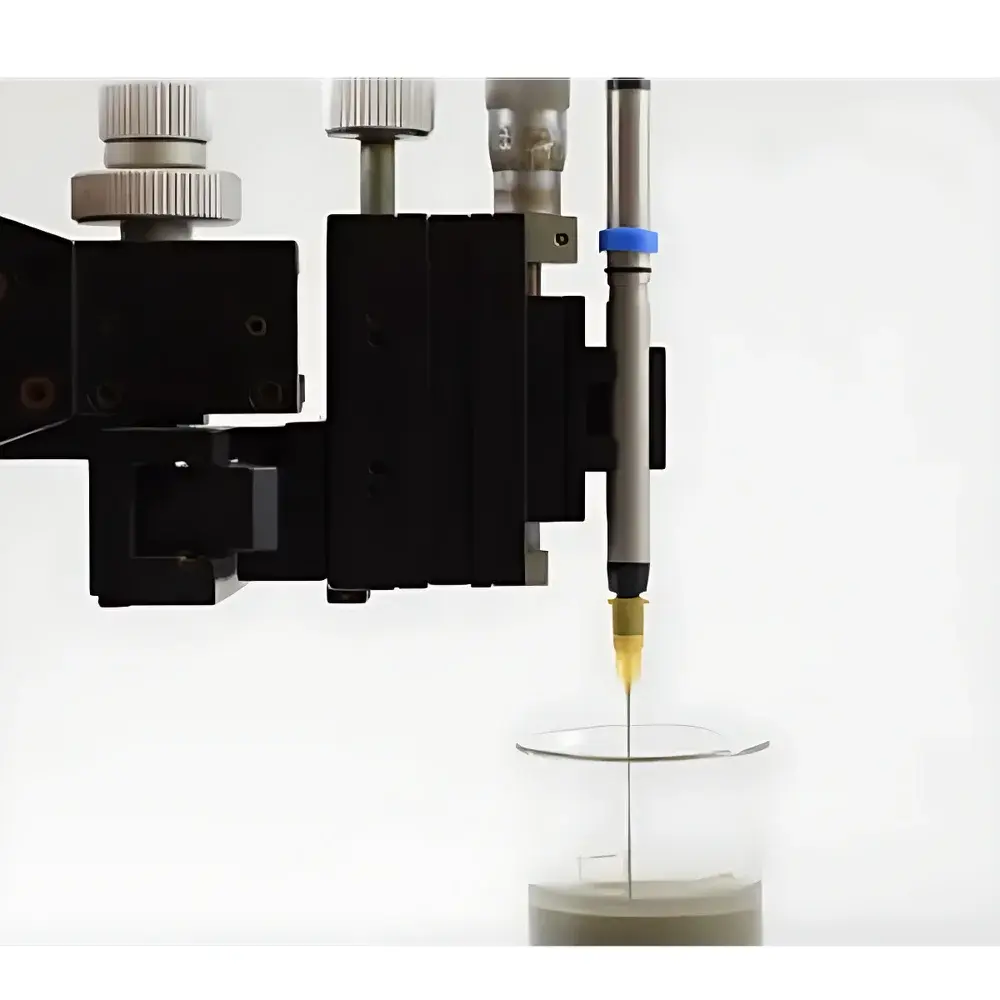
PyroScience RF-O2 Environmental Fluorescence Fiber-Optic Oxygen Meter
| Brand | PyroScience |
|---|---|
| Origin | Germany |
| Model | RF-O2 Environmental |
| Measurement Principle | Fluorescence Quenching of Oxygen-Sensitive Dyes |
| Optical Sensor Technology | REDFLASH (Rapid Excitation and Detection of Fluorescence) |
| Channel Options | 1-, 2-, or 4-Channel Configurations |
| Power Supply | USB 5V DC (20 mA) |
| Dimensions | 78 × 120 × 24 mm |
| Weight | 290 g |
| Operating Temperature | 0–50 °C, non-condensing |
| Integrated Sensors | Barometric pressure (300–1100 mbar, ±3 mbar accuracy), Relative humidity (0–100 %RH, ±0.2 %RH), Pt100 temperature input |
| Sampling Rate | 10–20 Hz per channel |
| Analog Output | 0–2.5 VDC |
| Interface | USB 2.0, UART serial |
| Software Suite | Pyro Workbench (device control & calibration), Pyro Data Inspector (respiration rate calculation, drift correction, TOU analysis) |
| Oxygen Ranges | Full-scale: 0–100 %O₂ (gas phase), 0–44 mg/L (dissolved O₂) |
| Trace | 0–21 %O₂ (gas), 0–9 mg/L (dissolved) |
| LOD | 0.02 %O₂ / 0.01 mg/L (full-scale), 0.005 %O₂ / 0.002 mg/L (trace) |
| Temperature Compensation | Real-time, integrated |
| Sensor Compatibility | Contact-type (probes, needles, bare fiber, solvent-resistant, insertion) and non-contact (optode films, flow cells, respirometry chambers) |
| Compliance | Designed for GLP-aligned workflows |
Overview
The PyroScience RF-O2 Environmental Fluorescence Fiber-Optic Oxygen Meter is an engineered solution for high-fidelity, maintenance-free oxygen quantification across heterogeneous environmental matrices. It operates on the physical principle of fluorescence quenching—where molecular oxygen dynamically suppresses the excited-state lifetime of ruthenium- or platinum-based luminophores immobilized within gas-permeable or hydrogel-coated optical sensor spots. Unlike electrochemical sensors, this optical method imposes zero oxygen consumption during measurement, eliminating analytical artifacts in low-flow, diffusion-limited, or microscale systems such as sediment microlayers, soil pores, or biofilm interfaces. The RF-O2 system integrates PyroScience’s proprietary REDFLASH technology, enabling rapid excitation-pulse delivery and time-resolved fluorescence decay analysis to yield precise, temperature-compensated partial pressure (pO₂) or concentration (mg/L or %O₂) outputs. Its design targets long-term field deployment and laboratory-based mechanistic studies where spatial resolution, temporal stability, and chemical inertness are critical—particularly in oxic-anoxic transition zones, biogeochemical incubations, and ecosystem-scale flux assessments.
Key Features
- Zero-oxygen-consumption optical sensing ensures non-invasive, artifact-free measurements in diffusion-controlled environments.
- REDFLASH-based architecture delivers high signal-to-noise ratio with sub-second response times (t₉₀ < 1 s) and minimal photobleaching over extended operation.
- Multi-channel flexibility: 1-, 2-, or 4-channel configurations support parallel monitoring of vertical profiles, replicate incubations, or multi-compartment respirometry.
- Integrated environmental compensation: Onboard barometric pressure (±3 mbar) and relative humidity (±0.2 %RH) sensors enable real-time pO₂ normalization without external instrumentation.
- USB-powered compact form factor (78 × 120 × 24 mm, 290 g) eliminates need for external power supplies—ideal for portable field use, shipboard deployments, or benchtop integration.
- Wide dynamic range: Dual-range capability supports both full-scale (0–100 %O₂ / 0–44 mg/L) and trace-level (LOD 0.005 %O₂ / 0.002 mg/L) applications in atmospheric, aquatic, and porous media contexts.
- Modular sensor ecosystem: Compatible with >15 optode formats—including needle microprobes (tip diameter down to 50 µm), planar optode films (µm-thick polymer coatings), flow-through cuvettes, and custom-fit respirometry chambers.
- Real-time temperature compensation via embedded Pt100 input or internal thermistor ensures accuracy across 0–50 °C operating range.
Sample Compatibility & Compliance
The RF-O2 system is validated for quantitative oxygen assessment in gaseous, liquid, and semi-solid phases—including ambient air, surface water, porewater, saturated soils, marine sediments, anaerobic digesters, and bioreactor headspaces. Its optical transduction mechanism avoids electrode poisoning, sulfide interference, or electrolyte depletion common in Clark-type sensors—making it suitable for long-term deployments in sulfidic sediments, organic-rich wastewater, or acidic peat soils. Sensor formats comply with ISO 5814:2012 (water quality — determination of dissolved oxygen — electrochemical probe method) for comparative validation, though optical measurement falls outside its scope. For regulatory-grade environmental monitoring, Pyro Workbench supports metadata-enriched data export (CSV, HDF5) with timestamps, sensor IDs, and environmental parameters—facilitating alignment with EPA Method 360.1 (dissolved oxygen), ASTM D888-22 (oxygen saturation), and GLP/GMP documentation requirements. Optional 21 CFR Part 11-compliant user access controls and electronic signature modules are available for validated laboratory environments.
Software & Data Management
Pyro Workbench serves as the primary interface for hardware configuration, multi-device synchronization (up to 10 units), and real-time visualization. It provides intuitive sensor calibration workflows—including two-point (air-saturated water and sodium sulfite zero) and single-point referencing—and stores calibration history with operator ID and timestamp. Raw fluorescence decay curves, corrected pO₂ values, and environmental sensor readings are logged at user-defined intervals (10–20 Hz maximum) with lossless precision. Pyro Data Inspector extends analytical capability: it computes oxygen consumption rates (OCR) via linear or non-linear regression of time-series DO decline, applies exponential drift correction to account for slow sensor baseline shifts, and calculates Total Oxygen Uptake (TOU) from sediment profile integrals using trapezoidal numerical integration. All software modules run natively on Windows 7/8/10 (minimum 1 GB RAM, 700 MB disk space, 1360×768 resolution) and support batch processing of multi-experiment datasets for meta-analyses.
Applications
The RF-O2 platform is extensively deployed in environmental biogeochemistry and ecosystem science. In freshwater and marine sediments, planar optode films coupled with 4-channel FireSting-O2 record millimeter-scale O₂ gradients across redox boundaries—enabling quantification of aerobic mineralization rates and diffusive oxygen uptake (DOU). In soil science, micro-needle probes map rhizosphere O₂ dynamics under variable irrigation regimes, directly informing aerated irrigation strategies for greenhouse gas mitigation. Field campaigns utilize floating optode arrays on autonomous platforms to resolve diel O₂ supersaturation patterns linked to benthic primary production. Wastewater treatment facilities apply flow-cell sensors to monitor aerobic zone efficiency and denitrification onset in sequencing batch reactors. Additional use cases include landfill leachate monitoring, compost pile aeration control, and hypolimnetic oxygenation efficacy trials—all leveraging the system’s immunity to electromagnetic noise, absence of electrolyte leakage, and compatibility with aggressive solvents or high-ionic-strength matrices.
FAQ
Does the RF-O2 require routine recalibration during long-term deployments?
No—optical oxygen sensors exhibit exceptional long-term stability. Zero-point verification every 2–4 weeks is recommended for trace-range measurements; full two-point calibration is typically required only after sensor replacement or exposure to extreme pH/solvent conditions.
Can the same sensor be used interchangeably between gas-phase and aqueous measurements?
Yes, provided the sensor format is chemically rated for both phases (e.g., certain probe tips and planar films). However, calibration must be performed separately for gas and liquid media due to differing solubility and quenching kinetics.
Is the system compatible with third-party data acquisition platforms like LabVIEW or MATLAB?
Yes—PyroScience provides documented ASCII-based UART and USB HID protocols, enabling direct integration with custom scripts or industrial SCADA systems via serial communication.
What is the expected service life of an optical oxygen sensor under continuous field use?
Typical operational lifetime exceeds 2 years in ambient air and 6–12 months in aggressive sediment porewater, depending on mechanical abrasion, UV exposure, and biofouling mitigation strategy.
How does temperature affect measurement accuracy, and how is it compensated?
Fluorescence lifetime is intrinsically temperature-dependent. The RF-O2 employs dual compensation: real-time correction using either the integrated Pt100 channel or a co-located temperature sensor, combined with factory-characterized thermal response coefficients embedded in firmware.







