
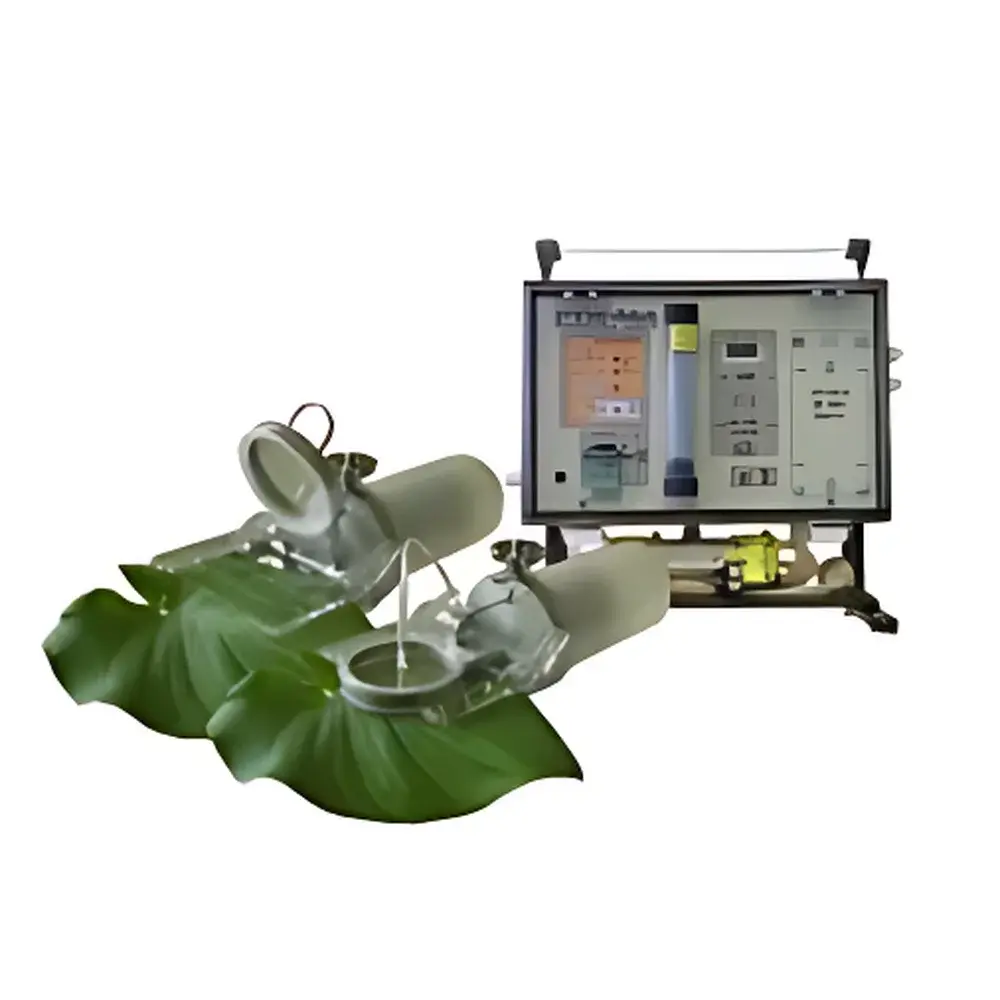
PTM-50 Plant Physiology and Ecophysiology Monitoring System
| Origin | Europe |
|---|---|
| Manufacturer Type | Authorized Distributor |
| Origin Category | Imported |
| Model | PTM-50 |
| Pricing | Available Upon Request |
Overview
The PTM-50 Plant Physiology and Ecophysiology Monitoring System is an advanced, field-deployable platform engineered for continuous, autonomous measurement of key plant functional traits under natural or controlled environmental conditions. Built upon the proven architecture of the PTM-48A, the PTM-50 integrates dual-channel non-dispersive infrared (NDIR) gas analysis with synchronized microclimate sensing to deliver high-temporal-resolution data on net CO2 assimilation, transpiration, stomatal conductance, and photosynthetic efficiency. Its core measurement principle relies on real-time differential analysis of CO2 and H2O concentrations between reference and sample airstreams—enabling robust quantification of leaf-level gas exchange dynamics even under fluctuating ambient CO2 or humidity. Designed for long-term ecophysiological monitoring, the system operates unattended for weeks without manual intervention, supporting hypothesis-driven research in plant stress physiology, climate adaptation, and crop phenotyping.
Key Features
- Dual independent NDIR analyzers for simultaneous, time-synchronized measurement of reference and sample gas streams—eliminating time-lag artifacts and enhancing signal stability under variable atmospheric conditions.
- Four motorized, pneumatically actuated leaf chambers (LC-10R), each with 10 cm² measurement area and precise airflow control (0.25 L/min), enabling rapid (<20 s per chamber) sequential sampling across multiple leaves or individuals.
- Integrated RTH-50 multifunctional environmental sensor providing concurrent measurements of photosynthetically active radiation (PAR: 0–2500 µmol·m⁻²·s⁻¹), total solar radiation (300–3000 nm), air temperature (−10 to +60 °C), relative humidity (3–100 % RH), and dew point.
- Modular wireless expansion architecture: Optional sensors—including chlorophyll fluorescence (MP110), stem flow (SF-4/SF-5), stem diameter variation (SD-5/SD-6/SD-10), trunk growth (DE-1), fruit expansion (FI-L/M/S/XS), canopy height (SA-20), and soil water content/temperature/electrical conductivity (SMTE)—transmit data via 2.4 GHz RF to the central controller without cabling constraints.
- IP55-rated enclosure and ruggedized stainless-steel mounting hardware ensure reliable operation in outdoor environments ranging from arid field plots to humid greenhouse settings.
- Onboard data logging (1200 entries at 30-min intervals ≈ 25 days) with timestamped metadata, battery-backed memory, and configurable sampling intervals (5–120 min).
Sample Compatibility & Compliance
The PTM-50 accommodates a broad spectrum of plant morphologies—from herbaceous monocots and dicots to woody shrubs and fruit-bearing vines—via interchangeable leaf chamber designs (circular LC-10R and rectangular LC-10S) and non-invasive peripheral sensors. All gas exchange measurements adhere to established protocols referenced in ISO 17025-accredited laboratories, and raw output parameters (e.g., An, E, gs, VPD, PAR) are traceable to NIST-calibrated standards. The system supports GLP-compliant data integrity through immutable timestamping, user-accessible audit logs, and export-ready CSV/Excel formats compatible with statistical analysis packages (R, Python, SAS). While not FDA 21 CFR Part 11 certified out-of-the-box, its software architecture permits integration with validated LIMS environments where electronic signatures and change control are required.
Software & Data Management
The proprietary English-language software provides real-time visualization of up to 16 concurrent parameters—including CO2 exchange rate, sap flow, VPD, PAR, fluorescence yield (QY), and stem diameter dynamics—across customizable time windows (hourly, daily, weekly). Data synchronization occurs automatically via embedded 3G modem or local Wi-Fi, enabling remote access to live feeds and historical archives. Export functions support batch download in ASCII-delimited format with embedded units and metadata headers, facilitating direct import into MATLAB, JMP, or Crop Growth Modeling frameworks (e.g., APSIM, DSSAT). Firmware updates are delivered over-the-air, and configuration backups can be stored locally or on network drives for version control and reproducibility assurance.
Applications
- Quantifying species- or cultivar-specific differences in drought tolerance, heat resilience, and light-use efficiency under field or semi-controlled conditions.
- Evaluating physiological responses to agronomic interventions—such as irrigation scheduling, nutrient amendments, or biostimulant application—using diurnal gas exchange trajectories as early biomarkers.
- Identifying limiting factors in photosynthesis (e.g., stomatal vs. biochemical limitation) through coupled analysis of An, gs, and chlorophyll fluorescence parameters (Ft, QY).
- Validating remote sensing indices (e.g., PRI, NDVI) against ground-truthed ecophysiological metrics across spatial scales—from single-leaf to multi-canopy deployments.
- Supporting breeding programs by generating high-resolution phenotypic datasets for genome-wide association studies (GWAS) and genomic selection models.
- Integrating with ECODRONE® UAV platforms for synchronized ground–air phenotyping, combining PTM-50’s temporal resolution with hyperspectral or thermal imaging spatial context.
FAQ
What is the maximum number of leaf chambers that can be operated simultaneously?
The PTM-50 controls four LC-10R chambers sequentially; simultaneous multi-chamber gas exchange is not supported due to shared gas handling infrastructure.
Can the system operate without external power for extended periods?
Yes—when paired with a 12 V deep-cycle battery (not included), the PTM-50 achieves >72 hours of continuous operation at 30-min sampling intervals.
Is calibration of the NDIR analyzers required in the field?
Zero-point calibration using ambient air or nitrogen is recommended before deployment; span calibration with certified CO₂ standards (e.g., 350 ppm, 700 ppm) is advised every 30 days for critical applications.
Does the software support automated detection of abnormal physiological events (e.g., stomatal closure spikes)?
No built-in event-detection algorithms exist; however, users may apply custom thresholds or statistical outlier filters during post-processing using exported time-series data.
Are firmware updates backward-compatible with legacy PTM-48A hardware modules?
No—PTM-50 firmware is specific to its dual-analyzer architecture and revised communication protocol; cross-platform compatibility is not maintained.




