
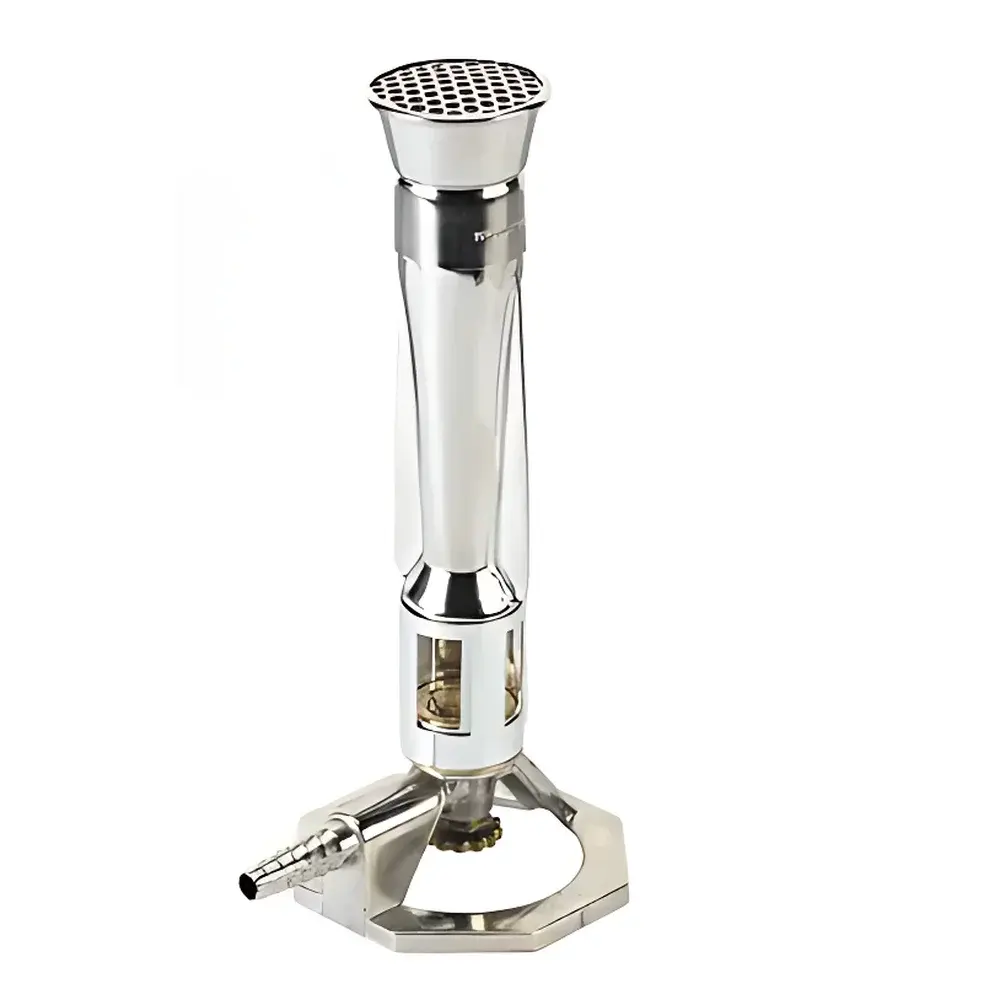
Humboldt H-5600 Bunsen Burner for Thermal Protective Performance (TPP) and Convective Heat Testing
| Brand | NYX |
|---|---|
| Origin | USA |
| Manufacturer | Humboldt |
| Model | H-5600 |
| Gas Types | Natural Gas or Liquefied Petroleum Gas (LPG) |
| Flame Output | Compliant with ISO 9151:2016, EN 367:1992, ISO 11612:2015, NFPA 2112-2023, ASTM F2703, GB 38453-2019 Annex A.2.2, AQ 6103-2007 Annex F |
| Injector Tube ID/Inlet OD | Φ38 mm |
| Air Regulator | Sleeve-type |
| Gas Control | Rotary Piston Valve |
| Base | Nickel-plated Octagonal |
| Dimensions (L×W×H) | 10 × 12 × 22 cm |
Overview
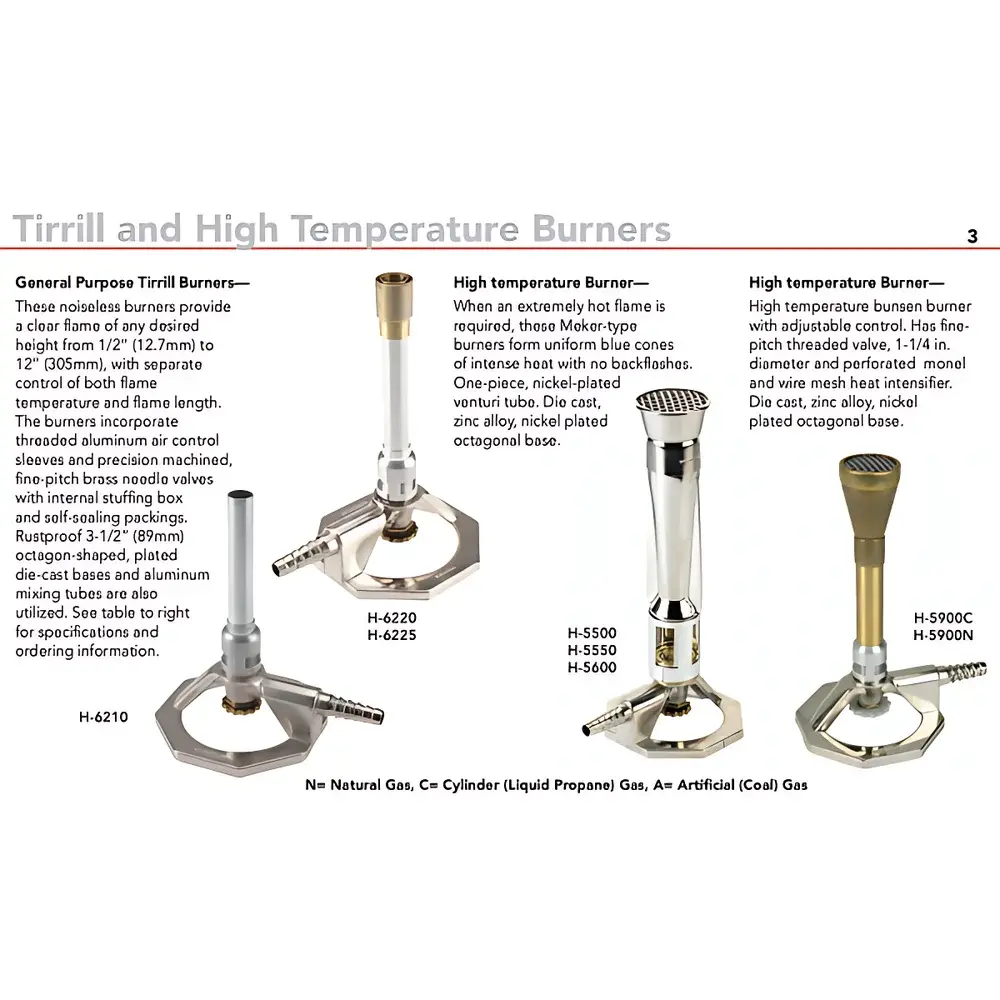
The Humboldt H-5600 Bunsen Burner is a precision-engineered laboratory-grade thermal source designed specifically for standardized convective heat exposure testing of flame-resistant (FR) and thermally protective materials. Unlike general-purpose laboratory burners, the H-5600 is calibrated and constructed to meet the stringent geometric, flow, and thermal output requirements defined in international test standards—including ISO 9151:2016 (determination of convective heat resistance), EN 367:1992 (protective clothing against heat and fire), ISO 11612:2015 (clothing protecting against heat and flame), and NFPA 2112-2023 (standard on flame-resistant garments for protection against flash fire). Its operation relies on the Venturi principle to ensure stoichiometric air–fuel mixing, generating a stable, laminar, and radially uniform conical flame front essential for reproducible heat flux profiles across test specimens.
Key Features
- Venturi-type injector assembly ensures consistent fuel–air mixing and eliminates flame flicker or flashback under regulated gas supply conditions.
- Φ38 mm inlet diameter with precision-machined brass burner tube optimized for uniform thermal distribution and minimal radial temperature gradient across the flame cross-section.
- Multi-orifice nozzle array generates a dense, homogeneous flame envelope—critical for achieving the ±5% spatial heat flux uniformity required by ISO 9151 and ASTM F2703.
- Sleeve-style air regulator enables fine-tuned control over primary air entrainment without mechanical play or hysteresis—maintaining flame stability across varying gas pressures (0.5–2.5 kPa typical operating range).
- Rotary piston gas valve offers repeatable, tactile feedback for precise volumetric flow adjustment; compatible with both natural gas (NG) and liquefied petroleum gas (LPG) supply systems via interchangeable orifice inserts.
- Nickel-plated octagonal base provides corrosion resistance, mechanical rigidity, and alignment stability during long-duration TPP or convective heat tests—minimizing positional drift during calorimeter probe placement.
Sample Compatibility & Compliance
The H-5600 is validated for use in test configurations specified in ISO 9151:2016 Clause 6.2 (convective heat source setup), EN 367:1992 Annex A, and NFPA 2112-2023 Section 8.8 (glove flammability testing). It supports flat-panel specimen mounting at standardized distances (e.g., 25 mm or 40 mm from flame tip per ISO 11612) and integrates seamlessly with guarded hotplate calorimeters (e.g., ASTM D6970-compliant sensors) and thermal manikins. All structural components comply with UL 1037 and CSA C22.2 No. 107.1 safety requirements for laboratory gas appliances. Device calibration documentation and traceable verification reports are available upon request to support GLP-compliant test facility audits.
Software & Data Management
While the H-5600 operates as a standalone analog thermal source, it is routinely integrated into automated test platforms via external gas pressure monitoring modules (e.g., Honeywell ST3000 series transducers) and digital data acquisition systems compliant with FDA 21 CFR Part 11. When paired with Humboldt’s optional H-TPP-DAQ interface module, real-time flame temperature profiling (via Type K thermocouples), gas flow logging (mass flow controller integration), and time-synchronized calorimeter output can be recorded with audit-trail-enabled timestamps and user-access-controlled permissions. Raw thermal flux data export supports CSV, HDF5, and ASTM E2933-compliant formats for third-party statistical analysis.
Applications
- Evaluation of thermal protective performance (TPP) values for firefighter turnout gear, military combat uniforms, and industrial FR workwear per ASTM F2703 and ISO 17492.
- Convective heat resistance testing of gloves, hoods, and face shields in accordance with NFPA 1971, NFPA 1977, and GA 10-2014.
- Material qualification for arc flash PPE per ASTM F1959/F1959M, where controlled convective preheating precedes arc exposure.
- Research-scale flame impingement studies in textile engineering labs assessing char formation kinetics, shrinkage behavior, and thermal barrier degradation under sustained convective load.
- Calibration verification of heat flux sensors used in radiant panel testers (e.g., ASTM E1321) through comparative convective reference exposure protocols.
FAQ
What gas types are supported, and are conversion kits included?
The H-5600 ships configured for natural gas (NG); LPG conversion requires optional orifice insert kit H-5600-LPG (sold separately) and recalibration verification per ISO 9151 Annex B.
Is flame height adjustable, and how is repeatability ensured between operators?
Flame height is fixed by burner geometry and regulated via air/fuel ratio—not physical height adjustment. Repeatability is maintained through rotary piston valve detents and factory-set air sleeve positions documented in the Certificate of Conformance.
Does the unit include gas pressure regulators or flow meters?
No—external certified regulators and calibrated flow meters meeting ISO 4008 requirements must be supplied by the end user to ensure compliance with test standard pressure tolerances (±0.1 kPa).
Can the H-5600 be used for radiant heat testing?
No. This burner is exclusively designed for convective heat exposure. Radiant heat testing requires separate equipment such as the ASTM E1321 radiant panel or ISO 6942 cylindrical radiant source.
What maintenance intervals are recommended for long-term accuracy?
Quarterly inspection of nozzle orifices for carbon buildup, biannual verification of air sleeve seal integrity, and annual full-system calibration using NIST-traceable thermocouples and flow standards are advised per ISO/IEC 17025:2017 clause 7.7.



