
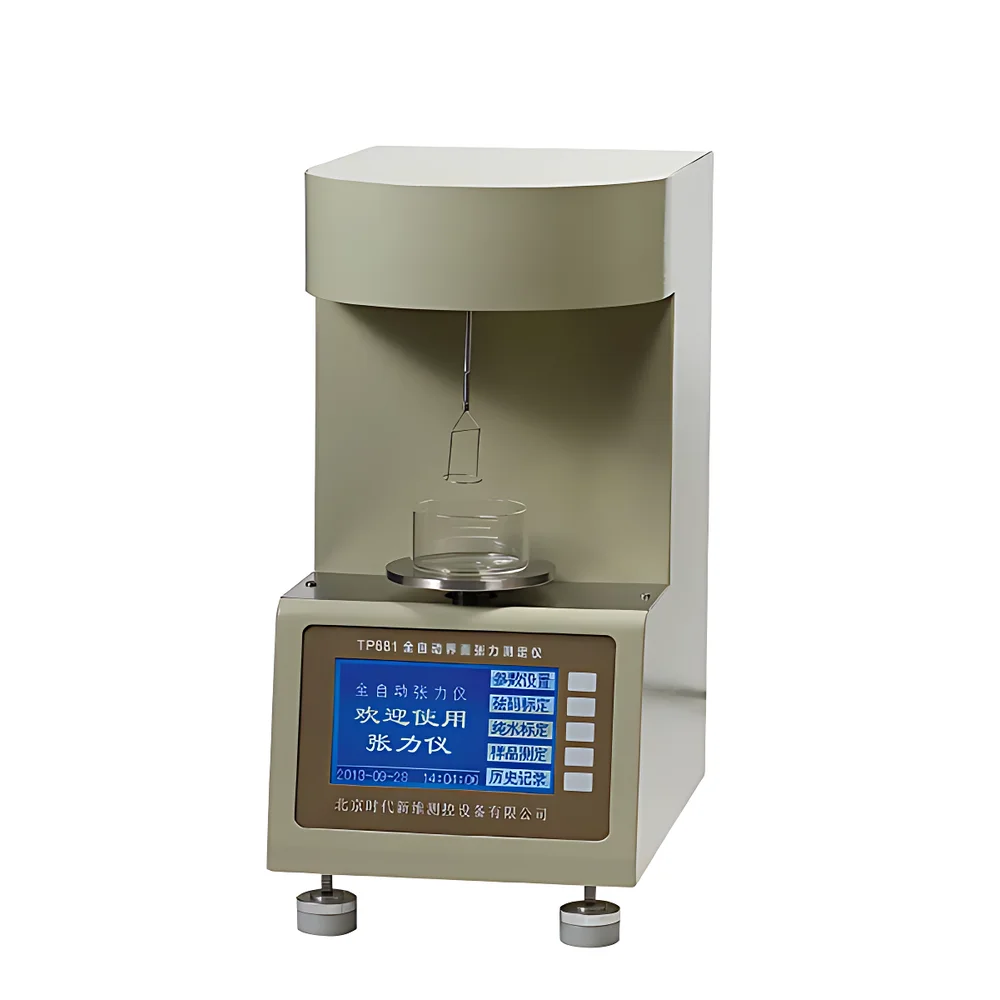
Timepower TP681 Interfacial Tension Analyzer
| Brand | Timepower |
|---|---|
| Origin | Beijing, China |
| Manufacturer | Timepower Measurement & Control Co., Ltd. |
| Model | TP681 |
| Measuring Principle | Du Noüy Ring Method (Non-equilibrium Mode) |
| Compliance | GB/T 6541–2018, ISO 6295:2023 |
| Full Scale Range | 5–100 mN/m (for insulating oils) |
| Accuracy | ±0.5% F.S. |
| Resolution & Sensitivity | 0.1 mN/m |
| Temperature Compensation | Automatic, with integrated Pt100 sensor |
| Data Storage | Up to 256 test records with timestamp (real-time clock, battery-backed for ≥10 years) |
| Communication Interface | RS-232 serial port |
| Display | LCD with Chinese/English bilingual interface |
| Printer | Built-in thermal printer (36-character line, Chinese character support) |
| Power Supply | AC 220 V ±10%, 50 Hz ±10% |
| Max. Power Consumption | 40 W |
| Operating Environment | 5–40 °C, ≤85% RH |
| Lifting Speed | 0.3–0.4 mm/s |
| Dimensions (W×D×H) | 190 × 260 × 370 mm |
| Weight | 8.9 kg |
Overview
The Timepower TP681 Interfacial Tension Analyzer is a precision laboratory instrument engineered for the quantitative determination of surface tension and interfacial tension between immiscible liquid phases—particularly mineral oil and water—using the standardized Du Noüy ring method under non-equilibrium conditions. Based on the principle of force balance measurement, the system employs a platinum-iridium ring suspended from an electromagnetic force compensation transducer; the maximum pull force required to detach the ring from the liquid interface is directly correlated to the interfacial tension value (in mN/m). This method is widely accepted in petrochemical, lubricant, transformer oil, and quality control laboratories for its robustness, repeatability, and alignment with internationally recognized test standards including GB/T 6541–2018 and ISO 6295:2023. The TP681 is specifically optimized for routine analysis of insulating oils and industrial petroleum products where detection of hydrophilic oxide contaminants—such as oxidation by-products or hydrolysis residues—is critical to assessing fluid degradation and service life.
Key Features
- Dual-CPU microcontroller architecture ensures stable real-time control of motorized lift mechanism, sensor signal acquisition, and thermal printer operation.
- Multi-point linearization calibration across the full measurement range corrects inherent nonlinearity of the electromagnetic force transducer, achieving ±0.5% full-scale accuracy without manual recalibration.
- Integrated temperature sensing (Pt100 class B) enables automatic temperature measurement prior to each test cycle and applies empirically validated correction coefficients to raw tension values—essential for compliance with ASTM D971 and ISO 6295 reporting requirements.
- Built-in real-time clock with non-volatile memory retains date/time stamps for all stored results (up to 256 entries); data integrity is preserved for ≥10 years during power loss via supercapacitor backup.
- LCD display supports dual-language UI (English/Chinese), intuitive menu navigation, and real-time graphical feedback of force curve progression during ring detachment.
- RS-232 interface allows bidirectional communication with external PCs for automated report generation, audit trail export, and integration into LIMS environments supporting GLP/GMP workflows.
Sample Compatibility & Compliance
The TP681 accommodates standard 30–50 mL sample volumes in supplied borosilicate glass tension cups. It is validated for use with refined mineral insulating oils (e.g., IEC 60296), turbine oils, hydraulic fluids, diesel fuels, and aqueous surfactant solutions. Its operational methodology conforms strictly to the procedural constraints defined in GB/T 6541–2018 (equivalent to ISO 6295:2023), including ring immersion depth (1–2 mm), vertical withdrawal speed (0.3–0.4 mm/s), and dwell time before detachment. The instrument’s design facilitates detection of trace hydrophilic oxides—manifested as anomalous hysteresis or reduced peak force—thereby serving as an indirect indicator of oxidation stability per IEC 61125 protocols. All mechanical and electronic components comply with CE marking directives for EMC (2014/30/EU) and Low Voltage (2014/35/EU).
Software & Data Management
While the TP681 operates autonomously with embedded firmware, its RS-232 port enables connection to host software (provided separately or custom-developed) for advanced data handling. Exported datasets include: test ID, date/time stamp, measured tension (mN/m), ambient temperature (°C), operator ID (if entered), and pass/fail status against user-defined specification limits. Audit trails meet basic FDA 21 CFR Part 11 readiness criteria when paired with validated PC-based applications—supporting electronic signatures, user access levels, and immutable record archiving. Thermal printouts provide immediate hard-copy documentation compliant with internal QA checklists and third-party inspection requirements.
Applications
- Quality assurance of transformer oils prior to commissioning and during in-service monitoring per IEEE C57.106 guidelines.
- Assessment of oxidation resistance in turbine and hydraulic oils per ASTM D2272 and ISO 12937.
- Surfactant efficacy evaluation in enhanced oil recovery (EOR) formulations.
- Stability testing of emulsions and microemulsions in pharmaceutical excipient development.
- Research into interfacial phenomena at oil–water boundaries for environmental remediation studies.
FAQ
What standards does the TP681 comply with?
The instrument implements the Du Noüy ring method in strict accordance with GB/T 6541–2018 and ISO 6295:2023. It also supports procedural alignment with ASTM D971 for interfacial tension of oil–water systems.
Can the TP681 measure both surface and interfacial tension?
Yes—it measures surface tension of pure liquids (e.g., water, solvents) and interfacial tension between two immiscible liquids (e.g., mineral oil/water, polymer solution/air), provided the density difference permits stable ring detachment.
Is temperature compensation mandatory for accurate results?
Yes. Surface and interfacial tension exhibit strong temperature dependence; the built-in Pt100 sensor and algorithmic correction are essential for metrological traceability and inter-laboratory comparability.
How many test records can be stored internally?
The device stores up to 256 complete test records—including numeric values, timestamps, and temperature—with retention guaranteed for ≥10 years without power.
Does the TP681 support GLP/GMP documentation requirements?
When used with validated external software and controlled access procedures, the TP681’s data export, timestamping, and audit-ready print output support core GLP and GMP documentation needs, particularly for QC labs in regulated industries.





