
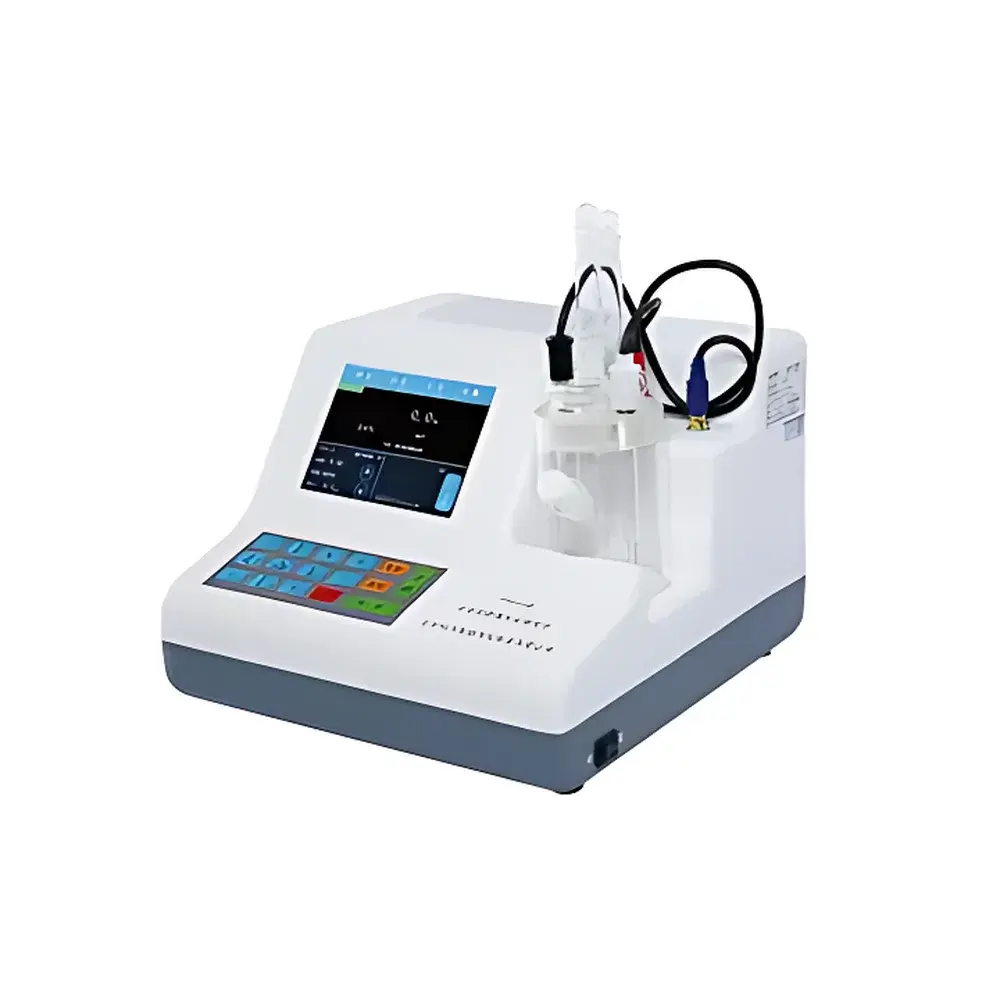
TimePower TP653 Coulometric Karl Fischer Moisture Analyzer
| Brand | TimePower |
|---|---|
| Origin | Beijing, China |
| Manufacturer Type | Direct Manufacturer |
| Model | TP653 |
| Measurement Principle | Coulometric Karl Fischer Titration |
| Detection Range | 3 µg – 100 mg H₂O |
| Resolution | 0.1 µg |
| Accuracy | ±20% at 3 µg, ±10% at 10 µg, ±5% at 100 µg, ±0.5% above 100 µg (excluding sampling error) |
| Electrolysis Current Control | 0–400 mA, auto-regulated |
| Display | 5.6-inch color TFT LCD touchscreen |
| Interface | RS-232 for balance & PC connectivity |
| Data Storage | Method storage for up to 6 pre-configured protocols (12 total methods) |
| Environmental Operating Conditions | 20–30 °C, ≤85% RH |
| Power Supply | AC 220 V ±10%, 50 Hz ±10%, max. 40 W |
| Dimensions | 300 × 290 × 200 mm |
| Weight | 3.7 kg |
| Electrolytic Cell | Hermetically sealed, low-equilibration-time design |
| Input Methods | Touchscreen + tactile membrane keys |
| Peripheral Support | Integrated micro-thermal printer, optional balance/PC synchronization |
| Compliance | GB/T 7600, GB/T 6283, SH/T 0246, SH/T 0255 |
Overview
The TimePower TP653 Coulometric Karl Fischer Moisture Analyzer is an engineered solution for trace water quantification in laboratories where regulatory compliance, repeatability, and operational robustness are non-negotiable. It operates on the fundamental electrochemical principle of coulometric Karl Fischer titration—where iodine is generated *in situ* via controlled electrolysis of iodide ions in a methanol-based reagent containing sulfur dioxide and pyridine derivatives. According to Faraday’s law, the quantity of iodine produced is directly proportional to the charge passed; since one mole of iodine reacts stoichiometrically with one mole of water, the water content is calculated precisely from the integrated current over time. This method eliminates volumetric reagent calibration drift and delivers superior accuracy for samples containing ≤100 mg of water—particularly critical in high-value matrices such as pharmaceutical intermediates, transformer oils, lithium battery electrolytes, and hygroscopic active pharmaceutical ingredients (APIs).
Key Features
- 32-bit embedded microprocessor with real-time operating system ensures deterministic response, stable baseline control, and minimal thermal drift during extended analysis cycles.
- Auto-regulated electrolysis current (0–400 mA) enables dynamic adaptation to sample water load—optimizing reaction kinetics without over-titration or electrode passivation.
- Integrated 5.6-inch color TFT LCD touchscreen with physical membrane keys provides dual-mode operation: intuitive graphical navigation and tactile feedback for gloved-hand use in controlled environments.
- Real-time electrolysis curve visualization allows immediate assessment of reagent activity, endpoint sharpness, and system stability—supporting proactive maintenance and GLP-compliant record review.
- Hermetically sealed electrolytic cell minimizes ambient moisture ingress, reduces equilibration time to <60 seconds, and extends reagent service life by up to 40% compared to standard open-cell designs.
- Onboard micro-thermal printer supports audit-ready hardcopy output with timestamp, method ID, sample ID, and result metadata—fully traceable per FDA 21 CFR Part 11 requirements when paired with validated software workflows.
- Automatic reagent dispensing and waste evacuation reduce manual handling, improve operator safety, and eliminate cross-contamination risks associated with pipetting toxic, volatile KF reagents.
Sample Compatibility & Compliance
The TP653 accommodates liquid, solid, and gaseous samples across diverse industrial sectors—including insulating oils (IEC 60814), hydrocarbon solvents (ASTM D6304), polymers (ISO 15512), APIs (USP <921>), and food-grade emulsifiers (AOAC 985.24). Its coulometric architecture avoids dilution errors common in volumetric systems and maintains linearity across the full 3 µg–100 mg detection range. The instrument is fully compliant with Chinese national standards GB/T 7600 (for insulating oils), GB/T 6283 (general chemical products), SH/T 0246 (light petroleum fractions), and SH/T 0255 (additive-containing lubricants). Its hardware architecture and firmware logic support ALCOA+ data integrity principles—ensuring attributable, legible, contemporaneous, original, accurate, complete, consistent, enduring, and available records.
Software & Data Management
The TP653 supports bidirectional RS-232 communication with analytical balances (e.g., Mettler Toledo XS series) and laboratory PCs. Raw current-time integrals, method parameters, and result summaries are exportable in CSV format for integration into LIMS or ELN platforms. Up to six frequently used analysis protocols—including custom titration thresholds, delay times, and drift compensation settings—can be stored onboard. All method changes, result entries, and system events are time-stamped and retained in non-volatile memory, satisfying GLP/GMP audit trail requirements. Optional PC-based software enables advanced reporting, statistical process control (SPC) charting, and electronic signature workflows aligned with 21 CFR Part 11 Annex 11 expectations.
Applications
- Power industry: Quantification of moisture in transformer oil, turbine oil, and SF₆ gas—directly impacting dielectric strength and oxidation stability.
- Petrochemical QA/QC: Water determination in benzene, toluene, xylene, MTBE, and biofuels per ASTM D6304 and IP 386.
- Pharmaceutical manufacturing: Release testing of lyophilized powders, excipients, and solvent residues in final drug products per ICH Q5C and USP <921>.
- Electronics materials: Moisture verification in lithium hexafluorophosphate (LiPF₆) electrolytes and epoxy encapsulants—critical for battery cycle life and semiconductor packaging reliability.
- Agrochemical R&D: Water content validation in pesticide formulations, wettable powders, and emulsifiable concentrates to ensure shelf-life stability.
FAQ
What safety precautions are required when handling the Karl Fischer reagent?
KF reagents contain pyridine and iodine—both toxic and volatile. All reagent transfers must occur inside a certified fume hood. Nitrile gloves, safety goggles, and lab coats are mandatory. Spills require immediate neutralization with sodium thiosulfate solution followed by ethanol wipe-down.
How often should the electrolyte be replaced?
Reagent replacement is triggered when the cumulative charge consumed approaches the manufacturer-specified total capacity (displayed as “Reagent Total” in Setup Mode) or when baseline drift exceeds 2 µg/min for >3 minutes under inert atmosphere.
Can the TP653 analyze viscous or particulate-laden samples?
Yes—when coupled with optional oven vaporization units (e.g., TimePower OV-100) or homogenized slurry injection kits. Solid samples require validated dissolution protocols using compatible anhydrous solvents like chloroform or formamide.
Is the instrument suitable for ISO/IEC 17025-accredited laboratories?
Yes—provided calibration is performed using certified water standards (e.g., Hydranal® CertiPUR®), system suitability is verified per USP <921> Procedure A, and all firmware updates are documented with version-controlled change logs.
What is the minimum detectable water mass and its associated uncertainty?
The lower limit of quantitation (LLOQ) is 3 µg H₂O, with expanded uncertainty (k=2) of ±20% under optimized conditions—verified using gravimetrically prepared aqueous standards in dry nitrogen-purged vials.






