
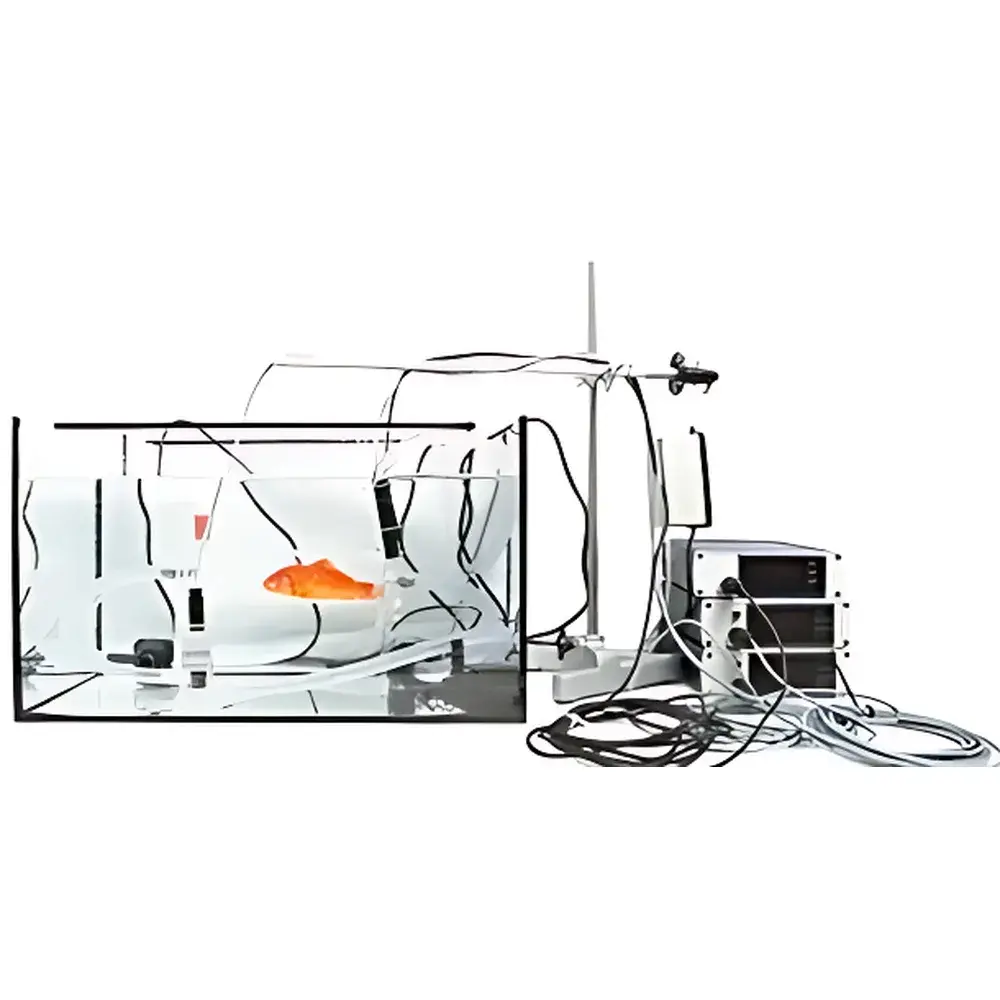
DAQ Aquatic Respirometry System for Fish and Invertebrates
| Origin | Denmark |
|---|---|
| Manufacturer Type | Authorized Distributor |
| Origin Category | Imported |
| Model | DAQ |
| Pricing | Upon Request |
Overview
The DAQ Aquatic Respirometry System is a rigorously engineered, research-grade platform developed in collaboration with Aalborg University and the University of Copenhagen for high-precision measurement of oxygen consumption (MO₂) in aquatic organisms. It operates on the intermittent-flow respirometry principle—a method that combines the temporal resolution of closed-system respirometry with the long-term stability and physiological relevance of open-system designs. Unlike continuous-flow systems—whose low time resolution limits detection of transient metabolic shifts—or fully closed chambers—which induce hypoxia and stress artifacts—the DAQ system alternates between three precisely timed phases: (1) measurement (respiratory chamber isolated), (2) water exchange (peristaltic or diaphragm pump reintroduces normoxic water from the external bath), and (3) equilibration (circulation-only mode). This cycle—typically repeated every 10 minutes—enables multi-day, unattended monitoring without compromising animal welfare or data fidelity. The system calculates mass-specific oxygen consumption rate (mg O₂·kg⁻¹·h⁻¹) from the linear slope of dissolved oxygen decline during each measurement phase, normalized to chamber volume and organism wet mass. Its architecture supports both static and swim-tunnel configurations, making it suitable for studies ranging from embryonic zebrafish metabolism to sustained aerobic scope assessment in adult salmonids.
Key Features
- 8-channel USB-connected data acquisition unit with 16-bit analog-to-digital resolution and 6 × 0–5 VDC analog outputs
- Programmable peristaltic/diaphragm pumps for precise control of water exchange timing and flow dynamics
- Dual oxygen monitoring capability: simultaneous real-time tracking of chamber O₂ and bath O₂ concentration
- Integrated temperature logging (Pt100 sensor, ±0.2 °C accuracy) and active thermal regulation (−20 °C to +60 °C range)
- Modular environmental control: optional CO₂/pH regulation via pH-driven solenoid valve actuation and CapCTRL software
- Flexible sensor compatibility: supports both galvanic oxygen electrodes (±1% accuracy, <20 s response) and fiber-optic fluorescence O₂ sensors (15 ppb LOD, <1 s response, zero O₂ consumption)
- Automated data processing: real-time MO₂ calculation, R² fitting, Excel (.xlsx) and raw ASCII (.txt) export
Sample Compatibility & Compliance
The DAQ system accommodates a broad spectrum of aquatic models: teleost fish (larval to adult), crustaceans, mollusks, zooplankton, fish embryos, and benthic microalgae. Static respirometers are available in borosilicate glass or acrylic, with internal diameters from 3.3 cm to 190 cm and customizable lengths; volume-to-biomass ratios follow established guidelines (1:10 for static, 1:200 for swim tunnels). Micro-respirometers (11.2–22.2 mm ID) integrate with non-invasive fiber-optic probes and remote-controlled magnetic stirrers (0.1–5 mL capacity). Swim tunnels (W-series) feature precision-machined acrylic chambers, calibrated flow velocities (3–225 cm·s⁻¹), and integrated centrifugal pumps (4.5–57 L·min⁻¹). All hardware complies with IEC 61000-6-3 (EMC) and IP54 environmental protection standards. Data handling protocols support GLP/GMP-aligned workflows, including audit-trail-capable timestamping and metadata tagging per ISO/IEC 17025 requirements.
Software & Data Management
The DAQ Control Suite provides deterministic, event-driven experiment orchestration. Users define custom duty cycles (measurement/exchange/wait durations), set alarm thresholds for O₂, temperature, or pH deviations, and trigger external devices (e.g., cameras, LED stimulators) via TTL outputs. Raw sensor streams are timestamped at sub-second intervals and stored with embedded calibration coefficients. Post-acquisition analysis includes automatic baseline correction, outlier rejection using robust regression (Theil-Sen estimator), and batch processing across multi-chamber experiments. Export formats include native .daq binary files, CSV, and Excel-compatible workbooks containing calculated MO₂, standard error, and goodness-of-fit metrics. For regulatory submissions, the software optionally logs user actions, instrument states, and environmental parameters in FDA 21 CFR Part 11-compliant audit trails when deployed on validated Windows environments.
Applications
This system is deployed globally in peer-reviewed research addressing:
- Aerobic scope and critical swimming speed (Ucrit) in climate change physiology
- Sublethal toxicant effects (e.g., pharmaceuticals, microplastics, pesticides) on mitochondrial efficiency per OECD TG 210 and ASTM E1241
- Embryonic metabolic phenotyping under hypoxia or hypercapnia (ISO 10253:2022)
- Feed conversion efficiency and post-prandial metabolism in aquaculture species (FAO Technical Paper No. 599)
- Behavioral respirometry via synchronized video tracking (e.g., EthoVision XT integration)
- pH- and pCO₂-dependent metabolic depression in ocean acidification studies
FAQ
What oxygen sensing technology is recommended for larval fish or phytoplankton studies?
Fiber-optic fluorescence sensors are mandatory for small-volume, low-biomass preparations due to their zero oxygen consumption, sub-second response, and immunity to chlorophyll autofluorescence interference.
Can the system operate unattended for >72 hours?
Yes—intermittent-flow design prevents chamber hypoxia accumulation, enabling stable multi-day measurements when paired with temperature-stabilized baths and redundant power supplies.
Is CO₂ control direct or inferred?
CO₂ modulation is indirect but highly accurate: pH is measured continuously and converted to aqueous CO₂ concentration using temperature-corrected dissociation constants (Henderson–Hasselbalch equation); solenoid valves then inject CO₂-saturated or N₂-purged air to maintain target pCO₂.
Does the software support third-party behavioral analysis tools?
Yes—TTL synchronization pulses and shared memory buffers enable frame-accurate alignment with EthoVision XT, DeepLabCut, or custom Python-based tracking pipelines.
Are calibration protocols traceable to NIST standards?
Oxygen sensors are calibrated using dual-point (0% and 100% air-saturation) methods with certified gas mixtures; temperature sensors are factory-calibrated against Pt100 reference standards accredited to ISO/IEC 17025.





