
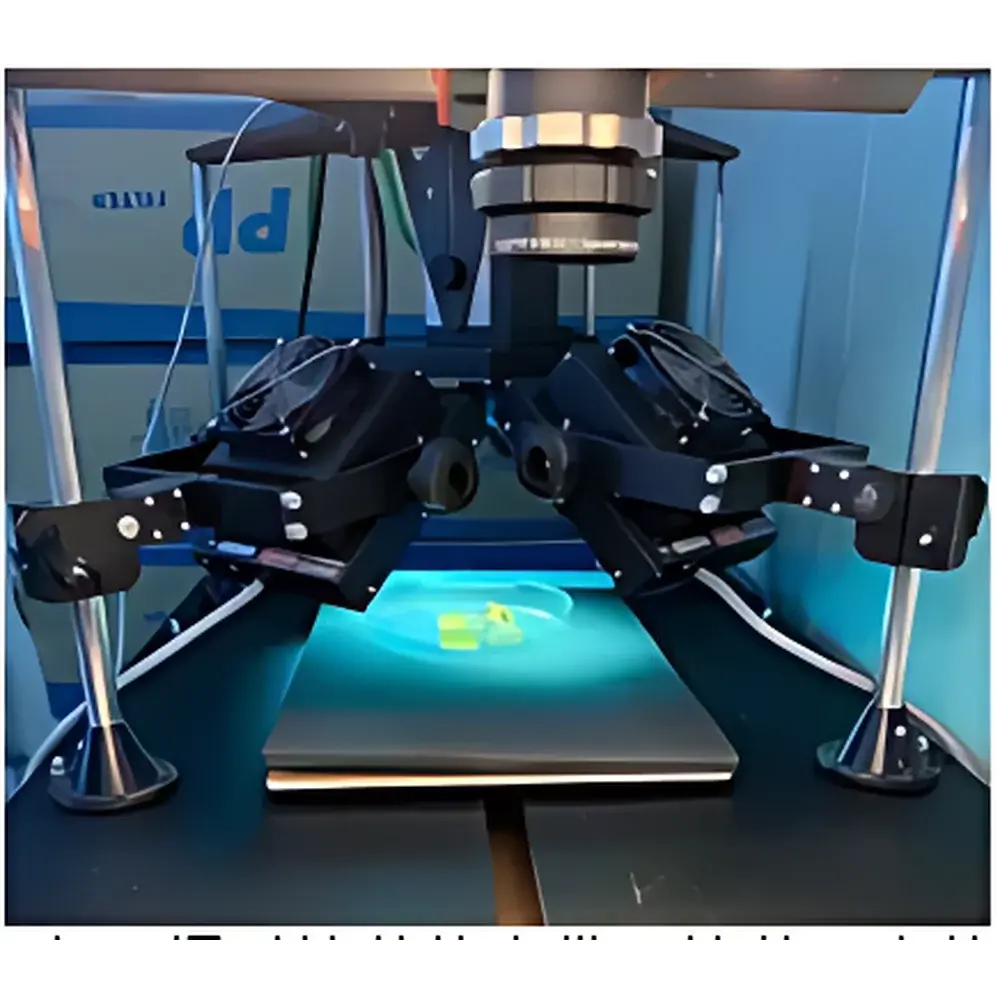
AlgaTech® High-Throughput Algal Phenotyping Imaging Platform
| Origin | Beijing, China |
|---|---|
| Manufacturer Type | Authorized Distributor |
| Origin Category | Domestic (China) |
| Model | AlgaTech® |
| Pricing | Upon Request |
Overview
The AlgaTech® High-Throughput Algal Phenotyping Imaging Platform is an integrated, non-invasive optical phenotyping system engineered for quantitative, multi-modal imaging of algal physiology and stress responses across diverse growth formats. Built upon the Plant-to-Sensor (PTS) automated conveyance architecture, it synchronizes high-spectral-resolution imaging with functional fluorescence assays to deliver spatially resolved, time-series phenotypic data at scale. The platform operates on core optical principles including hyperspectral reflectance (400–2500 nm), pulse-amplitude-modulated (PAM) chlorophyll fluorescence kinetics, multispectral UV-excited autofluorescence, and optional thermal emission mapping (7.5–13.5 µm). Designed for reproducible, GLP-aligned experimental workflows, it supports standardized acquisition protocols compliant with ISO 17025 traceability requirements for instrument calibration and data integrity.
Key Features
- Modular, PTS-based transport system with dual-rail synchronized vertical actuation and SpectraScan© precision linear scanning—enables repeatable positioning of samples (petri dishes, multi-well plates, macroalgae on substrates, benthic biofilms, or soil-embedded microalgae) beneath dedicated imaging stations.
- Triple-imaging station configuration: (1) VIS-NIR/SWIR hyperspectral imager (400–1000 nm & 900–1700 nm; optional 1000–2500 nm SWIR); (2) High-sensitivity chlorophyll fluorescence imager (720 × 560 px, 50 fps, saturating pulse up to 3900 µmol·m⁻²·s⁻¹); (3) UV-excited multispectral fluorescence imager (1392 × 1040 px, 7-position filter wheel supporting F440, F520, F690, F740 bands).
- Configurable excitation source array: UV-A (365 nm), cool white, monochromatic red (660 nm), blue (450 nm), green (520 nm), cyan (490 nm), and far-red (730 nm) LEDs—enabling tailored spectral stimulation for pigment-specific or secondary metabolite-responsive assays.
- Embedded environmental monitoring: Integrated temperature, relative humidity, and photosynthetic photon flux density (PPFD) sensors with GPS-synchronized real-time clock—ensuring metadata traceability for longitudinal studies.
- Protocol-driven automation: Supports user-defined experimental sequences (e.g., diurnal Kautsky induction followed by nocturnal NPQ recovery), with full audit trail logging per ISO/IEC 17025 and FDA 21 CFR Part 11–compatible data management.
- Touchscreen interface with embedded Linux OS and bilingual (English/Chinese) ground station software—enabling local operation, remote SSH access, and wireless control via LAN/WiFi.
Sample Compatibility & Compliance
The AlgaTech® platform accommodates a broad morphological spectrum: unicellular and colonial microalgae (in liquid suspension, agarose gels, or multi-well plates), filamentous species (e.g., Spirulina, Oscillatoria), macroalgae (e.g., Laminaria japonica thalli), epiphytic algae on coral fragments or artificial substrates, and soil-cyanobacterial crusts. All imaging modalities are non-destructive and require no labeling or fixation. System compliance includes CE marking for electromagnetic compatibility (EMC Directive 2014/30/EU), RoHS 2011/65/EU, and mechanical safety (Machinery Directive 2006/42/EC). Calibration certificates accompany all optional sensors (SWIR, IR thermal, high-res RGB), and spectral response functions are NIST-traceable where applicable.
Software & Data Management
The proprietary AlgaTech® Analysis Suite provides end-to-end workflow control—from protocol design and hardware orchestration to pixel-wise parameter extraction and statistical mapping. It implements FAIR (Findable, Accessible, Interoperable, Reusable) data principles: raw hypercubes (.bil/.hdr), fluorescence time-series (.csv/.mat), and thermal stacks (.tiff) are stored with embedded EXIF metadata (timestamp, sensor ID, exposure, gain, ambient conditions). Protocol templates support ASTM E2918-21 (standard guide for fluorescence imaging of biological specimens) and enable export of quantitative maps for Fv/Fm, Y(II), NPQ, Rfd, ETR, anthocyanin index (AI), photochemical reflectance index (PRI), and normalized difference vegetation index (NDVI). Data output conforms to MIAPPE v1.1 metadata standards and integrates with ELN systems via RESTful API.
Applications
- Algal strain screening under abiotic stress (salinity, temperature, nutrient limitation, heavy metals)
- Functional genomics validation in mutant libraries (e.g., photosystem II repair mutants)
- Time-resolved photoinhibition and recovery kinetics in marine phytoplankton
- Non-invasive quantification of phenolic compounds and flavonoids via UV-induced autofluorescence
- Thermal heterogeneity mapping during light-stress experiments (via optional IR module)
- Multi-omics correlation: Hyperspectral-derived pigment ratios aligned with transcriptomic or metabolomic datasets
- Greenhouse and controlled-environment facility deployment—mobile chassis with locking casters enables reconfiguration between lab, growth chamber, and greenhouse zones
FAQ
What spectral ranges does the standard hyperspectral imager cover?
The base configuration includes two spectrometers: 400–1000 nm (224 bands, FWHM 5.5 nm) and 900–1700 nm (224 bands, FWHM 8 nm). Optional 1000–2500 nm SWIR extension is available.
Can the system perform simultaneous multi-modal imaging?
No—imaging modalities operate sequentially under PTS control to ensure optical path integrity and avoid cross-talk; however, temporal synchronization within sub-second intervals is achievable via TTL-triggered acquisition.
Is FDA 21 CFR Part 11 compliance supported?
Yes—audit trail, electronic signatures, and role-based access control are implemented in the Analysis Suite; full validation documentation (IQ/OQ/PQ) is provided upon request.
What sample carriers are compatible with the PTS conveyor?
Standard carriers include 6-/12-/24-/96-well plates, 35/60/100 mm petri dishes, custom acrylic trays (up to 300 × 300 mm), and mounted macroalgal fragments secured on inert substrates.
Does the system support third-party software integration?
Yes—raw data export in ENVI, HDF5, and TIFF formats; Python and MATLAB SDKs are available for custom algorithm development and pipeline integration.
Related Products




