
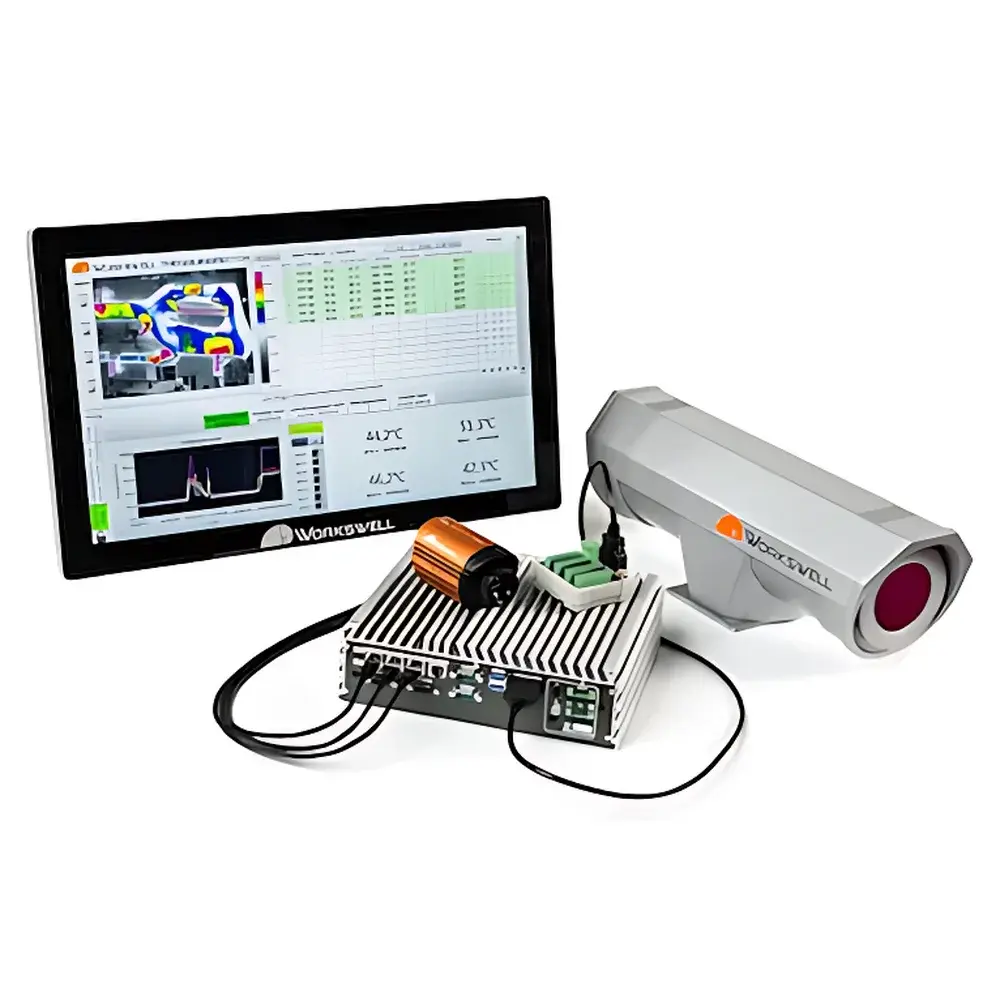
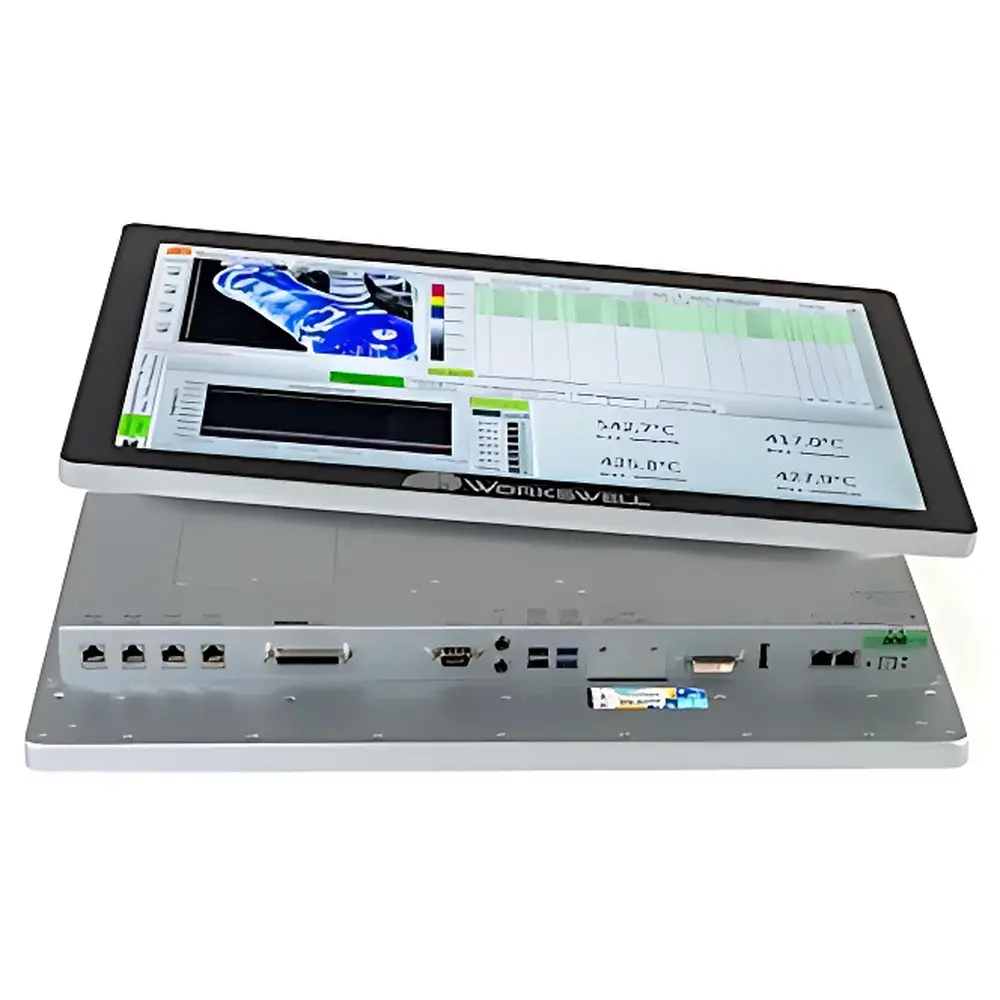
Workswell ThermoInspector Infrared Thermal Imaging Monitoring System
| Brand | Workswell |
|---|---|
| Origin | Czech Republic |
| Model | ThermoInspector |
| Temperature Range | −40 °C to 2000 °C (configurable per camera) |
| Thermal Sensitivity | < 0.03 °C NETD |
| Supported Cameras | Up to 4 LWIR cameras |
| Resolutions | 640×512, 336×256, or 160×128 |
| Interface | 4× PoE Ethernet ports, 8× digital I/O |
| Enclosure Rating | IP65 |
| Power Supply | 24 V DC via Ethernet or dedicated line |
| Operating Environment | Industrial, real-time process monitoring |
Overview
The Workswell ThermoInspector Infrared Thermal Imaging Monitoring System is an industrial-grade, multi-camera thermal vision platform engineered for continuous, non-contact surface temperature measurement and dynamic thermal field analysis in automated manufacturing and critical infrastructure environments. Based on long-wave infrared (LWIR) radiometry (7.5–14 µm spectral band), the system captures calibrated radiometric video streams from up to four synchronized thermal cameras—each equipped with high-stability microbolometer sensors delivering thermal sensitivity better than 0.03 °C NETD. Designed for integration into production lines, safety surveillance systems, and R&D test benches, ThermoInspector performs real-time thermographic evaluation of transient thermal events—including weld pool evolution, induction heating profiles, polymer cooling gradients, exothermic chemical reactions, and biological heat signatures—without requiring physical contact or emissivity recalibration during operation. Its architecture supports deterministic latency (< 50 ms end-to-end frame delivery), hardware-triggered acquisition, and deterministic synchronization across distributed camera nodes—making it suitable for time-critical process control applications compliant with IEC 61508 functional safety prerequisites.
Key Features
- Modular multi-sensor architecture supporting up to four LWIR cameras with selectable resolutions: 640×512, 336×256, or 160×128 pixels
- Dual central processing options: ruggedized touchscreen HMI unit (IP65 front panel, full-HD display, VESA mountable) or compact passive controller (26×22×8 cm) for space-constrained installations
- Real-time radiometric video streaming over Gigabit Ethernet with Power-over-Ethernet (PoE) support for all connected cameras
- Configurable measurement tools including point, line, rectangle, circle, and polygon ROIs—with live statistical output (min/max/avg/delta/median) per region
- Programmable alarm logic engine with user-defined thresholds, emissivity compensation per ROI, and digital I/O signaling (8× inputs/outputs) for PLC interfacing
- Full-screen visualization interface with customizable color palettes, isotherms, dynamic temperature scaling, and overlay annotations
- Industrial power architecture: 24 V DC input with redundant PoE sourcing; operating ambient range: −10 °C to +50 °C
Sample Compatibility & Compliance
ThermoInspector accommodates diverse material classes—including metals (steel, aluminum, copper), polymers (PP, PE, ABS), ceramics, composites, and organic substrates—across a broad emissivity range (0.1–0.99). Emissivity correction is applied per ROI using built-in lookup tables or manual entry, enabling quantitative accuracy on reflective or oxidized surfaces. The system complies with CE marking requirements under the EU Machinery Directive 2006/42/EC and EMC Directive 2014/30/EU. Radiometric calibration traceability follows ISO/IEC 17025-accredited procedures performed by Workswell’s metrology laboratory. For regulated industries, audit trails, user access logs, and configuration versioning support GLP/GMP documentation workflows. While not FDA 21 CFR Part 11-certified out-of-the-box, the system’s deterministic logging architecture and timestamped data export (CSV, HDF5, TIFF) enable validation-ready deployments in pharmaceutical or medical device manufacturing settings.
Software & Data Management
ThermoInspector operates with Workswell’s proprietary ThermoVision Studio software suite, deployed either embedded on the HMI unit or remotely via Windows/Linux clients. All captured radiometric frames are stored with full metadata—including sensor ID, exposure time, lens focal length, ambient reference temperature, and user-defined tags. Time-series data from multiple ROIs can be exported as synchronized CSV files or visualized in interactive plots showing temporal evolution of peak temperature, thermal gradient magnitude, or rate-of-change (°C/s). The software includes batch analysis mode for post-process evaluation of historical datasets, and supports scripting via Python API for custom analytics pipelines. Raw thermal data is archived in lossless 16-bit format; compressed streaming modes (H.264/H.265) are available for bandwidth-limited networks without compromising measurement integrity. Data encryption (AES-256) and role-based user authentication ensure secure access in shared infrastructure environments.
Applications
- Manufacturing Process Control: Real-time thermal validation of injection molding cycle consistency, laser welding melt pool stability, induction brazing uniformity, and composite autoclave cure profiling
- Preventive Maintenance & Safety Monitoring: Continuous surveillance of electrical cabinets, conveyor bearings, furnace linings, slag levels in metallurgical ladles, and coal stockpile hotspots in bulk material handling
- Quality Assurance: Detection of delamination in bonded structures, void formation in castings, and thermal signature anomalies in PCB assemblies or battery modules
- Research & Development: Quantitative thermography for reaction kinetics studies in catalysis, thermal effusivity mapping of novel insulation materials, and plant physiological response tracking under controlled environmental stress
- Environmental & Agricultural Surveillance: Surface temperature anomaly detection in landfill methane oxidation zones, irrigation efficiency assessment via canopy temperature differentials, and forest fire risk early warning through thermal contrast analysis
FAQ
Can ThermoInspector operate in hazardous environments?
Yes—when integrated with ATEX-certified camera housings and intrinsically safe barriers, the system meets Zone 2/22 classification requirements. Standard units are rated IP65 for dust/water resistance but require external enclosure for explosive atmospheres.
Does the system support third-party camera integration?
No—ThermoInspector is designed exclusively for Workswell-branded LWIR cameras with proprietary firmware handshake and timing protocols. Interoperability with non-Workswell sensors is not supported.
How is radiometric calibration maintained over time?
Each camera undergoes factory calibration against NIST-traceable blackbody sources. Drift compensation is implemented via internal shutter-based non-uniformity correction (NUC) executed automatically every 5–30 minutes depending on operational mode and ambient stability.
What PLC communication protocols are supported?
Digital I/O signals (24 V TTL-compatible) are provided for discrete alarm triggering. Modbus TCP is available via optional software module for register-level read/write access to temperature values and system status variables.
Is remote configuration possible over public networks?
Configuration and monitoring are restricted to local area networks by default. Secure remote access requires deployment behind enterprise-grade firewalls and VPN gateways; no cloud connectivity or vendor-hosted services are included.




