
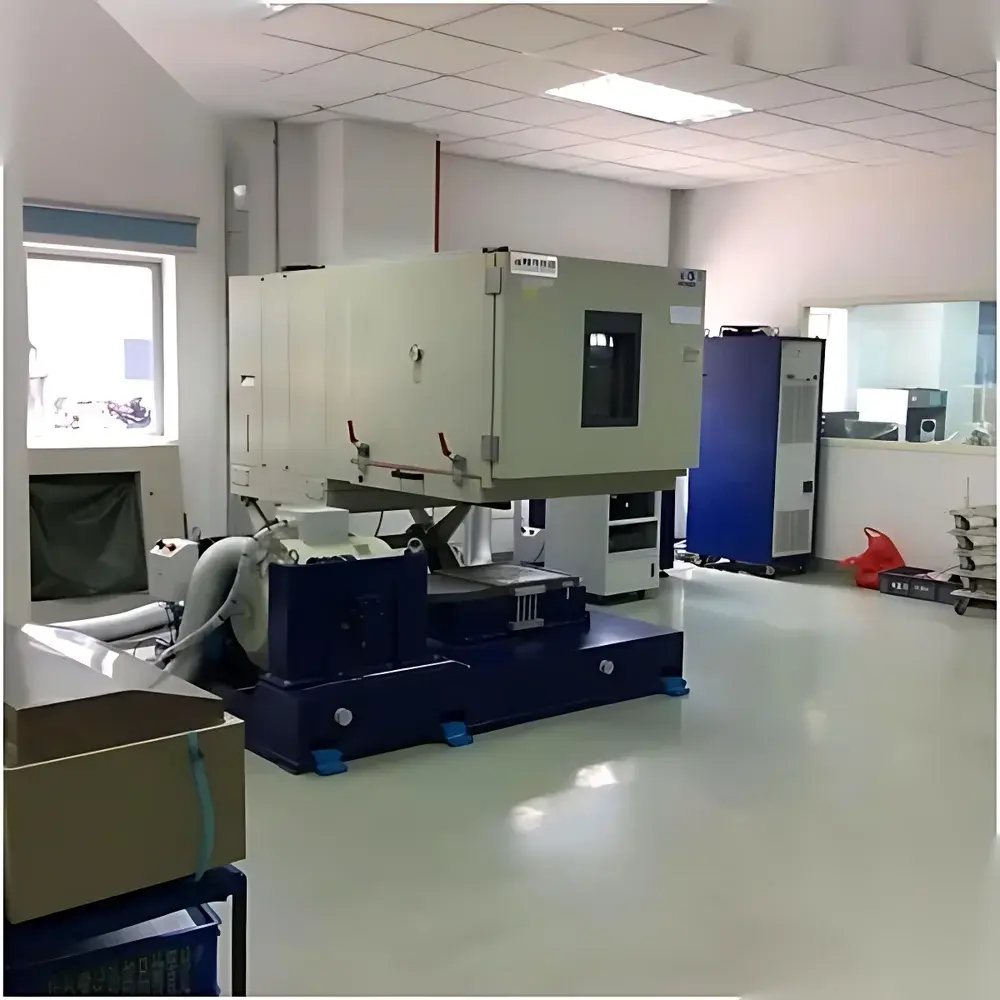
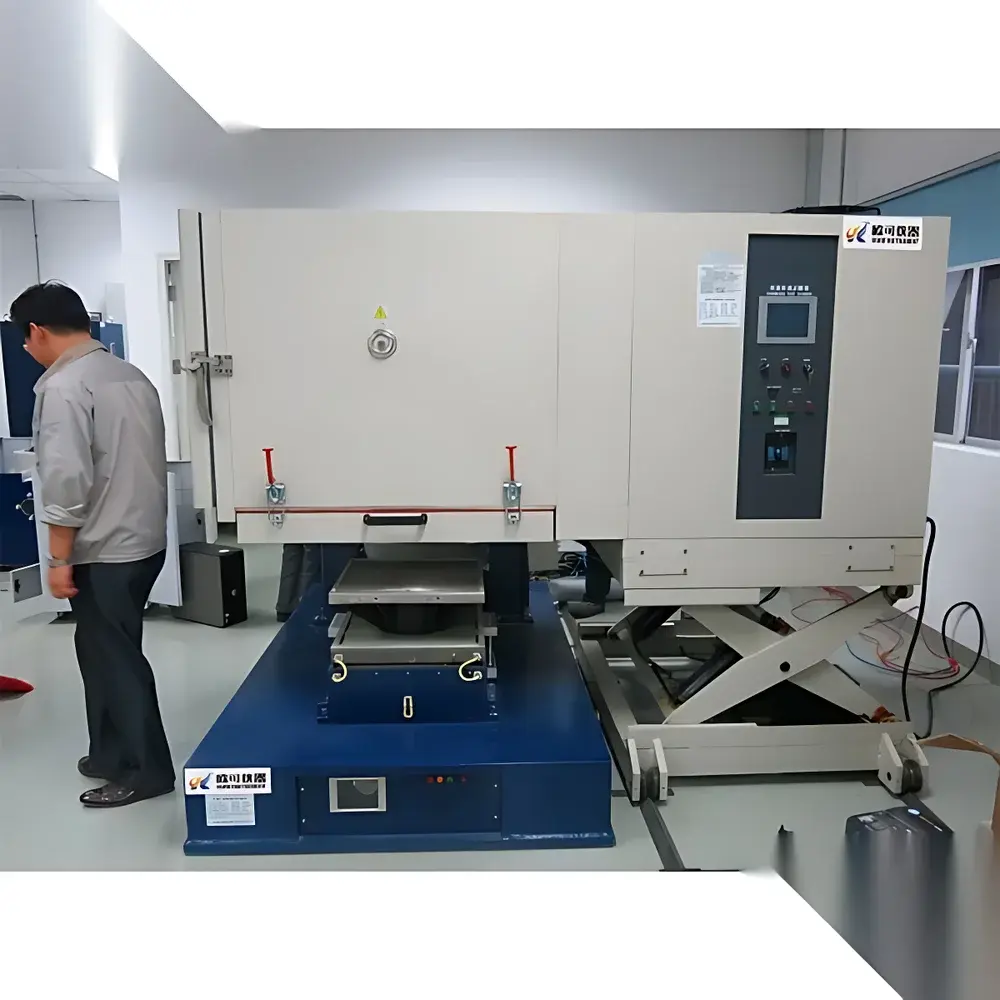
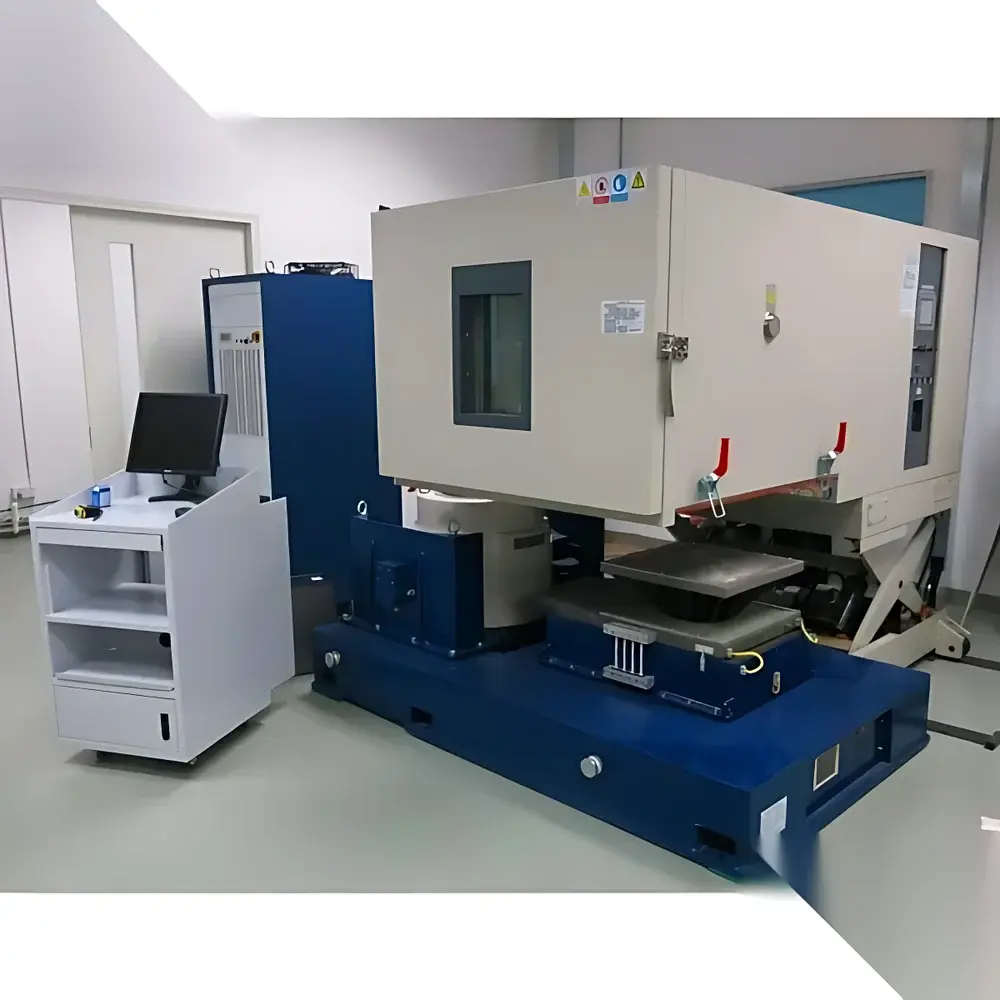
Combined Temperature-Humidity-Vibration Environmental Test Chamber
| Temperature Range | -20 °C to 150 °C |
|---|---|
| Temperature Uniformity | ≤ ±2 °C |
| Temperature Fluctuation | ±0.5 °C |
| Temperature Deviation | ≤ ±2 °C |
| Ramp Rate | 0.7–1.0 °C/min |
| Test Duration Setting | 0–9999 hours |
| Sinusoidal Force Capacity | 2.94 kN (300 kgf) |
| Frequency Range | 5–500 Hz |
| Maximum Acceleration | 980 m/s² (100 g) |
| Maximum Velocity | 1.1 m/s |
| Maximum Displacement | 25 mm peak-to-peak |
| Moving Mass | 2.7 kg |
| Maximum Payload | 120 kg |
| Table Surface Dimensions | 150 mm × 150 mm |
| Vibration Axis | Vertical (Z-axis only) |
| Power Supply | AC 380 V ±10%, 50 Hz, 3-phase 5-wire |
Overview
The Combined Temperature-Humidity-Vibration Environmental Test Chamber is an integrated reliability testing platform engineered for simultaneous exposure of test specimens to controlled thermal, hygrothermal, and mechanical vibrational stressors. It operates on the principle of accelerated environmental simulation—combining precision climate control (via refrigeration, heating, and steam-based humidification) with high-fidelity electrodynamic vibration excitation—to replicate real-world service conditions encountered by aerospace components, automotive electronics, medical devices, and industrial control systems. Unlike sequential or single-stress test methods, this chamber enables true multi-stress synergy: temperature-induced material expansion/contraction occurs concurrently with resonant mechanical loading, revealing latent failure modes such as solder joint fatigue, seal delamination, or sensor drift under thermally modulated dynamic strain. Its architecture complies with foundational test standard frameworks—including IEC 60068-2-6 (vibration), IEC 60068-2-14 (thermal shock), and IEC 60068-2-78 (damp heat)—and supports method development aligned with MIL-STD-810H, DO-160G, and ISO 16750-4 protocols.
Key Features
- Triple-independent control architecture: fully decoupled temperature, humidity, and vibration subsystems ensure no cross-interference during concurrent operation.
- Electrodynamic shaker system with 2.94 kN force capacity, 5–500 Hz frequency coverage, and programmable profiles including sine sweep, random PSD, and classical shock waveforms (half-sine, trapezoidal).
- High-efficiency dual-stage refrigeration system featuring a hermetic Tecumseh (France) compressor, A-Gas (USA) dryer filters, and Castel (Italy) solenoid valves—optimized for stable sub-zero operation down to –60 °C.
- Uniform climate distribution via top-mounted centrifugal blower, bottom return air ducting, and multi-layer airflow baffle design—achieving ≤ ±2 °C spatial uniformity across the 150 mm × 150 mm test table.
- Modular vibration table interface: epoxy-silicone composite sealing between shaker and chamber floor enables rapid insertion/removal of the 2.7 kg moving mass assembly without compromising chamber integrity.
- Optically enhanced observation window with laminated tempered glass and conductive ITO film for real-time visual monitoring under operational conditions.
- Dual redundant safety interlocks: hardware-based over-temperature, over-humidity, and over-acceleration cut-offs integrated with software-level fault logging and emergency stop circuitry.
Sample Compatibility & Compliance
The chamber accommodates samples up to 120 kg gross mass on its rigid stainless-steel test table, with standardized 50 mm diameter feedthrough ports (left-side mounted) for external power, signal, or thermocouple routing. Internal chamber construction uses SUS304 mirror-finish stainless steel interior and A3 steel exterior with epoxy powder coating; insulation consists of high-density ultra-fine glass wool (λ ≤ 0.035 W/m·K). All materials meet UL 94 V-0 flammability requirements. The system supports compliance documentation generation per ISO/IEC 17025 calibration traceability and includes built-in audit trails for GLP/GMP-regulated environments. While not pre-certified to specific regulatory marks, its functional architecture aligns with FDA 21 CFR Part 11 data integrity requirements when paired with validated software configurations.
Software & Data Management
Control and analysis are executed via a dedicated industrial PC running Windows Embedded OS, equipped with a dual-channel charge amplifier DSP interface box and real-time vibration controller firmware. The bundled software suite—licensed from a U.S.-based developer—includes three core modules: Sine Vibration Control (with auto-resonance tracking and dwell control), Random Vibration Control (PSD synthesis, kurtosis enhancement, and fatigue damage spectrum calculation), and Classical Shock Control (pulse shaping, velocity change verification). All test parameters, setpoints, and real-time sensor data (acceleration, temperature, RH%) are logged at user-selectable intervals (10 ms–1 s) in CSV and binary formats. Data export supports third-party post-processing tools (MATLAB, Python SciPy, nCode DesignLife) and integrates with enterprise LIMS via OPC UA or Modbus TCP.
Applications
This chamber is deployed in R&D labs and quality assurance centers for qualification testing of: printed circuit board assemblies (PCBAs) subjected to thermal cycling + resonance; battery management systems exposed to humidity ingress + mechanical shock; avionics enclosures undergoing DO-160G Section 21 (vibration) and Section 10 (temperature/humidity); and implantable medical device housings validated per ISO 14971 risk analysis pathways. It is also used in failure analysis workflows to reproduce field returns linked to thermo-mechanical mismatch, condensation-induced corrosion, or micro-vibration-induced contact wear.
FAQ
Can the chamber perform independent humidity-only tests without vibration or temperature cycling?
Yes—the control system allows any combination of stressors to be activated or deactivated individually, supporting standalone humidity soak, temperature ramp, or vibration profile execution.
Is the vibration table capable of horizontal (X/Y-axis) excitation?
No—this model provides vertical (Z-axis) excitation only. Horizontal capability requires a separate 3-axis shaker configuration, which is not supported by the current mechanical interface.
What calibration standards apply to the temperature and humidity sensors?
Sensors are factory-calibrated against NIST-traceable references; optional annual recalibration services include ISO/IEC 17025-compliant certificates with uncertainty budgets per ANSI/NCSL Z540-1.
Does the system support remote monitoring and alarm notification?
Yes—via Ethernet-connected web server interface; email/SMS alerts can be configured for out-of-tolerance events, system faults, or test completion.
Are custom test profiles exportable between instruments?
All profile definitions (.vib, .thc files) adhere to IEEE 1671-2010 Standard for Test Description Language (TDL), ensuring interoperability across compliant platforms.



