
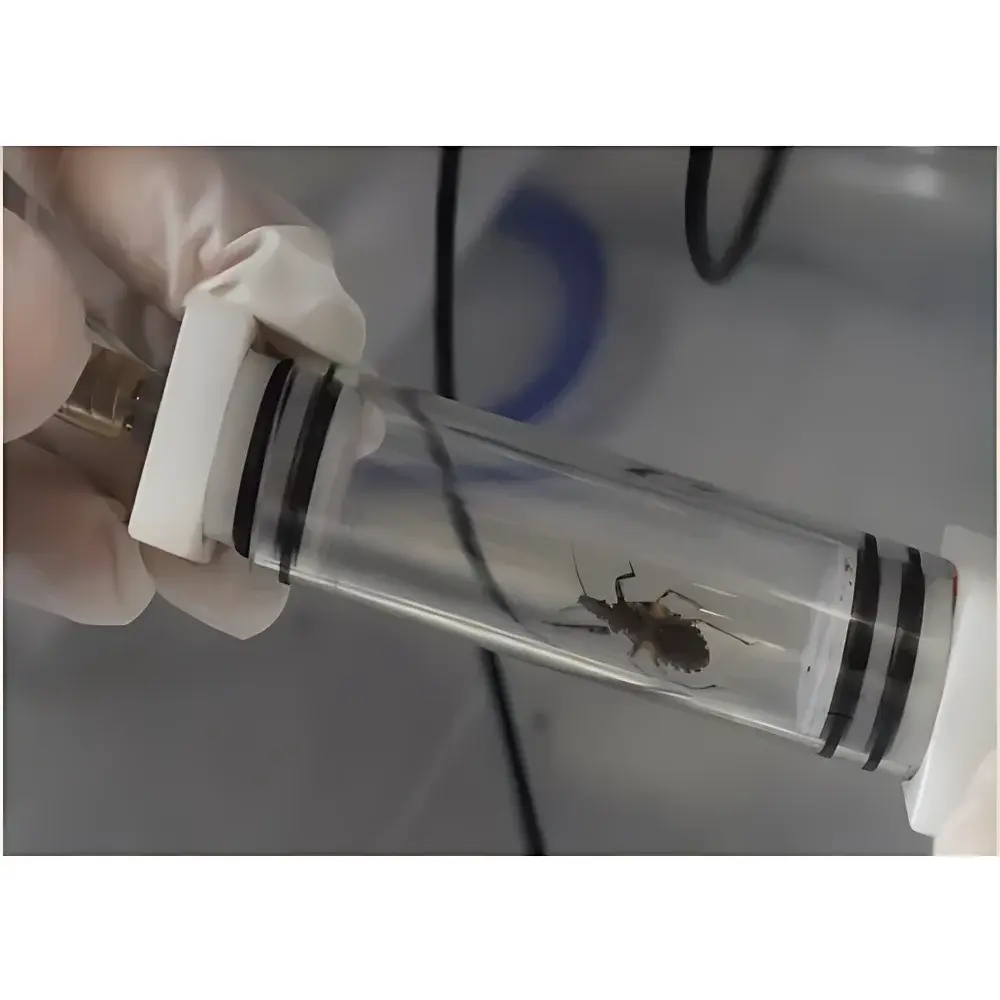
Sable Systems International SSI-High-Throughput High-Resolution Vector Respiratory Phenotyping System
| Brand | Sable |
|---|---|
| Origin | USA |
| Manufacturer Type | Authorized Distributor |
| Origin Category | Imported |
| Model | SSI-High-Throughput |
| Pricing | Upon Request |
Overview
The Sable Systems International SSI-High-Throughput High-Resolution Vector Respiratory Phenotyping System is a purpose-engineered, multi-channel respirometry platform designed for quantitative, real-time physiological phenotyping of arthropod disease vectors—including mosquitoes, ticks, fleas, sandflies, triatomines, and other small ectothermic organisms. Operating on the principle of flow-through open-circuit respirometry, the system enables simultaneous, non-invasive measurement of O2 consumption (VO2), CO2 production (VCO2), H2O vapor flux, and locomotor activity across up to 32 independent measurement chambers. Unlike traditional closed- or stop-flow systems, its fully ventilated architecture maintains normoxic and normocapnic conditions throughout extended assays—eliminating hypoxia- or hypercapnia-induced metabolic artifacts and ensuring physiological fidelity during long-term starvation, thermal stress, or pharmacological challenge studies. The system integrates high-precision gas analyzers, mass flow controllers with PID regulation, environmental sensors (temperature, humidity, light), and infrared-based motion tracking into a unified, time-synchronized data acquisition framework.
Key Features
- Scalable channel capacity: Configurable for 16- or 32-channel parallel monitoring with individually addressable, temperature-stabilized respirometry chambers (e.g., 200 µL for ticks; 2.4 mL for adult Drosophila)
- Ultra-fast per-individual metabolic sampling: As low as 15-second measurement cycles—enabling high-temporal-resolution tracking of circadian activity-metabolism coupling
- Dual high-fidelity gas analysis: Fuel-cell O2 sensor (0–100% range, ±0.1% accuracy, 0.0001% resolution, <7 s T90, auto-compensated for T/P); NDIR CO2/H2O analyzer (0–3000 ppm CO2, ±1% accuracy, 0.01 ppm resolution; 0–60 mmol/mol H2O, ±1% accuracy)
- Environmental control & monitoring: Integrated light sensor (0.1–5000 lux), high-resolution temperature probe (0–50°C, ±0.25°C, 0.01°C resolution), barometric pressure sensor (1 Pa resolution, ±0.05% full scale)
- Modular expandability: Optional add-ons include 2D/3D behavioral tracking (IR-based motion mapping), Peltier-controlled thermal gradients, secondary sampling modules (5–2000 mL/min flow, RS-232 + analog output), and analog input expansion (6 channels, 16-bit, ±5 V)
- Data integrity architecture: Time-stamped CSV export via SD card (up to 32 GB); native compatibility with Sable’s ExpeData™ software for GLP-compliant audit trails, metadata annotation, and batch processing
Sample Compatibility & Compliance
The system accommodates life-stage-specific respiratory phenotyping—from eggs and larvae to pupae and adults—across medically relevant vectors including *Aedes aegypti*, *Ixodes scapularis*, *Triatoma infestans*, *Phlebotomus papatasi*, and *Ctenocephalides felis*. Chamber geometries and flow rates (5–200 mL/min, mass-flow controlled) are optimized to minimize diffusion limitations while preserving signal-to-noise ratio in low-metabolic-rate specimens. All hardware and firmware comply with ISO/IEC 17025 calibration traceability standards; software supports 21 CFR Part 11-compliant electronic signatures, user-access controls, and immutable audit logs—making it suitable for regulatory preclinical vector physiology studies under GLP or GMP-aligned workflows.
Software & Data Management
ExpeData™ v8.5 serves as the central acquisition, visualization, and analysis engine. It synchronizes gas fluxes, activity indices (Absolute Difference Sum, ADS), environmental variables, and optional video-derived behavioral metrics at 1 Hz resolution. Built-in algorithms compute standard respirometric parameters (RER, metabolic rate, factorial scope), detect rest-activity transitions, and align physiological outputs with photoperiod or thermal ramp protocols. Raw data files retain full metadata (chamber ID, timestamp, calibration history, sensor status), enabling reproducible reprocessing. Export formats include CSV, MATLAB (.mat), and HDF5—facilitating integration with R/Bioconductor pipelines for multivariate modeling of vector energetics, transcriptomic correlations, or machine learning–driven phenotype classification.
Applications
- Vector starvation physiology: Quantifying progressive shifts in metabolic rate, substrate utilization (e.g., glycogen → lipid → protein catabolism), and host-seeking behavior during prolonged fasting (e.g., Rosendale et al., *Molecular Ecology*, 2018)
- Microbiome–host behavioral modulation: Assessing Wolbachia-induced changes in locomotor activity, circadian rhythmicity, and thermal preference across genetically diverse host backgrounds (Hague et al., *Biology Letters*, 2021)
- Insecticide resistance phenotyping: Detecting aerobic metabolism alterations linked to deltamethrin resistance mechanisms in *Triatoma infestans* (Rolandi et al., *J Med Entomol*, 2020)
- Climate–disease interface research: Evaluating temperature-dependent metabolic plasticity and biting persistence in tsetse flies under combined hygric and thermal stress (Béguin et al., *Parasites & Vectors*, 2013)
- Translational vector control: Validating novel repellents, attractants, or sterilants via real-time respiration–activity coupling metrics prior to field trials
FAQ
What is the minimum measurable metabolic rate for a single tick nymph?
The system achieves sub-pmol/s CO2 detection sensitivity under optimized flow (30 mL/min) and chamber volume (200 µL), validated for *Dermacentor variabilis* and *Ixodes scapularis* across 1–36 week starvation time courses.
Can the system operate unattended for >72 hours?
Yes—continuous operation is supported by stable power supply (12–15 VDC), passive thermal management, and internal SD logging with automatic file rotation; ambient temperature must remain within 0–50°C, non-condensing.
Is third-party gas analyzer integration possible?
Yes—six 16-bit analog inputs accept voltage signals from external analyzers (e.g., NOx, CH4, NH3), synchronized via TTL triggers and time-stamped in ExpeData™.
How is chamber cross-contamination prevented during multi-channel runs?
Each channel employs dedicated mass flow controllers and solenoid valves; gas paths are physically isolated, with stainless-steel manifolds and electropolished tubing minimizing adsorption and memory effects.
Does the system support FDA 21 CFR Part 11 compliance?
ExpeData™ includes role-based access control, electronic signatures, automated audit trails, and data immutability features—fully configurable to meet Part 11 requirements for regulated vector physiology studies.





