
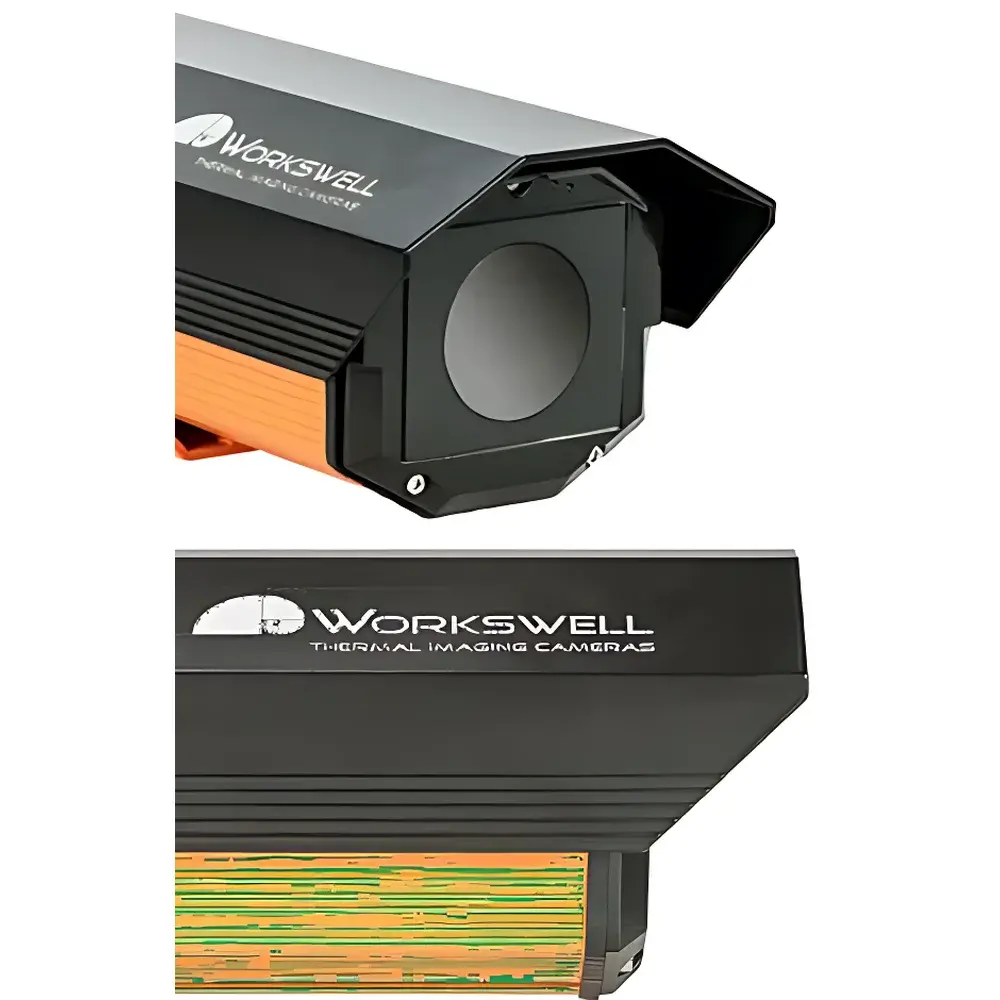
Workswell SAFETIS OUTDOOR Early-Warning Infrared Thermal Imaging Fire Detection System
| Brand | Workswell |
|---|---|
| Origin | Czech Republic |
| Model | SAFETIS OUTDOOR |
| Resolution | 640×512 px (standard), 336×256 px (optional) |
| Frame Rate | 9 Hz or 30 Hz |
| Thermal Sensitivity | 50 mK (0.05 °C) |
| Spectral Range | 7.5–13.5 µm |
| Detector Type | Uncooled VOx Microbolometer |
| Temperature Range | −40 °C to +550 °C (standard), up to +1500 °C (optional) |
| Accuracy | ±2% or ±2 °C (depending on lens/FOV) |
| IFOV | 0.895–2.267 mrad |
| NETD | ≤50 mK |
| IP Rating | IP67 |
| Operating Temperature | −25 °C to +50 °C |
| Power Input | 110/230 VAC, <20 W |
| Digital Outputs | 7 (camera), 7 (control unit), total 14 isolated open-collector |
| Communication | 100 Mbps Ethernet (RJ-45), integrated web server |
| Lens Options | 7.5 mm (FOV 90°×69°), 9 mm (69°×56°), 13 mm (45°×37°), 19 mm (32°×26°) |
| Calibration | Factory-calibrated with traceable certificate |
| Software Interface | SAFETIS SDK, LabVIEW examples, browser-based configuration (Chrome, Firefox, Safari, Edge) |
Overview
The Workswell SAFETIS OUTDOOR Early-Warning Infrared Thermal Imaging Fire Detection System is an industrial-grade, continuous-monitoring solution engineered for autonomous, real-time detection of incipient thermal anomalies preceding flame ignition. Based on uncooled vanadium oxide (VOx) microbolometer technology operating in the long-wave infrared (LWIR) spectral band (7.5–13.5 µm), the system detects subtle temperature gradients and localized hotspots—often undetectable by conventional smoke or point-heat sensors—enabling intervention before combustion escalates. Unlike passive thermal cameras used for inspection, SAFETIS OUTDOOR integrates domain-specific fire physics algorithms—including dynamic ROI-based thresholding, emissivity-compensated absolute temperature mapping, and motion-adaptive background subtraction—to suppress false alarms from solar loading, reflected radiation, or mechanical movement. Its design targets mission-critical infrastructure where downtime, asset exposure, or regulatory noncompliance carries high consequence: waste management facilities (landfills, transfer stations), energy infrastructure (substations, photovoltaic farms), logistics hubs (automated warehouses), and industrial storage (chemical depots, tire recycling centers).
Key Features
- High-resolution thermal imaging: Standard 640×512 pixel detector with optional 336×256 configuration for cost-optimized deployment.
- Thermal sensitivity of ≤50 mK (0.05 °C) at f/1.0, ensuring reliable detection of sub-degree temperature deviations across large fields of view.
- Multi-range calibrated temperature measurement: Standard range −40 °C to +550 °C; extended options up to +1500 °C for metallurgical or high-temperature process monitoring.
- IP67-rated aluminum housing with integrated anti-icing heater, enabling operation in harsh outdoor environments (−25 °C to +50 °C ambient, 5–95% RH non-condensing).
- Dual control architecture: Standalone operation via embedded web server (no client software required) or centralized management through the SAFETIS Control Unit supporting up to 16 synchronized cameras.
- 14 configurable digital outputs (7 per device): Isolated open-collector signals (≤40 VDC) for direct integration with fire alarm panels, PLCs, HVAC shutdown systems, or suppression actuators.
- Pre-alarm video recording: Captures radiometric video streams up to 30 seconds prior to trigger event, preserving full thermal context for forensic analysis and root-cause investigation.
Sample Compatibility & Compliance
SAFETIS OUTDOOR is designed for continuous surveillance of heterogeneous, spatially extensive targets—including conveyor belts carrying combustible refuse, transformer banks emitting conductive heat signatures, PV panel arrays exhibiting hot-spot degradation, and landfill surface gas migration zones. It complies with fundamental electromagnetic compatibility (EMC) requirements per EN 61000-6-2/-4 and meets mechanical robustness standards aligned with IEC 60068-2 environmental testing protocols. While not a certified fire alarm device under EN 54-2 or UL 268, the system delivers input data suitable for integration into certified life-safety systems as a supplementary early-warning sensor layer. Its radiometric calibration traceability follows ISO/IEC 17025 principles, and factory calibration certificates are provided with each unit. For regulated industries (e.g., pharmaceutical warehousing, food processing), audit-ready logging—including timestamped thermal metadata, user-access logs, and parameter-change history—is maintained in accordance with GLP-aligned data integrity practices.
Software & Data Management
Configuration and monitoring occur via a standards-compliant embedded web server accessible through any modern browser (Chrome, Firefox, Safari, Edge)—eliminating proprietary runtime dependencies. The SAFETIS SDK provides C/C++, Python, and .NET APIs for custom integration into SCADA, MES, or cloud-based IoT platforms. LabVIEW example applications facilitate rapid prototyping of alarm logic and visualization dashboards. All thermal video and still frames are stored in full-radiometric format (16-bit TIFF or SEQ), preserving raw pixel-intensity values for post-event quantitative analysis. The SAFETIS Control Unit implements deterministic time-synchronized acquisition across all connected cameras, supports scheduled radiometric image capture, and generates time-series temperature trend plots per defined ROI. Audit trails record all configuration changes, user logins, alarm activations, and output state transitions—supporting compliance with FDA 21 CFR Part 11 requirements when deployed in validated environments.
Applications
- Waste management: Real-time hotspot detection on active landfill surfaces, compost piles, and municipal solid waste conveyors to prevent spontaneous combustion.
- Energy infrastructure: Continuous thermal profiling of HV/MV switchgear, dry-type transformers, and battery energy storage systems (BESS) to identify insulation failure precursors.
- Renewable generation: Automated scanning of photovoltaic arrays for defective cells, bypass diode failures, and soiling-induced thermal mismatch.
- Industrial logistics: Monitoring automated storage-and-retrieval systems (AS/RS), pallet racking, and flammable goods staging areas without line-of-sight constraints.
- Mining & aggregates: Surveillance of conveyor head pulleys, crusher bearings, and stockpile edges where frictional heating precedes fire initiation.
FAQ
Is SAFETIS OUTDOOR certified as a Class A fire alarm device under EN 54?
No. SAFETIS OUTDOOR is a thermal anomaly detection system intended for early warning and integration into broader fire safety architectures—not a standalone EN 54-certified alarm appliance.
Can the camera operate without the SAFETIS Control Unit?
Yes. All core detection, visualization, and alarm functions are implemented onboard via the integrated web server and firmware.
What is the maximum distance at which a 1°C hotspot can be reliably detected?
Detection range depends on lens selection, target emissivity, atmospheric transmission, and required spatial resolution. Using the 19 mm lens (IFOV 0.895 mrad), a 1°C anomaly ≥5 cm in diameter is resolvable up to ~55 m under typical outdoor conditions.
Does the system support integration with BMS or DCS platforms?
Yes—via Modbus TCP (through SAFETIS SDK), OPC UA (custom wrapper), or HTTP RESTful API endpoints for alarm state, temperature values, and image metadata.
How is calibration maintained over time in outdoor installations?
The detector performs non-uniformity correction (NUC) automatically during startup and at user-defined intervals. No shutter-based recalibration is required; factory calibration remains valid for 24 months under normal operating conditions.







