
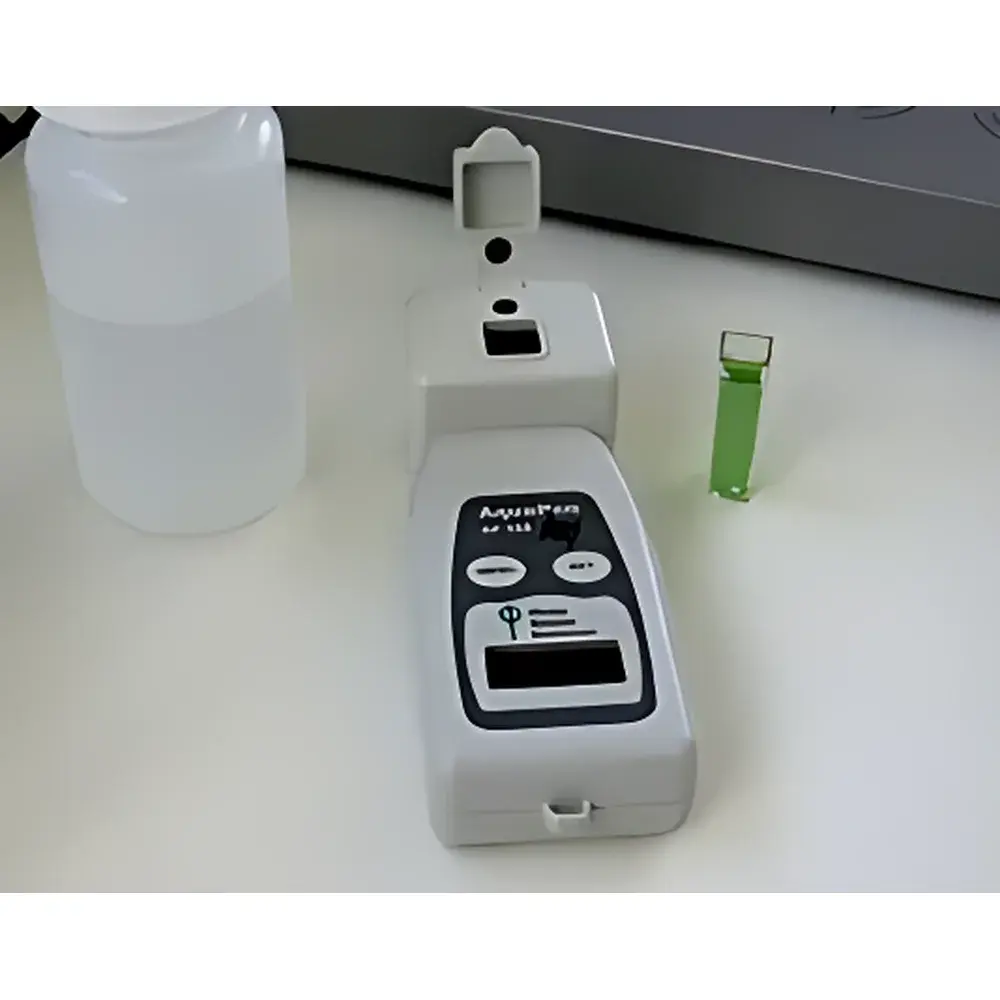
AP-C100 Handheld Chlorophyll Fluorescence Analyzer
| Origin | Czech Republic |
|---|---|
| Manufacturer Type | Authorized Distributor |
| Origin Category | Imported Instrument |
| Model | AP-C100 |
| Pricing | Available Upon Request |
Overview
The AP-C100 Handheld Chlorophyll Fluorescence Analyzer is a compact, field-deployable instrument engineered for high-fidelity measurement of chlorophyll a fluorescence kinetics in intact plant tissues and photosynthetic microorganisms. It operates on the principle of pulse-amplitude-modulated (PAM) fluorometry, utilizing precisely controlled LED excitation (blue, optionally red or white) to probe the functional status of Photosystem II (PSII) with minimal perturbation. The system quantifies key biophysical parameters—including Fo, Ft, Fm, Fm′, QY (quantum yield), NPQ (non-photochemical quenching), and the OJIP transient—enabling non-invasive, real-time assessment of photochemical efficiency, electron transport capacity, and stress-induced photophysiological adjustments. Designed for rigorous field and laboratory use, the AP-C100 delivers reproducible data under variable ambient conditions (0–55 °C, 0–95% RH non-condensing), supporting both fundamental research and applied agronomic monitoring.
Key Features
- Modulated PAM fluorometry architecture with dual-wavelength detection (697–750 nm) optimized for chlorophyll a emission
- Adjustable actinic and saturating light intensities (0–3000 µmol·m⁻²·s⁻¹), enabling dynamic light-response profiling
- Integrated PAR sensor (400–700 nm) with real-time µmol(photon)·m⁻²·s⁻¹ output and 20-point averaging capability
- Embedded GPS module (standard in full configuration) for georeferenced data logging and spatial mapping of physiological heterogeneity
- Ruggedized ergonomic housing (120 × 57 × 30 mm; 180 g) with IP65-rated sealed keypad and low-power LCD display (2 × 8 characters)
- Extended battery life: up to 70 hours continuous operation on four AAA alkaline or rechargeable cells, with auto-shutdown after 5 minutes of inactivity
- Onboard storage capacity: 100,000 measurements (4 MB flash memory), supporting multi-parameter protocols including OJIP kinetics, light curves (up to three profiles), and NPQ1/NPQ2 calculations
Sample Compatibility & Compliance
The AP-C100 is validated for use across diverse photosynthetic matrices: vascular plant leaves (dicots and monocots), bryophytes (mosses, liverworts), lichens, biological soil crusts, and phytoplankton suspensions in surface water samples. Its non-destructive, contact-based measurement protocol aligns with ISO 10264 (field instrumentation for plant physiology) and supports GLP-compliant experimental workflows when paired with FluorPen 2.0 software. Data integrity is maintained through timestamped, location-stamped records, satisfying traceability requirements for environmental monitoring programs and regulatory submissions (e.g., OECD TG 201, EPA OPPTS 850.4400). All firmware and calibration routines are traceable to NIST-traceable optical standards.
Software & Data Management
FluorPen 2.0 software (Windows 2000/XP or later) provides full remote control, real-time parameter visualization, and synchronized GPS plotting. Raw fluorescence transients and derived metrics export directly to CSV or Excel-compatible formats for downstream statistical analysis (e.g., R, Python, GraphPad Prism). The software implements automated dark-adaptation validation, baseline correction algorithms for Fo/Fm determination, and standardized NPQ calculation per the Kramer et al. (2004) formalism. Audit trails—including operator ID, session timestamps, instrument firmware version, and calibration history—are retained for 21 CFR Part 11–compliant environments upon optional user authentication setup.
Applications
- Quantification of PSII photochemical efficiency (Fv/Fm, ΦPSII) in stress physiology studies (drought, heat, heavy metals, salinity, nutrient deficiency)
- High-throughput screening of crop germplasm for abiotic/biotic stress tolerance during breeding programs
- Monitoring pesticide mode-of-action and phytotoxicity via rapid fluorescence decline kinetics
- In situ assessment of symbiotic interactions (plant–rhizobia, plant–mycorrhiza, plant–endophytes) through photosynthetic performance modulation
- Ecological surveys of cryptogamic ground cover health in arid and semi-arid ecosystems
- Validation of remote sensing indices (e.g., PRI, NDVI) using ground-truthed fluorescence parameters
- Teaching laboratories: demonstration of photosynthetic electron transport, light saturation responses, and photoprotective mechanisms
FAQ
What is the spectral range of the detection channel?
The fluorescence detection band is centered at 720 nm with a full width at half maximum (FWHM) spanning 697–750 nm.
Can the instrument measure both dark- and light-adapted parameters in a single session?
Yes—built-in dark-adaptation timer (configurable from 0 to 60 minutes) and automatic Fo/Fm acquisition enable sequential dark- and light-adapted measurements without manual reconfiguration.
Is firmware upgrade supported in the field?
Yes—firmware updates are delivered via USB or Bluetooth and preserve all stored datasets and user-defined protocols.
Does the PAR sensor require external calibration?
No—the integrated quantum sensor is factory-calibrated against NIST-traceable reference diodes and includes temperature compensation for stable output across operational ranges.
How is data security ensured during transfer from device to PC?
All communication channels (USB, Bluetooth, serial) transmit encrypted metadata headers; raw fluorescence waveforms are stored unaltered in proprietary binary format with optional password-protected access layers.
Related Products



