
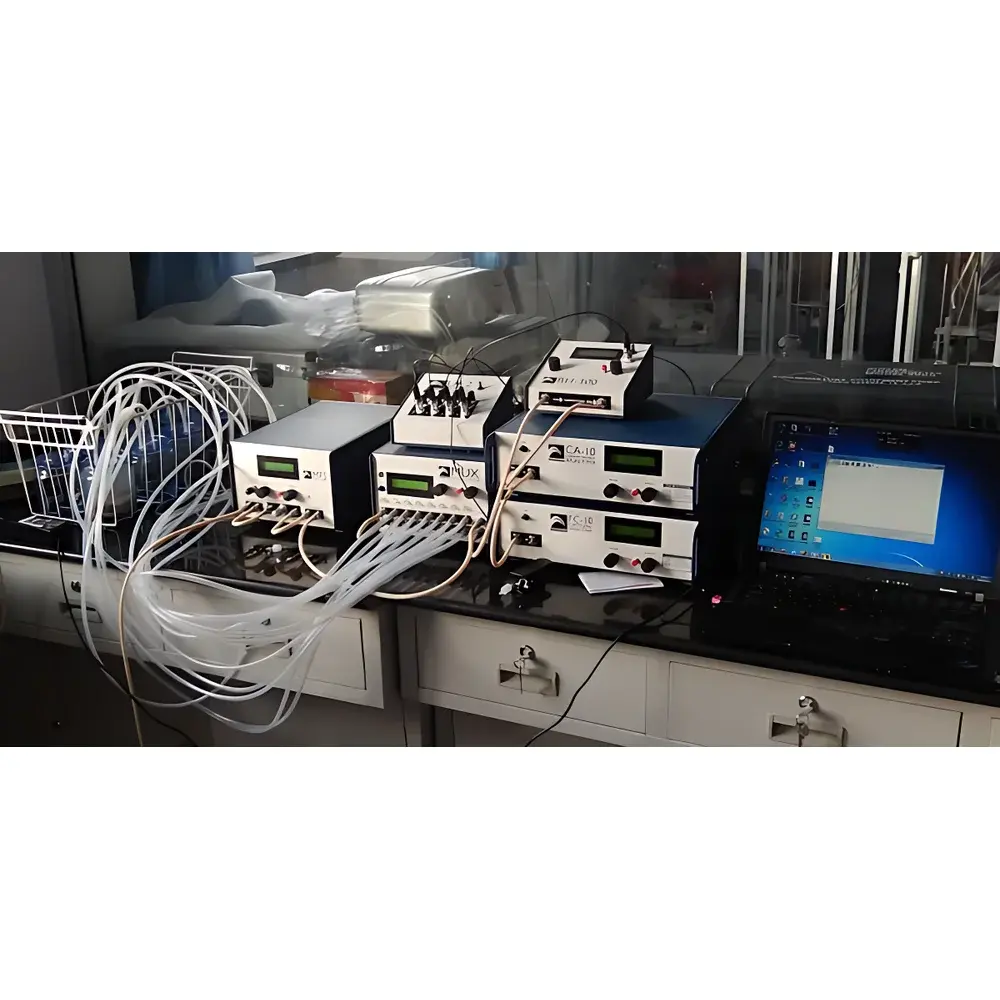
Sable SoilLab Laboratory Soil Respiration Measurement System
| Brand | Sable |
|---|---|
| Origin | USA |
| Model | SoilLab |
| Instrument Type | Multi-channel Laboratory Soil Respiration System |
| Gas Analyzers | CO₂ (NDIR), O₂ (Fuel Cell), Optional CH₄ (TCD), H₂O (Capacitive) |
| Channel Configurations | 4, 8, 16, or 24 channels |
| Compliance | ISO 14240-1 (Substrate-Induced Respiration for Microbial Biomass), ASTM D5039 (Soil Respiration Testing), GLP-Compatible Data Logging |
Overview
The Sable SoilLab Laboratory Soil Respiration Measurement System is a modular, research-grade platform engineered for quantitative, real-time monitoring of gaseous exchange dynamics in controlled soil microcosms. It operates on the principle of closed- or open-flow dynamic respirometry—measuring temporal changes in CO₂ efflux, O₂ depletion, and optionally CH₄ or H₂O vapor concentration across multiple parallel samples under precisely regulated environmental conditions. As a core tool in soil biogeochemistry and ecotoxicology, SoilLab enables high-reproducibility assessment of heterotrophic and autotrophic respiration components—including microbial biomass activity (via ISO 14240-1 SIR protocol), root respiration, soil fauna metabolism (e.g., *Folsomia candida*, *Enchytraeus* spp.), and decomposition kinetics in diverse matrices such as wetland peat, contaminated industrial soils, and landfill amendments. Its architecture supports both benchtop laboratory deployment and field-portable configurations, facilitating seamless transition from controlled microcosm experiments to in situ validation.
Key Features
- Modular multi-channel design: Scalable from 4 to 24 independent measurement channels via auto-switching gas manifolds (MFS-series controllers and 8-channel rotary valves with <50 ms switching latency)
- High-fidelity dual-gas analysis: Standard CO₂ (dual-wavelength NDIR, 0–5% range, ±1% FS accuracy, <0.5 s response) and O₂ (fuel-cell sensor, 0–100% range, ±0.1% absolute accuracy, <7 s T₉₀) analyzers with integrated temperature/pressure compensation and 16-bit A/D conversion
- Differential O₂ measurement capability: Optional dual-channel O₂ analyzer for ultra-low-flux respiration studies (e.g., enchytraeid worms, collembolan microarthropods, fine roots) with sub-ppm resolution
- Flexible chamber integration: Customizable microcosm chambers (standard 500 mL borosilicate glass, GL80 thread) compatible with FytoScope plant growth chambers for coupled soil–plant–atmosphere continuum studies
- Field-deployable configuration: Integrated portable version includes all analyzers, MFS flow controller, data logger, and power management in a single ruggedized case (IP54-rated) with battery backup support
- Comprehensive environmental monitoring: Optional H₂O vapor analyzer (capacitive sensor, 0–100% RH, ±1% RH accuracy) and UGT soil porosity module for concurrent physical–biological parameter correlation
Sample Compatibility & Compliance
SoilLab accommodates heterogeneous sample types—including mineral and organic soils, sediment cores, leaf litter, rhizosphere zones, intact soil monoliths, and live macro/microfauna—in standardized or custom-designed microcosm chambers. All hardware and firmware comply with ISO/IEC 17025 documentation requirements for calibration traceability. Data acquisition protocols support audit-ready GLP/GMP workflows: timestamped raw signals, metadata tagging (operator ID, chamber ID, ambient T/P), and electronic signatures per FDA 21 CFR Part 11 when paired with validated software. The system implements ISO 14240-1 compliant SIR (Substrate-Induced Respiration) routines for soil microbial biomass estimation, and its gas flow control meets ASTM D5039 specifications for soil respiration rate quantification under defined moisture and temperature regimes.
Software & Data Management
The native SoilLab Control Suite (v4.2+) provides unified instrument orchestration, real-time visualization, and post-acquisition analysis. It supports synchronized sampling at user-defined intervals (1 s to 60 min), automatic baseline correction using dedicated reference channel input, and stoichiometric respiration quotient (RQ = CO₂/O₂) calculation. Raw data export is available in CSV, HDF5, and MATLAB-compatible formats; time-series plots include confidence bands derived from sensor noise profiles (RMS <1 ppm CO₂, <0.002% O₂). Audit trails record all parameter modifications, calibration events, and user logins. For regulatory submissions, the software generates PDF reports compliant with OECD Test Guideline 216 (soil microflora) and EU Regulation EC No. 440/2008 (ecotoxicological testing).
Applications
- Soil microbial biomass quantification via substrate-induced respiration (ISO 14240-1)
- Ecotoxicological screening of pesticides, heavy metals, and PFAS-contaminated soils
- Carbon sequestration potential assessment in restored wetlands and biochar-amended fields
- Root–microbe interaction studies under controlled drought or nutrient stress
- Decomposition kinetics modeling of organic amendments (compost, digestate, crop residues)
- Validation of process-based biogeochemical models (e.g., CENTURY, DNDC)
- Regulatory compliance testing for landfill cover performance and bioreactor landfill monitoring
FAQ
What gas analyzers are included in the standard SoilLab configuration?
The base system includes a dual-beam NDIR CO₂ analyzer (0–5% range) and a fuel-cell O₂ analyzer (0–100% range), both with full temperature and pressure compensation, analog/digital outputs, and built-in LCD displays.
Can SoilLab be used for field measurements?
Yes—optional portable configurations integrate all core modules (analyzers, MFS flow controller, data logger, and power supply) into a single transportable case rated for outdoor use (0–50°C, non-condensing), enabling in situ microcosm incubations and transect-based respiration mapping.
How does SoilLab support ISO 14240-1 compliance?
The system automates SIR protocol execution: precise glucose addition timing, pre- and post-substrate baseline acquisition, and integrated calculation of microbial biomass carbon (Cmic) using the 0.41 kg conversion factor specified in the standard.
Is differential O₂ measurement necessary for small soil organisms?
For specimens with respiration rates below 0.1 µL O₂·h⁻¹ (e.g., *Folsomia candida*, nematodes), the optional dual-channel O₂ analyzer eliminates background drift artifacts by continuously referencing against a sterile control chamber, improving signal-to-noise ratio by >10×.
What chamber customization options are available?
Standard GL80-threaded 500 mL borosilicate chambers are supplied; custom volumes (10–2000 mL), materials (stainless steel, PTFE-lined), and inlet/outlet port configurations are available upon request for anaerobic incubations or volatile organic compound (VOC) trapping applications.
Related Products







