
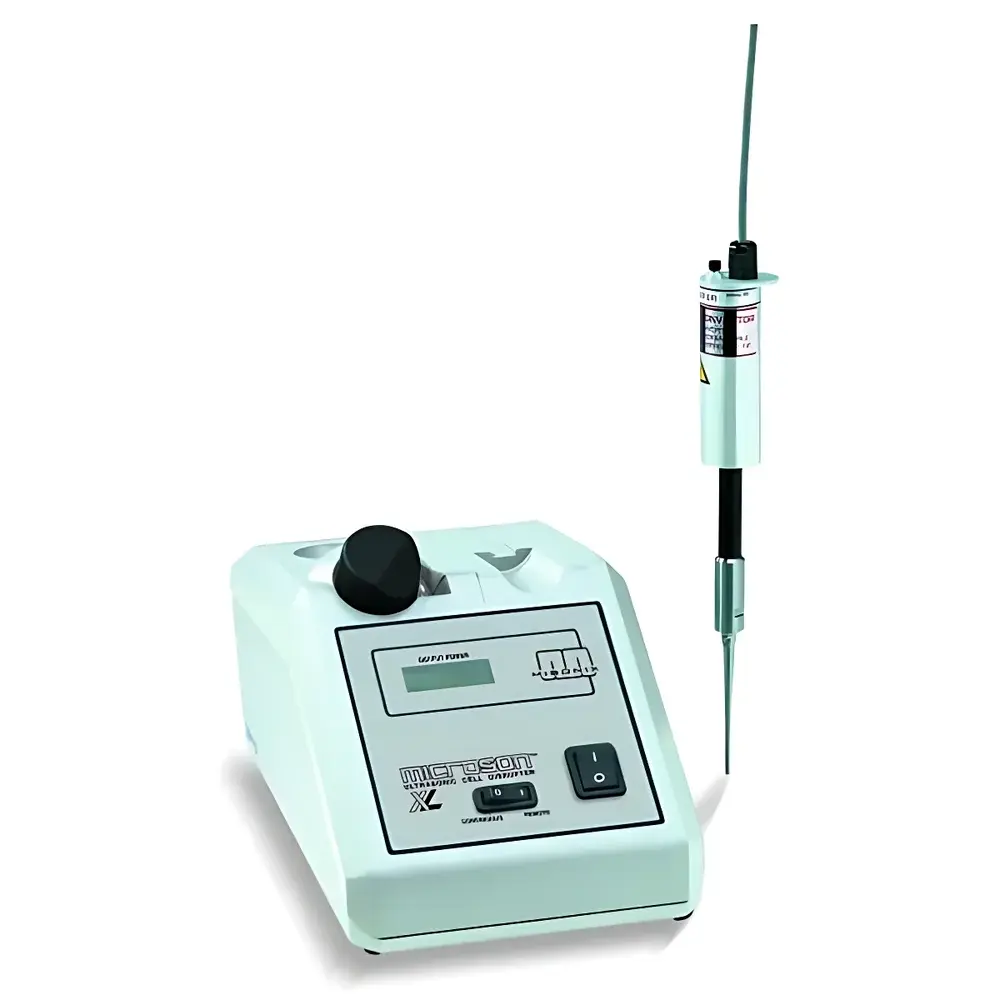
Misonix XL2000 Ultrasonic Cell Disruptor
| Brand | Misonix |
|---|---|
| Origin | USA |
| Model | XL2000 |
| Maximum Output Power | 100 W |
| Operating Frequency | 22.5 kHz |
| Sample Volume Range | 0.2–50 mL |
| Dimensions (W × D × H) | 19.0 × 33.0 × 17.8 cm |
| Weight | 4.1 kg |
| Display | LCD Digital Interface |
| Operating Modes | Continuous & Pulse |
| Probe Options | P-1 (1/8″, 0.5–15 mL), P-2 (3/16″, 2–25 mL), P-3 (3/32″, 0.2–5 mL), P-4 (1/4″, 5–50 mL) |
| Optional Accessories | Acoustic Enclosure, Cup Horn (Non-contact Sonication) |
Overview
The Misonix XL2000 Ultrasonic Cell Disruptor is a benchtop sonicator engineered for precise, reproducible cell lysis and sample homogenization in life science laboratories. It operates on the principle of high-intensity ultrasonic cavitation—generating rapid pressure fluctuations in liquid media that induce microbubble formation, growth, and violent collapse. This physical mechanism delivers localized shear forces sufficient to disrupt cellular membranes, solubilize inclusion bodies, extract nucleic acids and proteins, and achieve nano-scale particle dispersion without chemical or thermal degradation. Designed for routine use in molecular biology, microbiology, and biopharmaceutical QC/QA workflows, the XL2000 provides consistent energy delivery across small-volume samples (0.2–50 mL), making it especially suitable for precious or low-yield biological specimens.
Key Features
- Compact, lightweight design (4.1 kg) with footprint under 0.06 m²—ideal for crowded fume hoods or shared core facilities.
- Digital LCD interface enabling real-time monitoring and adjustment of amplitude (0–100% of 100 W max output) and duty cycle in pulse mode.
- Fixed-frequency transduction at 22.5 kHz ensures stable acoustic coupling and minimizes frequency drift during extended operation.
- Two operational modes: continuous for rapid lysis of robust cells (e.g., E. coli, yeast), and pulse mode (adjustable on/off intervals) to manage heat generation and preserve labile biomolecules such as enzymes or RNA.
- Interchangeable titanium alloy probes (P-1 through P-4) optimized for specific volume ranges and sample viscosities—each calibrated for impedance matching to maximize energy transfer efficiency.
- Optional acoustic enclosure reduces ambient noise to <65 dB(A) and contains aerosolized biohazards, supporting biosafety level 2 (BSL-2) compliance when processing pathogenic strains or clinical isolates.
- Cup horn accessory enables non-contact sonication—samples remain sealed in microcentrifuge tubes placed within a water-filled cup, eliminating cross-contamination risk and probe erosion in abrasive or corrosive matrices.
Sample Compatibility & Compliance
The XL2000 accommodates diverse biological matrices including bacterial cultures, mammalian cell suspensions, tissue homogenates, viral lysates, and nanoparticle dispersions. Its mechanical lysis approach avoids enzymatic bias or detergent-induced artifacts, supporting orthogonal validation per ISO 13485 and FDA guidance for biologics process development. When used with validated protocols and documented calibration records, the system supports GLP-compliant data generation. The optional acoustic enclosure meets ANSI S1.13-2020 noise emission standards and facilitates adherence to institutional biosafety policies requiring containment of aerosol-generating procedures.
Software & Data Management
While the XL2000 operates via standalone hardware controls (no PC dependency), its digital interface logs time-stamped operational parameters—including total sonication duration, cumulative energy delivered (J), and selected probe type—for manual entry into electronic lab notebooks (ELN). For regulated environments, users may integrate timing and amplitude settings into SOP-driven workflows traceable under 21 CFR Part 11 when paired with audit-trail-enabled ELN platforms. Calibration verification is performed annually using a NIST-traceable power meter; certificate documentation is retained per laboratory quality management system requirements.
Applications
- Preparative lysis of prokaryotic and eukaryotic cells prior to Western blotting, ELISA, or mass spectrometry analysis.
- Chromatin shearing for ChIP-seq library preparation (with optimized pulse parameters).
- Disruption of biofilms and extracellular polymeric substances (EPS) in environmental microbiology studies.
- Nanoparticle deagglomeration and uniform dispersion in drug delivery formulation development.
- Routine QC testing of recombinant protein solubility and aggregation state post-purification.
- Homogenization of plant tissues for metabolite extraction under cold conditions (using chilled cup horn setup).
FAQ
What safety certifications does the XL2000 carry?
The instrument complies with IEC 61010-1:2010 for electrical safety and electromagnetic compatibility (EMC) per IEC 61326-1:2013. It is CE-marked and listed under UL 61010-1 in North America.
Can the XL2000 be used for RNA isolation without degradation?
Yes—when operated in pulse mode (e.g., 5 sec on / 10 sec off) with pre-chilled samples and probes, RNA integrity (RIN > 8.5) is routinely maintained in mammalian cell lines.
Is probe calibration required before each use?
No. Probes are factory-calibrated and require only annual verification using a calibrated calorimetric or radiometric power meter per ISO/IEC 17025 guidelines.
Does Misonix provide application support for method development?
Yes—Misonix Technical Services offers protocol optimization guides, peer-reviewed reference methods, and remote troubleshooting aligned with common assay endpoints (e.g., A260/A280 ratios, SDS-PAGE band intensity, qPCR Ct values).
How often should the titanium probe tip be inspected for erosion?
Visual inspection is recommended after every 10 hours of cumulative use; replacement is advised if pitting exceeds 0.1 mm depth or if amplitude consistency falls outside ±5% of baseline readings.




