
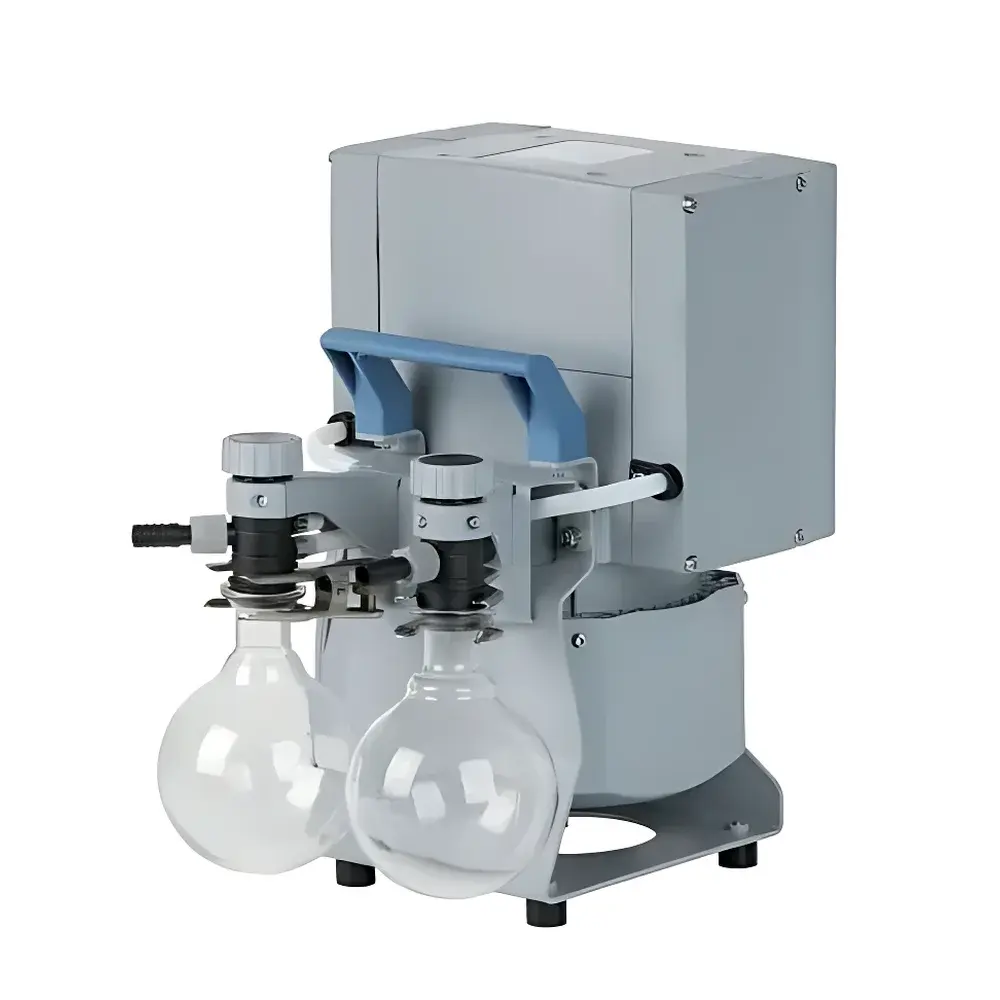
VACUUBRAND ME 8C NT+2AK Chemical-Resistant Dual-Stage Diaphragm Vacuum Pump System
| Brand | VACUUBRAND® |
|---|---|
| Origin | Germany |
| Model | ME 8C NT+2AK |
| Pump Type | Chemically Resistant, Oil-Free Diaphragm Vacuum Pump |
| Number of Pump Heads / Stages | 4 / 1 |
| Max. Suction Speed (50/60 Hz) | 7.1 / 7.8 m³/h |
| Max. Suction Speed (50/60 Hz) | 4.2 / 4.6 cfm |
| Ultimate Vacuum (abs.) | 70 mbar |
| Ultimate Vacuum (abs.) | 52 torr |
| Ambient Operating Temp. | 10–40 °C |
| Storage Temp. | −10–60 °C |
| Max. Exhaust Pressure (abs.) | 1.1 bar |
| Inlet/Outlet Port | DN 10 mm hose nozzle |
| Rated Motor Power | 0.25 kW |
| Rated Speed (50/60 Hz) | 1500 / 1800 min⁻¹ |
| IP Rating | IP 40 |
| Dimensions (L×W×H) | 319 × 243 × 374 mm |
| Weight | 16.7 kg |
| Noise Level (50 Hz, typical) | 45 dBA |
| Safety Certifications | NRTL (US & Canada), ATEX II 3G IIC T3 X (230 V only), Internal Atmosphere Only |
Overview
The VACUUBRAND ME 8C NT+2AK is a high-performance, oil-free diaphragm vacuum pump system engineered specifically for demanding chemical laboratory applications involving aggressive vapors, corrosive gases, and solvent-laden exhaust streams. Unlike conventional rotary vane or scroll pumps, this system employs a robust, multi-head single-stage diaphragm architecture—comprising four synchronized pumping heads—to deliver high volumetric flow rates while maintaining exceptional chemical resistance and long-term operational stability. Its core operating principle relies on the reciprocating motion of chemically inert PTFE-reinforced diaphragms, which isolate the drive mechanism from process media entirely. This ensures zero oil contamination, eliminates the need for lubricants, and prevents degradation under exposure to halogenated solvents, acids, bases, and organic vapors. The NT-series enhancements—including optimized valve geometry, thermally stabilized motor windings, and improved thermal management—significantly extend tolerance to condensable vapors and transient overloads, making the ME 8C NT+2AK suitable for continuous operation in distillation, rotary evaporation, vacuum filtration, freeze drying, and vacuum oven applications where reliability and material compatibility are non-negotiable.
Key Features
- Four-head single-stage diaphragm design delivering high suction speed (up to 7.8 m³/h at 60 Hz) with stable performance down to 70 mbar absolute pressure
- Chemically inert wetted parts constructed entirely from fluoropolymers—PTFE, FFKM, and ETFE—ensuring compatibility with HCl, HF, Cl₂, SO₂, acetone, THF, chloroform, and other aggressive media
- Proprietary PTFE “sandwich” diaphragm structure combining mechanical resilience with fatigue resistance, validated for >20,000 hours of service life under typical lab duty cycles
- Low-vibration, low-noise operation (45 dBA at 50 Hz) enabled by precision-balanced crankshafts, elastomeric motor mounts, and acoustic damping housing
- Sealed, brushless induction motor with IP40 ingress protection, rated for continuous duty across 10–40 °C ambient conditions
- Integrated dual AK gas ballast valves (2AK configuration) for enhanced vapor handling—enabling reliable operation during solvent evaporation without condensation-induced stalling
- Compact footprint (319 × 243 × 374 mm) and modular mounting options support integration into fume hoods, benchtop systems, and automated platforms
Sample Compatibility & Compliance
The ME 8C NT+2AK is designed for use with liquid and gaseous samples commonly encountered in synthetic chemistry, pharmaceutical development, and analytical sample preparation. It is compatible with aqueous, acidic, alkaline, and organic-phase systems—including those containing methanol, ethanol, ethyl acetate, dichloromethane, and toluene—provided inlet condensation traps and cold traps are employed where appropriate. All materials contacting the process stream conform to FDA 21 CFR §177.1550 (PTFE) and EU Regulation (EC) No. 1935/2004 for food-contact polymers. The unit carries NRTL certification for safety compliance in the United States and Canada (UL 61010-1, CSA C22.2 No. 61010-1), and ATEX certification (II 3G IIC T3 X) for use in Zone 2 hazardous areas—limited to 230 V configurations and internal atmosphere-only operation per directive 2014/34/EU.
Software & Data Management
While the ME 8C NT+2AK operates as a standalone analog device without embedded digital controls, it is fully compatible with external vacuum monitoring and control ecosystems. Analog 0–10 V or 4–20 mA vacuum feedback signals can be integrated via optional pressure transducers (e.g., VACUUBRAND VRD series) into LabVIEW, DeltaV, or Siemens Desigo CCMS platforms. When paired with VACUUBRAND’s VARIO software suite (via optional RS485 interface module), users gain access to real-time pump status logging, runtime hour tracking, thermal load trending, and configurable alarm thresholds—all supporting GLP-compliant audit trails and 21 CFR Part 11–ready electronic records when deployed with validated IT infrastructure.
Applications
- Routine and high-throughput rotary evaporation of acid-sensitive or halogenated compounds
- Vacuum-assisted crystallization and recrystallization under inert or reactive atmospheres
- Continuous degassing of polymer precursors and resin formulations
- High-purity vacuum filtration of catalyst slurries and metal-organic frameworks (MOFs)
- Support vacuum for glovebox antechambers and Schlenk line manifolds
- Backing pump for turbomolecular and diffusion vacuum systems requiring clean, dry, oil-free forevacuum
FAQ
Is the ME 8C NT+2AK suitable for pumping hydrogen chloride (HCl) gas?
Yes—its fully fluoropolymer-wetted construction (including PTFE diaphragms, FFKM valves, and ETFE-coated housing internals) provides proven resistance to anhydrous and aqueous HCl up to 40 °C. Use with a PTFE-lined inlet trap is recommended for prolonged exposure.
Can this pump be used with a vacuum oven operating at 10 mbar?
No—the ME 8C NT+2AK achieves a base pressure of 70 mbar (52 torr); for vacuum ovens requiring ≤10 mbar, it must serve as a forepump for a secondary high-vacuum stage such as a turbomolecular or diffusion pump.
Does the 2AK configuration require manual adjustment during operation?
No—the dual gas ballast valves are factory preset and remain fixed; they provide passive vapor dilution and do not require user intervention or recalibration during routine use.
What maintenance intervals are recommended for GLP-regulated environments?
Diaphragm replacement is advised every 18–24 months under continuous operation; motor bearings and valves require no scheduled servicing. Full maintenance logs, including part lot traceability and calibration certificates for optional pressure sensors, are retained per ISO/IEC 17025 requirements.
Is remote start/stop functionality supported?
Yes—via optional 24 V DC control input (dry contact or TTL-compatible), enabling integration with building management systems or programmable logic controllers (PLCs) for automated vacuum sequencing.



