
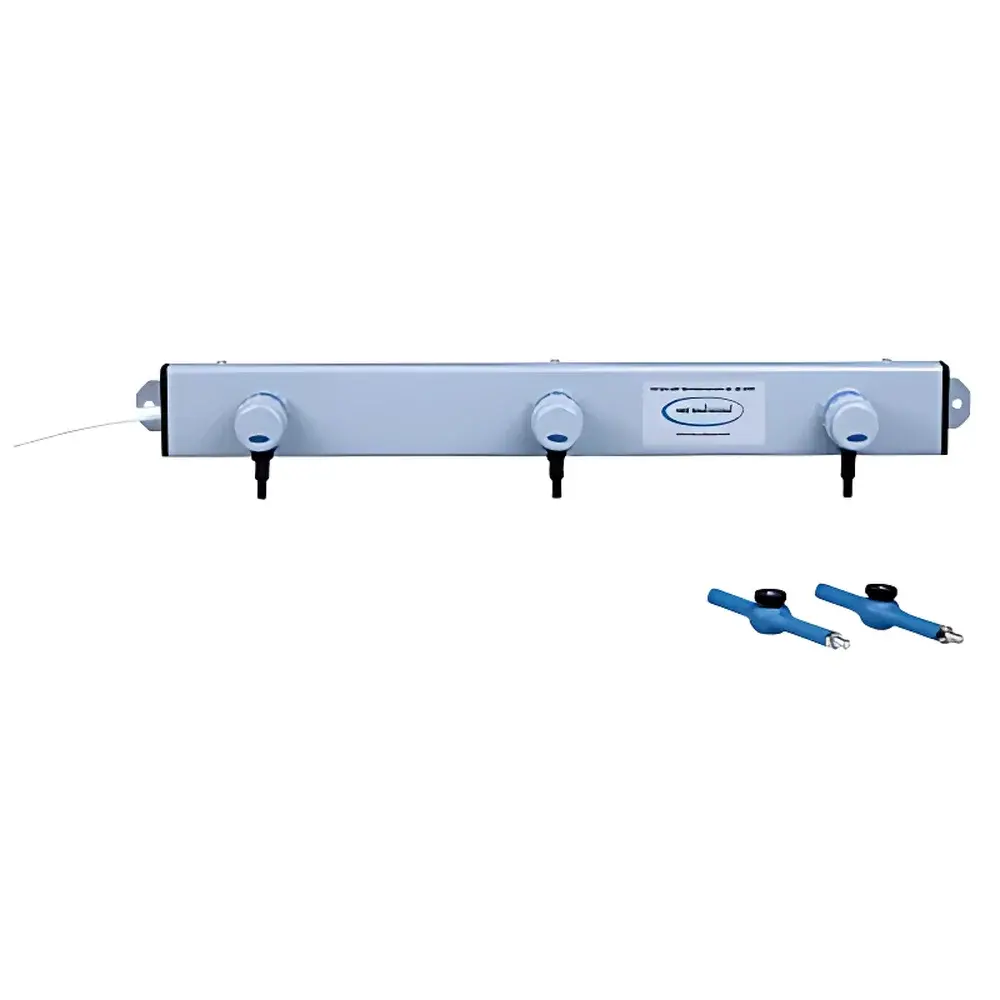
VACUUBRAND mini-Network Vacuum Distribution System
| Brand | VACUUBRAND® |
|---|---|
| Origin | Germany |
| Model | mini-Network |
| Construction | Corrosion-resistant materials (PP, PTFE, FKM) |
| Integrated Components | 3 built-in check valves |
| Configuration | Single-pump-to-three-port vacuum distribution network |
| Compliance | CE-marked, RoHS-compliant |
| Intended Use | Benchtop vacuum supply for laboratory filtration, aspiration, and vacuum drying applications |
Overview
The VACUUBRAND mini-Network is a compact, benchtop vacuum distribution system engineered for reliable, space-efficient vacuum supply in modern analytical and preparative laboratories. Unlike conventional manifold setups requiring external valves or custom plumbing, the mini-Network integrates three independent, non-return (check) valves directly into its molded polypropylene (PP) body—ensuring automatic isolation of each port during operation. It operates on the principle of passive vacuum routing: when connected to a single VACUUBRAND or compatible diaphragm vacuum pump (e.g., MD 4C NT, PC 3001 Vario), the system delivers stable, cross-contamination-free vacuum to up to three simultaneously active workstations. Its design adheres to fundamental vacuum engineering principles—minimizing dead volume, suppressing backflow via elastomeric FKM valve seals, and maintaining consistent conductance across all ports. The unit is not a vacuum source itself but a precision-engineered interface that extends the utility and operational flexibility of existing low-to-medium vacuum pumps (typically operating in the range of 2–10 mbar ultimate pressure).
Key Features
- Three integrated, maintenance-free check valves constructed with fluorocarbon (FKM) sealing elements for chemical resistance and long-term leak-tight performance
- Monolithic housing molded from high-purity polypropylene (PP) and lined with PTFE-sealed ports—resistant to common solvents, acids, and bases encountered in chemistry, pharmaceutical, and environmental labs
- No external power, electronics, or moving parts—operates purely pneumatically, eliminating failure modes associated with solenoid valves or digital controllers
- Benchtop footprint measuring only 125 × 85 × 60 mm—designed to fit beneath fume hoods, inside laminar flow cabinets, or adjacent to rotary evaporators without compromising ergonomic access
- Each port accepts standard 8 mm (5/16″) vacuum tubing with push-fit PP barbed connectors; optional stainless-steel reinforced tubing adapters available for high-cycle applications
- CE-marked and RoHS-compliant—certified for use within EU-regulated laboratory environments under Directive 2014/30/EU (EMC) and 2014/35/EU (LVD)
Sample Compatibility & Compliance
The mini-Network is compatible with aqueous, organic, and mildly corrosive vapors typical in vacuum filtration (e.g., Buchner funnel setups), liquid aspiration (e.g., cell culture media removal), and low-temperature vacuum drying (e.g., lyophilization pre-chamber support). It is not rated for explosive atmospheres (ATEX), halogenated solvent vapors at elevated temperatures, or vacuum levels below 1 mbar. For GLP- and GMP-regulated workflows—including those aligned with FDA 21 CFR Part 11 requirements—the mini-Network serves as a documented, fixed component of validated vacuum infrastructure; its passive architecture eliminates data logging dependencies while supporting audit-ready system configuration records. It conforms to ISO 8573-1:2010 Class 4 purity standards when used with oil-free VACUUBRAND diaphragm pumps.
Software & Data Management
As a purely mechanical distribution device, the mini-Network does not incorporate firmware, embedded software, or digital interfaces. This absence of electronics ensures immunity to electromagnetic interference, eliminates cybersecurity concerns, and removes calibration drift associated with sensor-based manifolds. Laboratory quality systems may document its installation, maintenance history (e.g., periodic visual inspection of valve integrity and seal compression), and integration into validated vacuum networks using standard equipment logbooks or LIMS-assigned asset IDs (e.g., “VAC-NW-MN-001”). No driver installation, firmware updates, or network configuration is required—reducing validation burden in regulated environments.
Applications
- Simultaneous vacuum filtration across three parallel reaction vessels or sintered glass funnels in synthetic organic chemistry workflows
- Distributed aspiration in multi-well plate handling stations—supporting high-throughput sample preparation without cross-well contamination
- Shared vacuum supply for benchtop centrifugal concentrators, cold traps, and desiccators in analytical QC labs
- Backup vacuum routing in GLP-compliant stability chambers where redundancy and mechanical simplicity are prioritized over automation
- Educational laboratory setups—demonstrating vacuum fundamentals, flow dynamics, and passive valve behavior without reliance on proprietary control platforms
FAQ
Can the mini-Network be used with oil-lubricated vacuum pumps?
No—it is explicitly designed for use with chemically resistant, oil-free diaphragm vacuum pumps. Oil mist ingress will degrade FKM valve seals and contaminate downstream processes.
Is tubing included with the unit?
No—standard 8 mm ID vacuum tubing must be sourced separately. VACUUBRAND recommends their ChemiGrip™ reinforced PVC or Viton-lined tubing for extended chemical compatibility.
What is the maximum recommended inlet vacuum pressure?
The system is rated for continuous operation at inlet pressures between 2 mbar and atmospheric (1013 mbar); sustained operation below 1 mbar may compromise check valve reseating reliability.
How often should the check valves be inspected or replaced?
Under normal laboratory use (≤8 hrs/day, non-aggressive vapors), visual inspection every 6 months is sufficient; replacement kits (Order No. 2614456) are available for full valve assembly renewal.
Does the mini-Network support vacuum monitoring or pressure regulation?
No—it provides unregulated vacuum distribution. For pressure-controlled applications, a separate VACUUBRAND DVR 2 digital vacuum regulator must be installed upstream of the mini-Network inlet port.



