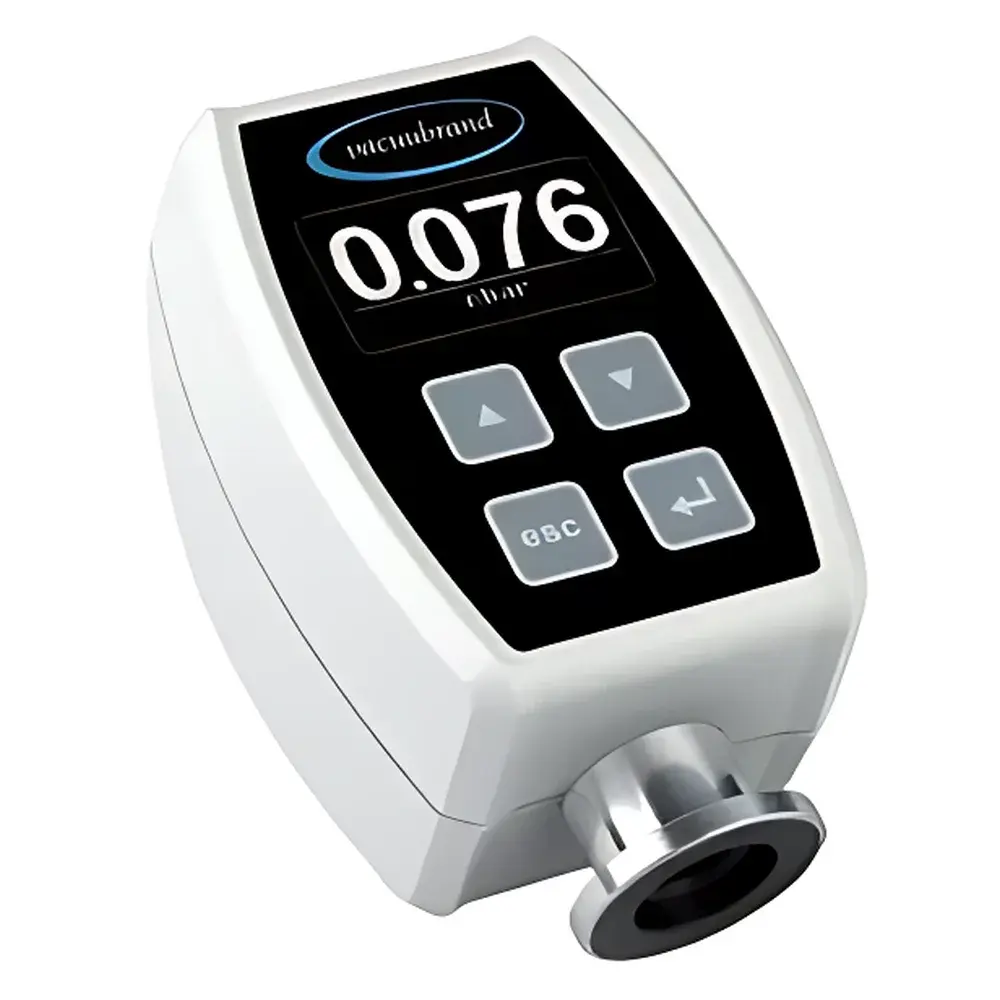
VACUUBRAND VACUU·VIEW® extended Combined Ceramic Vacuum Gauge
| Brand | VACUUBRAND® |
|---|---|
| Origin | Germany |
| Model | VACUU·VIEW® extended |
| Measurement Range | 1000 mbar to 1 × 10⁻³ mbar |
| Sensor Technology | Integrated ceramic diaphragm (capacitance manometer) + ceramic-encapsulated Pirani sensor |
| Chemical Resistance | Full compatibility with aggressive vapors and corrosive process gases |
| Display | Backlit LCD, menu-driven interface |
| Output | Analog (0–10 V) and digital (RS485/Modbus RTU) |
| Enclosure Rating | IP65 |
| Operating Temperature | 0–50 °C |
| Accuracy | ±2% of reading (full scale) in specified range |
| Long-term Stability | <0.5% drift/year |
Overview
The VACUUBRAND VACUU·VIEW® extended is a high-integrity, dual-sensor vacuum measurement system engineered for reliable pressure monitoring across the rough to medium vacuum range (1000 mbar to 1 × 10⁻³ mbar). Unlike conventional single-technology gauges, it integrates two physically distinct sensing elements—ceramic capacitive diaphragm and ceramic-encapsulated Pirani—within a single compact, hermetically sealed housing. This hybrid architecture eliminates measurement discontinuities at transition points and ensures traceable, continuous data across overlapping ranges. The device operates on the principle of differential capacitance for absolute pressure measurement in the higher range (1000–1 mbar), while the thermally conductive Pirani element provides stable thermal conductivity-based readings from 10 mbar down to 1 × 10⁻³ mbar. Designed specifically for environments where chemical exposure compromises standard metallic or glass sensors, its fully ceramic wetted parts—including the diaphragm, sensor housing, and Pirani filament encapsulation—resist attack from halogens, strong acids (e.g., HCl, HF), oxidizers (e.g., O₃, NO₂), and organic solvents commonly used in vacuum drying, distillation, degassing, and thin-film deposition.
Key Features
- Integrated dual-sensor architecture: ceramic capacitive manometer + ceramic-encapsulated Pirani sensor for seamless coverage from atmospheric pressure to 10⁻³ mbar
- Chemical-resistant construction: all wetted surfaces made of high-purity alumina ceramic (Al₂O₃), rated for continuous exposure to aggressive vapors and condensable media
- Robust mechanical design: IP65-rated enclosure with stainless steel front plate and integrated cable gland for cleanroom- and lab-grade installation
- High-stability electronics: temperature-compensated signal conditioning with <0.5% annual drift specification under GLP-compliant operating conditions
- Intuitive local interface: backlit monochrome LCD with multilevel menu navigation; supports unit selection (mbar, hPa, Torr, Pa), zero calibration, and alarm threshold setup
- Dual-output capability: simultaneous analog output (0–10 V, linearized) and digital communication via RS485 with Modbus RTU protocol for SCADA and LIMS integration
Sample Compatibility & Compliance
The VACUU·VIEW® extended is validated for use with chemically aggressive sample streams typical in pharmaceutical lyophilization, semiconductor etch processes, and academic synthetic chemistry workflows. Its ceramic sensor materials comply with ISO 8573-1 (compressed air purity classes) for particulate and vapor resistance, and meet material compatibility requirements outlined in ASTM E2912–22 for vacuum instrumentation in corrosive service. The device conforms to CE marking directives (2014/30/EU EMC, 2014/35/EU LVD) and carries RoHS 2011/65/EU certification. While not intrinsically safe, it is suitable for Zone 2/Class I Division 2 environments when installed per IEC 60079-14 guidelines. Calibration certificates (traceable to PTB, Germany) are available upon request and support audit readiness under FDA 21 CFR Part 11 and EU Annex 11 when paired with compliant data acquisition systems.
Software & Data Management
VACUUBRAND provides the free VACUU·VIEW PC software suite for configuration, real-time monitoring, and data logging. The application supports time-stamped export to CSV and Excel formats, customizable alarm notifications (email/SNMP), and batch report generation compliant with GLP documentation standards. When connected via RS485, the gauge supports full Modbus register mapping—including live pressure value, sensor status flags, temperature compensation offset, and diagnostic counters (e.g., overpressure events, zero-drift alerts). For enterprise deployment, the device integrates natively with LabArchives ELN, DeltaV DCS, and Siemens Desigo CC platforms using standard Modbus TCP gateways. Audit trails include user login history, parameter change logs, and firmware version stamps—all retained onboard for ≥30 days without external storage.
Applications
- Process vacuum monitoring in rotary evaporation, freeze-drying, and solvent recovery systems
- In-line pressure control during catalytic hydrogenation and Schlenk-line operations
- Chamber pressure validation in PVD/CVD coating equipment and plasma cleaning stations
- Leak rate verification in sealed packaging and medical device sterilization tunnels
- Educational laboratory demonstrations of gas kinetics and vacuum physics principles
- Environmental chamber calibration where humidity and VOC exposure limit traditional gauge lifetime
FAQ
What is the recommended recalibration interval for the VACUU·VIEW® extended?
Annual recalibration is advised under routine laboratory use; however, for GMP-regulated applications, a six-month schedule aligned with internal SOPs is recommended.
Can the gauge be cleaned in situ with isopropanol or acetone?
Yes—the ceramic sensor surface and front flange tolerate brief immersion or wipe-down with IPA, acetone, or ethanol; avoid chlorinated solvents (e.g., chloroform) due to potential long-term ceramic grain boundary effects.
Does the device support automatic zeroing during operation?
It features manual zero adjustment only; automatic zeroing is disabled to preserve long-term baseline integrity in chemically active environments.
Is the RS485 interface galvanically isolated?
Yes—opto-isolated RS485 transceiver ensures noise immunity in electrically noisy industrial settings and prevents ground loop interference.
How does the ceramic Pirani sensor differ from standard tungsten-filament variants?
The ceramic-encapsulated design eliminates oxidation and catalytic decomposition pathways, enabling stable operation in reducing or oxidizing atmospheres where conventional filaments degrade rapidly.