
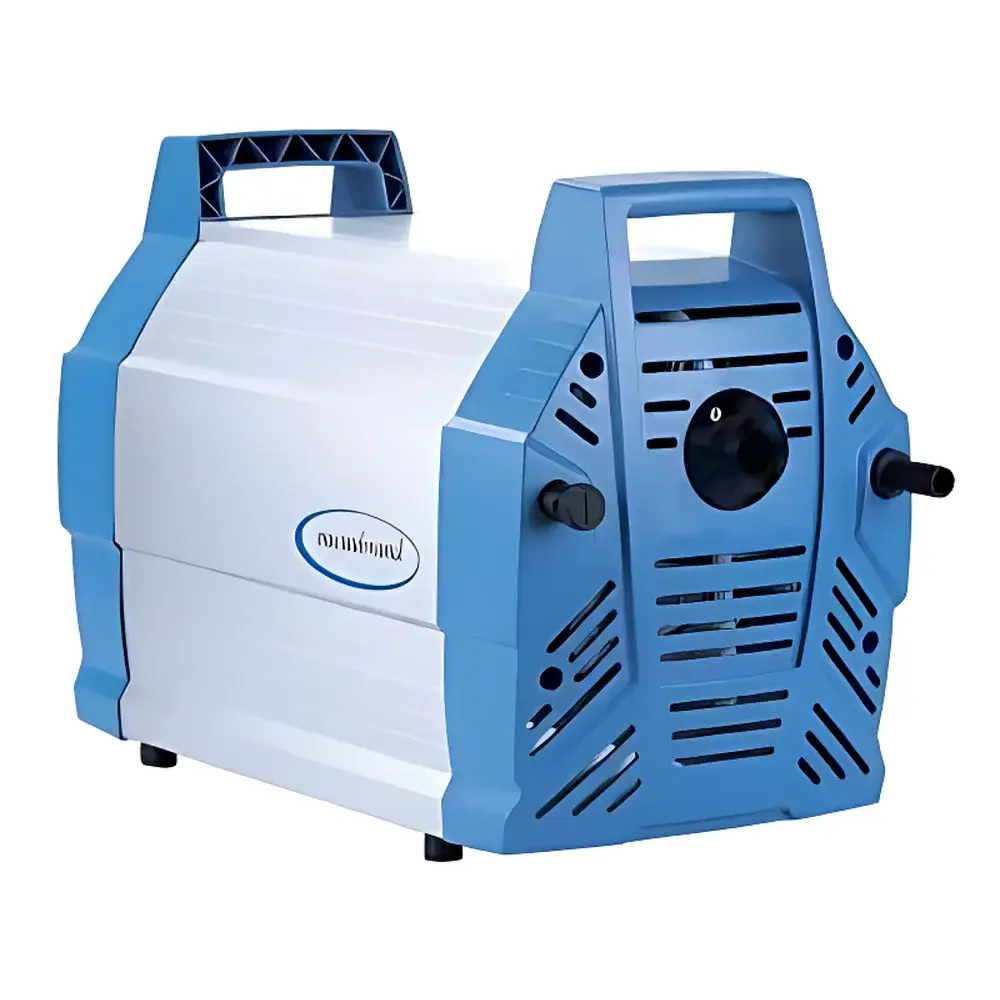
VACUUBRAND ME 16C NT Chemical-Resistant Diaphragm Vacuum Pump
| Brand | VACUUBRAND® |
|---|---|
| Country of Origin | Germany |
| Model | ME 16C NT |
| Pump Heads/Stage | 8/1 |
| Max. Pumping Speed (50/60 Hz) | 16.3 / 18.4 m³/h |
| Max. Pumping Speed (50/60 Hz) | 9.6 / 10.8 cfm |
| Ultimate Pressure (abs.) | 70 mbar / 53 torr |
| Ultimate Pressure with Gas Ballast (abs.) | 100 mbar / 75 torr |
| Max. Exhaust Pressure (abs.) | 1.1 bar |
| Inlet Port | KF DN 25 |
| Outlet Port | DN 15 mm hose nozzle |
| Rated Motor Power | 0.44 kW |
| Rated Speed (50/60 Hz) | 1500 / 1800 min⁻¹ |
| IP Rating | IP 40 |
| Dimensions (L×W×H) | 533 × 260 × 359 mm |
| Weight | 28.1 kg |
| Sound Pressure Level (50 Hz, typical) | 52 dBA |
| ATEX Certification (230 V only) | II 3G IIC T3 X, for internal atmosphere only |
Overview
The VACUUBRAND ME 16C NT is an eight-head, single-stage, oil-free diaphragm vacuum pump engineered specifically for demanding chemical laboratory applications involving aggressive vapors, corrosive gases, and solvent-laden exhaust streams. Its operational principle relies on reciprocating PTFE-coated diaphragms driven by a robust, brushless induction motor—eliminating lubricants and preventing contamination of sensitive processes. Unlike rotary vane or scroll pumps, the ME 16C NT achieves continuous, maintenance-free vacuum generation without risk of oil backstreaming or chemical degradation of internal lubricants. With a guaranteed ultimate pressure of 70 mbar (53 torr) and a maximum pumping speed of 16.3 m³/h at 50 Hz, it delivers high volumetric throughput even at moderate vacuum levels—making it ideal for solvent evaporation, vacuum filtration, freeze drying support, and inert gas purging where chemical compatibility and long-term reliability are non-negotiable.
Key Features
- Eight parallel diaphragm pump heads in a single compact housing ensure high pumping capacity while maintaining low vibration and acoustic emissions (52 dBA at 50 Hz).
- All wetted parts—including diaphragms, valves, and chamber housings—are constructed from chemically inert fluoropolymers (PTFE, FFKM, and PTFE-reinforced composites), certified for resistance to halogenated solvents, strong acids, alkalis, and organic vapors.
- Proprietary PTFE “sandwich” diaphragm design enhances mechanical stability under cyclic stress and extends service life significantly beyond conventional elastomeric membranes.
- Gas ballast valve (standard) enables controlled admission of ambient air to prevent condensate lock-up during high-solvent-load operation—improving pump resilience during rotary evaporation or distillation.
- Integrated thermal protection and overload monitoring safeguard motor integrity across variable load conditions; IP 40 enclosure provides basic protection against solid ingress.
- Modular accessory interface supports field-installation of inlet trap (AK series) and exhaust condenser (EK series) for enhanced process safety and solvent recovery—fully compatible with GLP-compliant documentation workflows.
Sample Compatibility & Compliance
The ME 16C NT is validated for continuous duty with vapors generated from common laboratory solvents including acetone, methanol, dichloromethane, ethyl acetate, and chloroform—as well as acidic (e.g., HCl, HNO₃) and basic (e.g., NH₃) gaseous effluents. Its materials comply with USP Class VI and FDA 21 CFR §177.1550 for fluoropolymer components. While not intrinsically safe for Zone 0/1 hazardous areas, the 230 V variant carries ATEX certification (II 3G IIC T3 X) for use in internal atmospheric environments only—requiring external explosion-proof enclosures if deployed in classified zones. The pump meets ISO 8573-1:2010 Class 0 air purity requirements for oil-free operation and aligns with ISO 27422:2015 guidelines for vacuum system validation in pharmaceutical development labs.
Software & Data Management
The ME 16C NT operates as a standalone analog device with no embedded digital controller or communication interface. However, its stable performance characteristics—consistent speed, predictable vacuum decay profiles, and repeatable gas ballast response—make it highly suitable for integration into automated systems via external PLCs or vacuum controllers (e.g., VACUUBRAND’s RC 6/RC 10 series). When paired with calibrated pressure transducers and data loggers compliant with 21 CFR Part 11, full audit trails—including runtime, cycle counts, and pressure setpoint deviations—can be maintained for GMP/GLP audits. Optional analog output (0–10 V) for vacuum level feedback is available upon request for closed-loop process control architectures.
Applications
- Solvent removal in rotary evaporators and centrifugal concentrators
- Vacuum-assisted filtration of aggressive reaction mixtures (e.g., Grignard workups, nitration residues)
- Support vacuum for glovebox antechambers and Schlenk line manifolds handling air-sensitive reagents
- Primary vacuum stage for diffusion or turbomolecular pump backing in analytical instrumentation (e.g., GC-MS, ICP-MS sample introduction)
- Controlled atmosphere drying of catalysts, MOFs, and battery electrode materials
- Environmental simulation chambers requiring chemically inert vacuum generation
FAQ
Is the ME 16C NT suitable for pumping hydrogen chloride (HCl) gas?
Yes—the entire gas path is lined with PTFE and FFKM elastomers, which exhibit excellent resistance to dry and humid HCl up to 80 °C.
Can this pump be used with a cold trap for water vapor removal?
Yes; the standard KF DN 25 inlet flange accepts commercially available liquid nitrogen or dry ice traps, though condensate accumulation must be managed to avoid diaphragm overloading.
Does the pump require periodic oil changes or lubrication?
No—it is completely oil-free; the motor and drive mechanism are sealed and maintenance-free for the rated service life.
What is the expected diaphragm lifetime under continuous operation?
Under typical lab conditions (≤60% duty cycle, ambient temperature ≤35 °C), PTFE sandwich diaphragms exceed 15,000 operating hours before replacement is recommended.
Is the ATEX marking valid for worldwide use?
No—the ATEX certification applies only within EU member states and countries recognizing EU directives; users outside this jurisdiction must verify local hazardous area classification requirements independently.



