
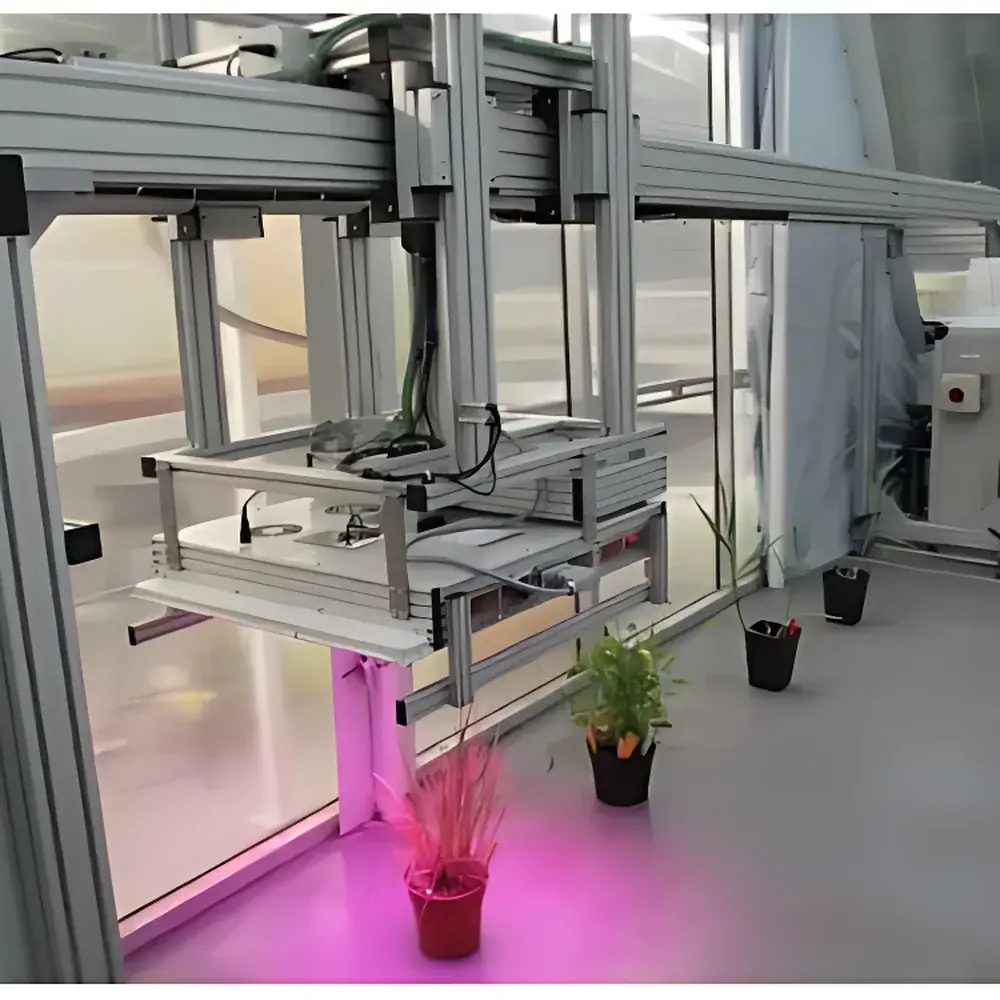
FluorCam High-Throughput Photosynthetic Phenotyping Platform
| Brand | PSI (Photosynthesis Systems Instruments, Czech Republic) |
|---|---|
| Origin | Czech Republic |
| Model | FluorCam HT |
| Imaging Area | Up to 80 × 80 cm (standard 35 × 35 cm) |
| Fluorescence Sensor | High-sensitivity CCD, 1392 × 1040 pixels (15 fps), 12-bit A/D |
| RGB Sensor | 2560 × 1920 pixels, 1/2.5″ format |
| IR Thermal Camera (optional) | 640 × 480 pixels, NETD < 50 mK @ 30°C, 20–120°C range |
| Scan Precision | ±0.1 mm positional accuracy |
| Scan Speed | Up to 150 mm/s |
| Sample Throughput | 12 pots (Ø ≈ 30 cm) in < 60 s |
| Fluorescence Parameters | >50 standard PAM-derived parameters (Fo, Fm, Fv/Fm, NPQ, QY_Ln, Rfd, etc.) |
| Software | FluorCam v7.x with GLP-compliant audit trail, protocol scripting, remote web access, multi-user role management |
| Compliance | Designed for ISO/IEC 17025-aligned lab workflows |
Overview
The FluorCam High-Throughput Photosynthetic Phenotyping Platform is an integrated, non-invasive imaging system engineered for quantitative plant physiological phenotyping under controlled or semi-controlled environments. Built upon PSI’s globally recognized Pulse-Amplitude-Modulated (PAM) chlorophyll fluorescence imaging technology, the platform enables spatially resolved, dynamic assessment of photosynthetic performance across entire plant canopies or sample arrays. Its core measurement principle relies on modulated excitation light and high-temporal-resolution detection of chlorophyll a fluorescence kinetics—providing direct, functional readouts of photosystem II (PSII) efficiency, electron transport rate (ETR), non-photochemical quenching (NPQ), and photoinhibitory status. Complemented by synchronized RGB reflectance imaging and optional infrared thermography, the system delivers multiparametric, correlative datasets essential for linking genotype to physiological phenotype under abiotic and biotic stress gradients.
Key Features
- World’s largest single-frame PAM fluorescence imaging area (standard 35 × 35 cm; expandable to 80 × 80 cm via modular optics and illumination configuration)
- Dual-mode imaging capability: simultaneous or sequential acquisition of chlorophyll fluorescence (Fv/Fm, ΦPSII, NPQ, qP, Rfd), high-resolution RGB morphology (leaf area, compactness, eccentricity, convex hull, relative growth rate), and optional thermal signatures (stomatal conductance proxy, drought response mapping)
- Configurable multispectral fluorescence detection: 7-position filter wheel with bandpass filters enabling GFP, YFP, RFP, and other exogenous fluorophore imaging—supporting transgenic expression quantification and promoter activity profiling
- Transect-based automated scanning architecture: 400 cm programmable scan length with ±0.1 mm positional repeatability and up to 150 mm/s linear speed; accommodates up to 12 standard 30-cm-diameter pots or SoilTron micro-lysimeters per full cycle
- Modular sensor integration: Interchangeable optical heads—including high-speed 1392 × 1040 CCD (15 fps, 2/3″ format) for time-resolved fluorescence kinetics and 2560 × 1920 RGB sensor with auto-exposure and white balance calibration
- Field-deployable mechanical design: Height-adjustable (60–110 cm, customizable), wheeled gantry structure enabling rapid repositioning between greenhouse bays, growth chambers, or field phenotyping trailers
- Real-time embedded analysis engine: Onboard computation of >50 standardized fluorescence parameters, pixel-wise false-color mapping, region-of-interest (ROI) segmentation, and export-ready tabular outputs compliant with MIAPPE metadata standards
Sample Compatibility & Compliance
The FluorCam HT platform is validated for use with intact, living plants—from Arabidopsis thaliana rosettes and rice seedlings to mature maize, tomato, and wheat canopies grown in pots, trays, or soil-filled lysimeters. Its non-destructive, contactless operation ensures longitudinal monitoring without experimental interference. The system complies with instrumentation requirements for GLP (Good Laboratory Practice) and GMP-aligned plant science workflows. Data acquisition software includes configurable audit trails, user authentication, electronic signature support (21 CFR Part 11 ready), and version-controlled protocol libraries—facilitating regulatory submissions in crop biotechnology and agrochemical development. All optical components meet CE and RoHS directives; thermal camera modules are NIST-traceably calibrated.
Software & Data Management
FluorCam v7.x software serves as the unified control, acquisition, and analysis environment. It features a scriptable protocol editor supporting conditional logic, time-series scheduling, and multi-step stimulus-response paradigms (e.g., dark adaptation → actinic light ramp → saturating pulse series). Acquired datasets are stored in hierarchical HDF5 containers with embedded metadata (time stamp, operator ID, environmental conditions, ROI definitions). Integrated statistical tools enable ANOVA, PCA, and cluster analysis across treatment groups. Web-based remote access allows real-time dashboard viewing, parameter reprocessing, and experiment reconfiguration from any authorized workstation. Database schema supports FAIR principles (Findable, Accessible, Interoperable, Reusable), with export options for PlantCV, R, Python (via PyFluorCam), and Crop Ontology-compliant formats.
Applications
- High-throughput screening of crop germplasm for drought, heat, salinity, or heavy-metal tolerance using kinetic fluorescence signatures (e.g., sustained NPQ decay, delayed Fv/Fm recovery)
- Functional validation of CRISPR/Cas9-edited lines through spatially resolved PSII quantum yield mapping under controlled stress gradients
- Time-course phenotyping of senescence dynamics via RGB-based greenness index (GNDVI) coupled with declining ΦPSII and rising Fo
- Eco-toxicological assessment: dose–response modeling of herbicide mode-of-action using early fluorescence inhibition metrics (e.g., I50 for Fv/Fm)
- Canopy-level stomatal conductance estimation via thermal heterogeneity patterns correlated with concurrent ΦPSII maps
- Phenomic association studies integrating fluorescence-derived physiological traits with SNP or RNA-seq datasets
FAQ
What is the minimum required dark adaptation time for accurate Fv/Fm measurement?
Standard protocols specify 20–30 minutes of complete darkness; the system supports programmable pre-measurement dark periods with LED shutoff verification.
Can the platform operate inside a growth chamber with limited headroom?
Yes—the gantry height is adjustable from 60 cm to 110 cm and can be further customized to match chamber specifications, including integration with FS-WI walk-in growth rooms.
Is raw image data export supported in open formats?
All fluorescence, RGB, and thermal frames are exported as TIFF (16-bit) or HDF5 with embedded calibration metadata; no proprietary binary lock-in.
How is system calibration maintained over long-term deployments?
Fluorescence intensity is referenced to built-in ND filters and certified reference panels; RGB sensors include daily auto-white-balance routines; thermal modules undergo annual NIST-traceable recalibration.
Does the software support batch processing of historical datasets?
Yes—FluorCam v7.x includes a command-line interface (CLI) module for headless, script-driven reanalysis of archived experiments across hundreds of samples.




