
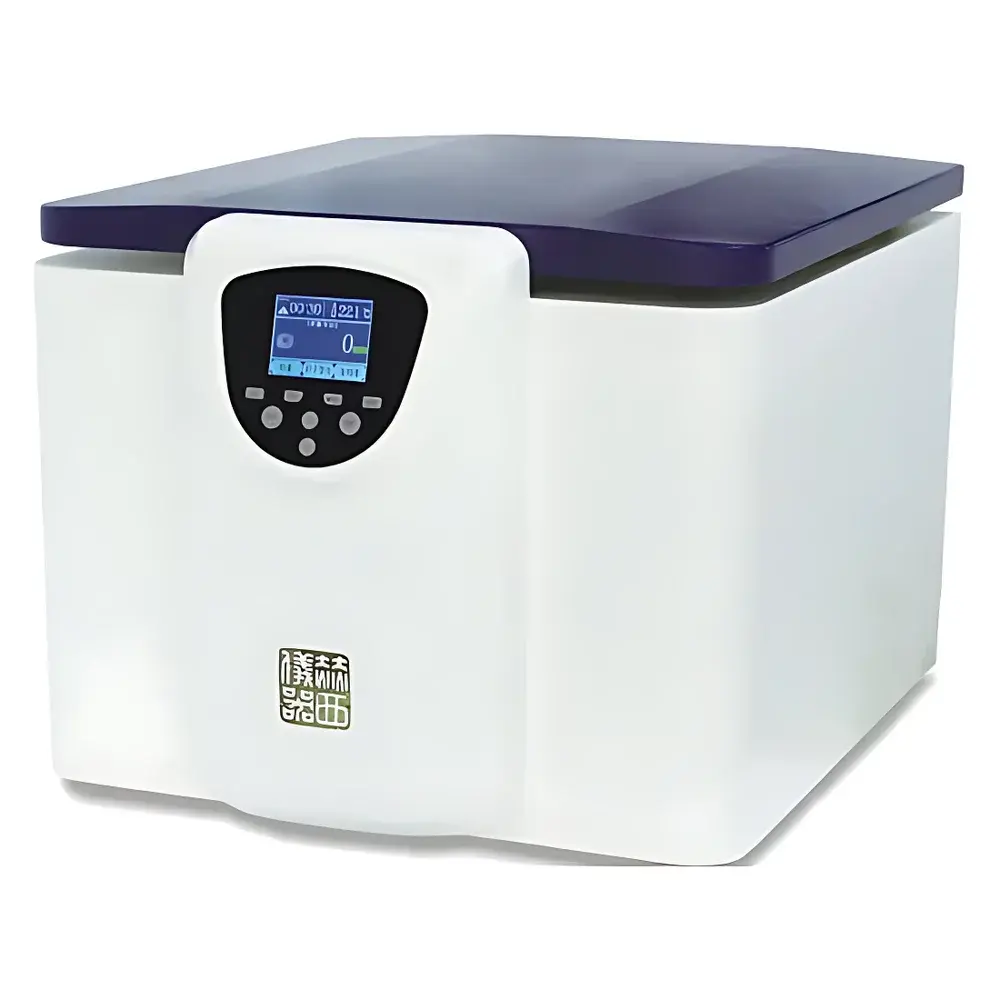
Herx TDD5 Vacuum-Debubbling Centrifuge
| [Brand | Herx |
|---|---|
| Origin | Hunan, China |
| Model | TDD5 Debubbling Centrifuge |
| Type | Benchtop Low-Speed Centrifuge |
| Max Speed | 5000 rpm |
| Max RCF | 4800 ×g |
| Max Capacity | 4 × 500 mL |
| Timer Range | 1–99 min / Continuous / Short Spin |
| Noise Level | ≤60 dB(A) |
| Power Supply | AC 220 V, 50 Hz |
| Speed Accuracy | ±50 rpm |
| Motor | High-Torque Brushless AC Motor |
| Drive Control | Infineon Driver Module + EnRuiEn MCU |
| Display | TFT-LCD True Color Touchscreen with Dual Keypad Interface |
| Safety Certifications | CFDA Registered Device, ISO 9001:2015 & ISO 13485:2016 Certified |
| Compliance | Designed for GLP-compliant labs |
Overview
The Herx TDD5 Vacuum-Debubbling Centrifuge is a purpose-engineered benchtop centrifuge designed specifically for the removal of entrapped air bubbles from viscous, non-Newtonian materials used in precision manufacturing and formulation laboratories. Unlike general-purpose centrifuges, the TDD5 operates on a controlled low-speed, high-capacity rotational principle—leveraging centrifugal force (up to 4800 ×g) to displace micro-bubbles from high-viscosity fluids without inducing shear degradation or chemical alteration. Its operational envelope—5000 rpm maximum speed, 4 × 500 mL horizontal rotor capacity, and programmable time control—makes it ideal for debubbling syringe-loaded adhesives, conductive pastes, UV-curable resins, thermal interface materials, and pharmaceutical ointments. The system is not intended for biological cell separation or high-speed pelleting; rather, it addresses a critical process step in microdispensing, encapsulation, and thin-film coating workflows where bubble-induced voids compromise bond integrity, optical clarity, or thermal conductivity.
Key Features
- High-torque brushless AC motor with Infineon driver module and EnRuiEn single-chip microcontroller ensures stable, low-vibration rotation and extended service life under continuous duty cycles.
- TFT-LCD true-color touchscreen with dual-mode operation (touch + physical keys) supports real-time display of setpoints and actual parameters—including RCF, rpm, time remaining, and acceleration/deceleration status—with on-the-fly parameter adjustment during active runs.
- 10-step programmable acceleration and deceleration profiles minimize sample disturbance and prevent re-suspension of settled material—critical for maintaining homogeneity in thixotropic gels and pastes.
- Triple-stage damping system combined with aerospace-grade forged aluminum rotor (angle-type optional) and reinforced polyamide fiber adapters provides mechanical stability across variable load conditions and mitigates resonance at operational speeds.
- OSS 304 stainless steel centrifuge chamber, fully powder-coated steel housing, and triple-layer protective front shield comply with IEC 61010-2-020 mechanical safety standards for laboratory equipment.
- Electromechanical door lock with silent engagement ensures secure containment during operation and automatic interlock verification prior to spin initiation.
- Comprehensive safety suite includes overspeed, overtemperature, imbalance, undervoltage, and overvoltage detection—all triggering immediate rotor deceleration and audible/visual alerts.
- 20-user-program memory with auto-recall of last-used protocol simplifies routine operation in multi-user environments such as QC labs or R&D pilot lines.
Sample Compatibility & Compliance
The TDD5 accommodates a broad range of industrial and formulation-grade materials—including epoxy adhesives, silver conductive pastes, solder pastes (e.g., SAC305), silicone thermal greases, UV-curable acrylates, cosmetic emulsions, and pharmaceutical semi-solids—loaded into standard Luer-lock syringes (10–100 mL). Horizontal rotor configurations support customizable adapter inserts for varying syringe diameters and lengths, enabling compatibility with OEM-specific dispensing cartridges. All wetted components are chemically inert and non-reactive, preserving material integrity without catalytic interference or leaching. The device carries CFDA registration as a Class I medical device manufacturing auxiliary instrument and conforms to ISO 9001:2015 (Quality Management) and ISO 13485:2016 (Medical Device QMS) standards—making it suitable for use in regulated environments requiring documented process control and audit readiness.
Software & Data Management
While the TDD5 operates via embedded firmware without external PC dependency, its control architecture supports full traceability for GLP/GMP-aligned workflows. Each run logs timestamp, selected program ID, final RCF, total runtime, and fault codes (if triggered) into non-volatile memory. Optional RS-232 or USB-to-serial interface enables integration with lab information management systems (LIMS) for automated data export. The multilingual UI (English, Chinese, Russian, Portuguese) facilitates deployment across global manufacturing sites and contract research organizations. Firmware updates are performed via secure USB flash drive, ensuring version control and compliance with change management protocols required under FDA 21 CFR Part 11 for electronic records and signatures.
Applications
- Pre-dispensing degassing of UV-curable resins for optical bonding and micro-optics assembly.
- Void elimination in solder paste prior to stencil printing in SMT line qualification.
- Stabilization of thermal interface materials (TIMs) for power electronics packaging.
- Batch processing of conductive silver pastes used in printed electronics and flexible circuit fabrication.
- QC release testing of pharmaceutical ointments and dermatological gels per USP compounding guidelines.
- Preparation of bubble-free silicone encapsulants for LED packaging and sensor potting.
FAQ
Is the TDD5 suitable for biological samples such as cells or proteins?
No. The TDD5 is optimized for high-viscosity industrial formulations—not aqueous suspensions or thermolabile biomolecules. It lacks refrigeration, aerosol containment, or rotor certification for biosafety level applications.
Can I use custom syringe holders or non-standard tube formats?
Yes. Custom horizontal rotor inserts and polyamide fiber adapters can be fabricated upon request to accommodate proprietary dispensing cartridges, subject to mechanical validation and balance certification.
Does the unit meet FDA or EU MDR requirements for use in medical device manufacturing?
The TDD5 holds CFDA registration and ISO 13485:2016 certification. While not an active medical device itself, it qualifies as a validated auxiliary process tool under Annex I GSPR (General Safety and Performance Requirements) when deployed within a certified quality management system.
What maintenance is required to ensure long-term accuracy and safety?
Routine verification includes monthly rotor balance checks, biannual calibration of speed and timer functions using NIST-traceable tachometers, and annual inspection of damping elements and door interlock mechanisms by authorized service personnel.



