
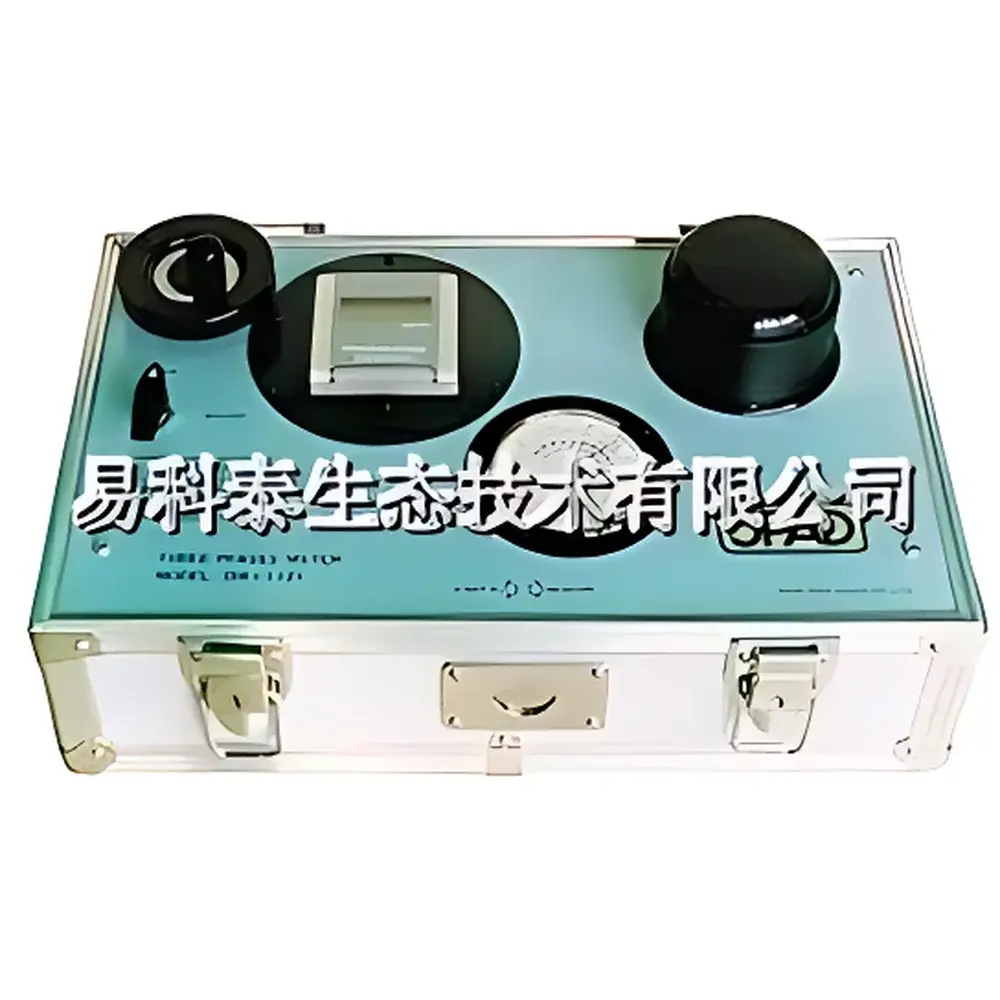
Soil Tri-Phase Analyzer (Japan-imported, Model: Soil Tri-Phase Analyzer)
| Origin | Japan |
|---|---|
| Manufacturer Type | Authorized Distributor |
| Origin Category | Imported |
| Model | Soil Tri-Phase Analyzer |
| Pricing | Upon Request |
| Dimensions | W425 × D290 × H275 mm |
| Pressure Measurement Range | 0–100 kPa |
| Battery | 3.6 V Li-ion rechargeable |
| Sample Chamber | Coupling-type |
| Volume Measurement Range | 0–100 mL |
| Minimum Volume Resolution | 0.05 mL |
| Weight | 8 kg |
| Accessories | 30 mL test disc, 50 mL test disc, perforated mesh plate, Petri-style dish, 100 mL sampling tube |
Overview
The Soil Tri-Phase Analyzer is a precision field-deployable instrument engineered to quantify the volumetric proportions of solid, liquid, and gaseous phases within undisturbed or minimally disturbed soil samples—a fundamental parameter in soil physics, hydrological modeling, and environmental risk assessment. Based on coupled pressure-volume equilibrium principles, the analyzer applies controlled pneumatic pressure to a sealed sample chamber while simultaneously monitoring real-time volume displacement and gas-phase pressure response. By integrating calibrated volumetric capacity, high-resolution liquid displacement sensing, and differential pressure transduction, the system computes phase fractions using mass-conservation and ideal gas law constraints under isothermal conditions. Designed for compliance with ISO 11272 (soil physical analysis), ASTM D2216 (moisture content), and USDA-NRCS soil characterization protocols, this instrument delivers traceable, repeatable tri-phase data without requiring destructive drying or mercury intrusion—making it suitable for both laboratory QA/QC workflows and on-site environmental monitoring.
Key Features
- Non-destructive, in-situ compatible measurement protocol preserving natural soil structure and pore connectivity
- Coupling-type sample chamber enabling rapid, tool-free installation of standardized test discs (30 mL and 50 mL) and interchangeable accessories
- High-fidelity dual-sensor architecture: capacitive volume transducer (±0.05 mL resolution) and piezoresistive pressure sensor (0–100 kPa, ±0.5% FS)
- Integrated 3.6 V lithium-ion battery supporting ≥8 hours of continuous operation—certified to IEC 62133 for safe field deployment
- Ergonomic, portable chassis (8 kg total mass) with IP54-rated enclosure for dust and splash resistance during outdoor use
- Modular accessory set including perforated mesh plate (for air-permeable support), Petri-style dish (for surface-level saturation control), and 100 mL graduated sampling tube (calibrated to ISO 4787 Class A tolerances)
Sample Compatibility & Compliance
The analyzer accommodates soils across the full textural spectrum—from coarse sands to heavy clays—and supports both disturbed bulk samples and intact core segments up to 100 mL volume. The coupling-type chamber design eliminates sealing artifacts common in rigid-cell systems, ensuring accurate gas-phase estimation even in low-permeability matrices. All measurement procedures align with GLP-compliant documentation requirements: each assay generates timestamped, operator-ID-tagged raw data files compliant with FDA 21 CFR Part 11 audit trail specifications when paired with optional PC-based acquisition software. Instrument calibration is traceable to NIST SRM 2192 (volumetric standards) and NIST SRM 2193 (pressure standards), with factory certification provided per ISO/IEC 17025.
Software & Data Management
Optional Windows-compatible desktop software enables automated calculation of solid volume fraction (SVF), water-filled pore space (WFPS), air-filled porosity (AFP), and bulk density—outputting results in CSV, Excel, and PDF report formats. The software enforces data integrity through role-based user access, electronic signature capture, and immutable audit logs. All raw sensor outputs (pressure vs. time, volume vs. time) are stored in HDF5 format to preserve metadata, scaling coefficients, and environmental context (ambient temperature, barometric pressure). Exported datasets include uncertainty propagation estimates based on sensor accuracy classes and measurement repeatability (n ≥ 5 per sample, per ISO 5725-2).
Applications
- Soil hydraulic property estimation for vadose zone modeling (e.g., van Genuchten parameter initialization)
- In-field validation of remote sensing-derived soil moisture products (e.g., SMAP, Sentinel-1)
- Contaminant transport studies requiring accurate gas-phase diffusivity inputs
- Agricultural irrigation scheduling via real-time WFPS monitoring at root-zone depth
- Landfill cover system performance assessment under dynamic wetting-drying cycles
- Climate change research on soil respiration dynamics and CO2/CH4 diffusion pathways
FAQ
What soil types can be measured without sample preparation?
The analyzer accepts air-dry, field-moist, or saturated samples—no oven-drying, sieving, or compaction is required. Cohesive clays and organic-rich histosols may require extended equilibration time (up to 15 min) due to lower gas diffusivity.
Is the instrument suitable for regulatory reporting?
Yes—when used with validated SOPs and the optional software suite, data meets EPA Method 9045D (field moisture determination) and ISO 11274 (soil water retention) documentation standards.
How is calibration verified in routine operation?
Daily verification uses the included 30 mL and 50 mL test discs with certified volume markings; annual recalibration is performed by an ISO/IEC 17025-accredited service laboratory.
Can measurements be performed in saturated conditions?
Yes—the coupling chamber design allows full submersion and maintains seal integrity during hydrostatic testing; the perforated mesh plate ensures uniform water entry into the sample matrix.
What is the typical measurement time per sample?
Standard protocol completes in 4–7 minutes depending on soil texture and initial water content; accelerated mode reduces this to ≤3 minutes with minor trade-offs in gas-phase resolution.
Related Products







