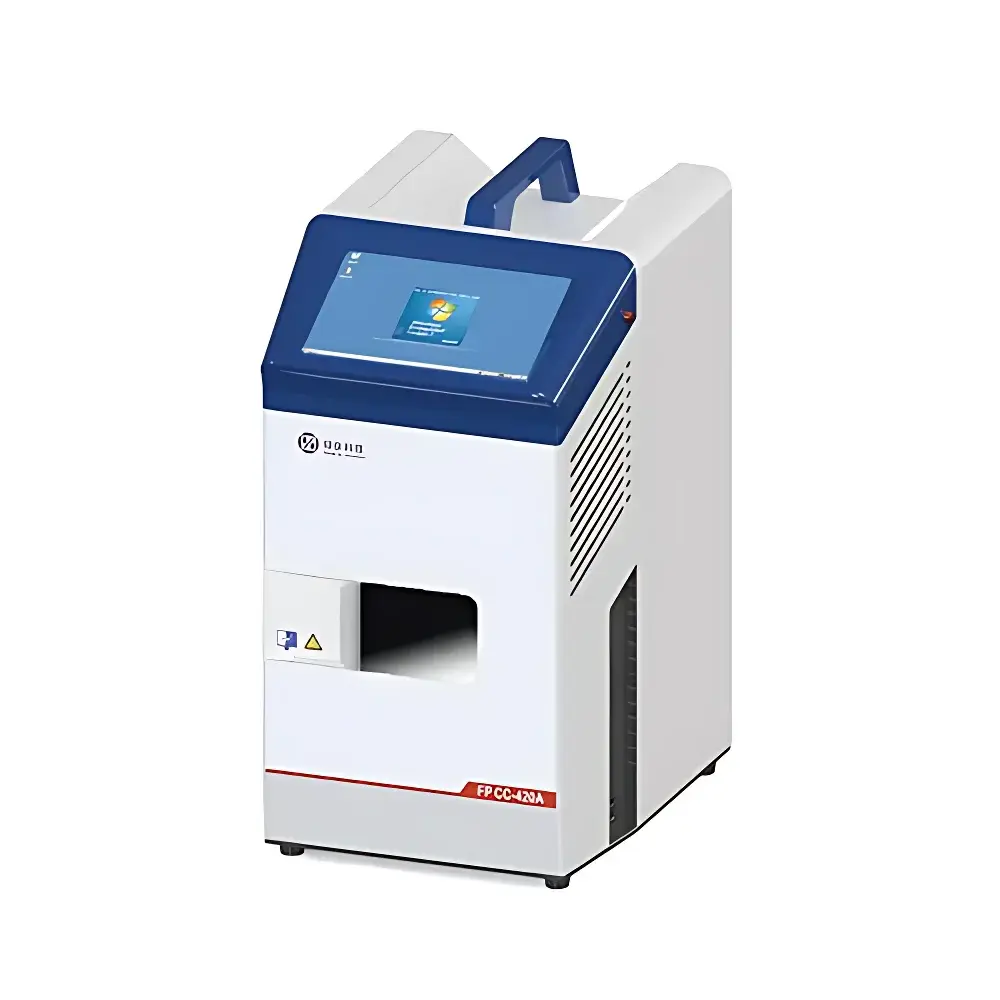
Young Instruments FP CC-420A Micro-Volume Continuous Closed-Cup Flash Point Analyzer
| Brand | Young Instruments |
|---|---|
| Origin | Beijing, China |
| Manufacturer Type | Authorized Distributor |
| Product Category | Domestic |
| Model | FP CC-420A |
| Detection Method | Closed-Cup (Continuous) |
| Operation Mode | Fully Automatic |
| Temperature Range | 0 °C to 260 °C (–30 °C to 420 °C with optional low-/high-temperature modules) |
| Ignition Method | High-Voltage Electronic Spark |
| Heating Rate | 2.5 ± 0.3 °C/min, 5.5 ± 0.5 °C/min, or user-defined (0.5–12 °C/min) |
| Temperature Accuracy | ±0.1 °C |
| Pressure Measurement Range | 0–200 kPa |
| Sample Volume | 1 mL or 2 mL |
| Stirring Speed | 50–300 rpm |
| Standards Compliance | ASTM D6450, ASTM D7094, ASTM D93, ASTM D3828, GB/T 261, GB/T 21615, GB/T 5208, GB/T 21790, SH/T 0768, SN/T 3077.1 & 3077.2, DL/T 1354 |
| Interface | RS232 ×1, RJ45 ×1, USB ×2 |
| Power Supply | AC 220 V / 50 Hz |
| Power Consumption | 300 W |
| Dimensions | 225 mm × 310 mm × 415 mm |
| Weight | 13.5 kg |
Overview
The Young Instruments FP CC-420A Micro-Volume Continuous Closed-Cup Flash Point Analyzer is a precision-engineered instrument designed for the reliable and repeatable determination of closed-cup flash point according to internationally recognized thermodynamic ignition principles. It operates on the continuous closed-cup method—where sample temperature is incrementally raised under a sealed test cup while periodic electronic spark ignition attempts are synchronized with real-time vapor pressure monitoring. This methodology eliminates manual intervention and discrete stepwise heating, enabling high-resolution detection of the lowest temperature at which vapors above the sample ignite transiently under controlled atmospheric conditions. The FP CC-420A is calibrated and validated for use across petroleum refining, power generation (e.g., transformer oil surveillance), specialty chemical manufacturing, and regulatory testing laboratories requiring compliance with dual-standard workflows (e.g., ASTM + GB/T or SN/T).
Key Features
- Continuous closed-cup measurement architecture ensures superior reproducibility (RSD < 0.5% for repeat tests on homogenous samples) versus traditional stepwise methods.
- Micro-volume sampling (1–2 mL) reduces reagent consumption, minimizes hazardous waste generation, and lowers operational cost per test—critical for high-throughput QC labs handling expensive or toxic materials.
- High-voltage electronic ignition system (no open flame) meets OSHA and IEC 61010-1 safety requirements for Class I, Division 2 environments; integrated spark gap monitoring confirms consistent discharge energy across all test cycles.
- Dual-stage thermal management: Peltier-based active cooling module enables rapid cooldown between tests (≤90 s from 260 °C to 40 °C), extending instrument uptime and supporting unattended batch operation.
- Multi-range temperature capability: Standard configuration covers 0–260 °C; optional low-temperature (–30 °C) and high-temperature (up to 420 °C) modules expand applicability to refrigerants, biofuels, and high-boiling industrial solvents.
- Real-time thermobaric profiling: Simultaneous acquisition of temperature, absolute pressure, and pressure rise rate generates a full T–ΔP/Δt curve—providing diagnostic insight into vapor generation kinetics beyond pass/fail flash point assignment.
- Automated barometric correction: Integrated absolute pressure sensor applies real-time atmospheric adjustment per ASTM D6450 Section 8.2 and GB/T 261 Annex C, eliminating manual lookup tables or external weather station dependencies.
- Role-based access control with audit-trail logging supports GLP/GMP-aligned data integrity: All method edits, result exports, and user logins are timestamped and attributed to individual accounts.
Sample Compatibility & Compliance
The FP CC-420A accommodates diverse sample matrices without modification—including low-volatility transformer oils (IEC 60296), high-viscosity lubricants (ASTM D445), water-miscible cutting fluids, aromatic hydrocarbon blends, plant-derived terpenes, pesticide emulsifiable concentrates, and halogenated solvents. Its sealed cup design prevents volatilization loss during ramping and mitigates cross-contamination in multi-sample sequences. Regulatory alignment spans three tiers: (1) U.S. federal standards (ASTM D93, D3828, D6450, D7094); (2) Chinese national and industry standards (GB/T 261, GB/T 21615, SH/T 0768, DL/T 1354); and (3) China Customs inspection protocols (SN/T 3077.1–3077.2). Instrument firmware includes preloaded, version-controlled test methods traceable to clause-level requirements of each standard, with configurable pass criteria (e.g., 2-second flame persistence per ASTM D6450).
Software & Data Management
Built-in embedded Linux OS powers the 7-inch capacitive touchscreen interface, supporting multilingual input (English/Chinese toggle) and intuitive workflow navigation. Test parameters—including heating rate, stir speed, ignition interval, and endpoint sensitivity—are programmable per method template. All raw thermobaric data and final results (flash point, onset temperature, pressure slope) are stored locally on 8 GB internal flash memory (≥5,000 test records retained). Data export options include CSV via USB 2.0 port, network transfer over TCP/IP (RJ45), or serial transmission (RS232). Optional thermal printer support enables immediate hardcopy generation with embedded instrument ID, operator name, date/time stamp, and compliance statement. Software architecture conforms to FDA 21 CFR Part 11 requirements for electronic records: digital signatures, immutable audit logs, and secure user authentication are enforced without third-party middleware.
Applications
- Quality control of insulating oils in substation maintenance programs (per DL/T 1354 and IEC 60156 equivalents)
- Regulatory submission testing for chemical registration under China’s MEPP Order No. 7 and U.S. EPA TSCA
- Stability assessment of fragrance formulations during accelerated aging studies
- Flash hazard classification of bio-based plasticizers per UN GHS Chapter 2.6
- In-process verification of solvent recovery efficiency in pharmaceutical coating operations
- Research-grade flammability mapping of novel e-liquid base compounds (propylene glycol, vegetable glycerin blends)
FAQ
Does the FP CC-420A comply with ASTM D6450 and D7094 simultaneously?
Yes—the instrument’s adaptive heating algorithm and dynamic ignition logic satisfy both standards’ distinct ramp profiles, dwell times, and pressure-triggered ignition thresholds.
Can it test samples with suspended solids or high pour point?
Samples must be homogeneous and fluid at test initiation temperature; pre-heating or filtration may be required for waxy or particulate-laden oils per ASTM D6450 Section 6.3.
Is external calibration verification required before each test series?
No—built-in reference resistor and NIST-traceable RTD sensor enable daily self-diagnostic checks; annual third-party calibration is recommended per ISO/IEC 17025.
What is the minimum ambient temperature for stable operation?
The specified operating range is 5 °C to 40 °C at ≤85% RH; operation below 5 °C may affect Peltier cooling efficiency and condensation control.
How does the system handle atmospheric pressure fluctuations during long-duration tests?
The integrated absolute pressure transducer updates barometric correction every 5 seconds, ensuring flash point values remain referenced to true local atmospheric conditions throughout the entire temperature ramp.