
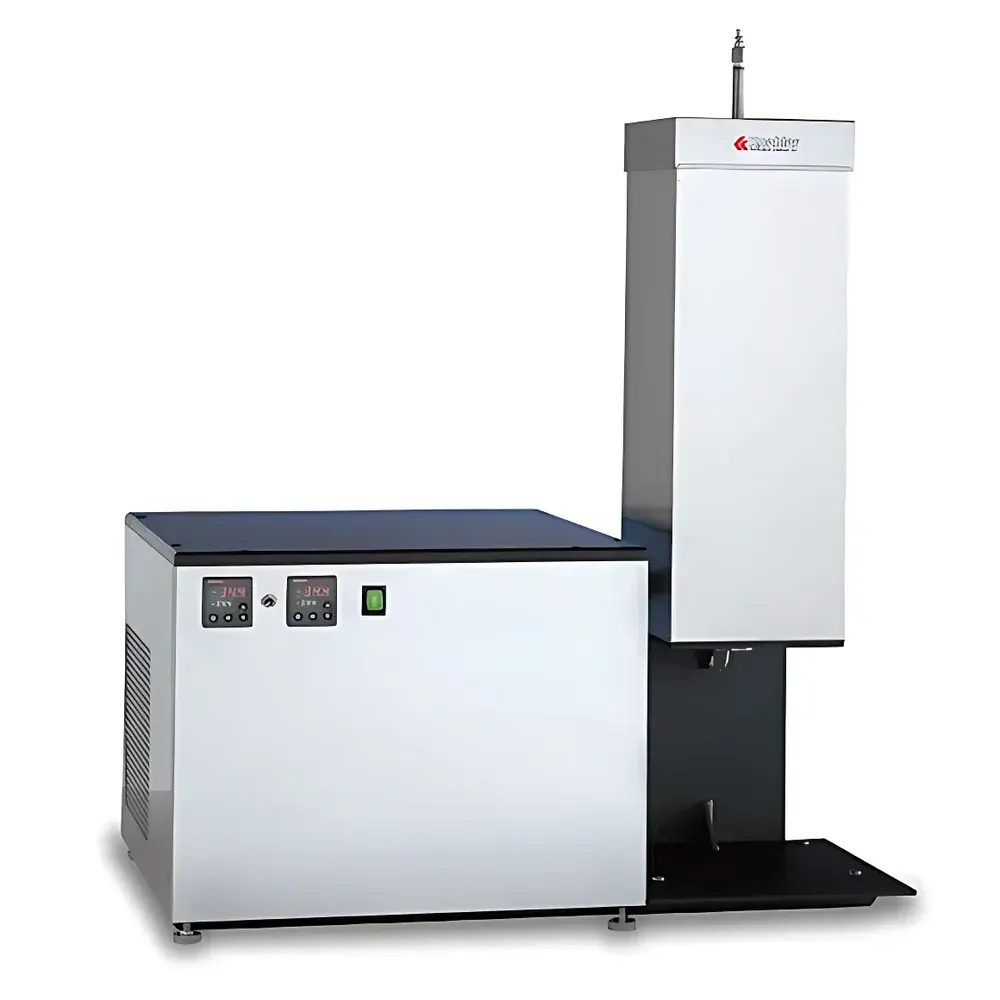
Koehler K22685 Low-Temperature Flow Tester for Greases
| Brand | Koehler |
|---|---|
| Origin | USA |
| Model | K22685 |
| Temperature Range | –34.4 °C to Ambient |
| Temperature Resolution | ±1 °C |
| Cooling Bath Dimensions | 30.5 × 30.5 × 76 cm |
| Refrigeration Unit Dimensions | 38 × 30 × 30 cm |
| Net Weight | 51.7 kg |
| Power Supply | 220–240 V, 50 Hz, Single-Phase, 3 A |
| Compliance | U.S. Steel Method, ASTM Draft Method Dxxxx (Low-Temperature Flow of Lubricating Greases) |
| Capillary Geometry | Stainless Steel SOD Pressure Viscometer with 40:1 Ratio Tapered Capillary |
Overview
The Koehler K22685 Low-Temperature Flow Tester for Greases is an engineered laboratory instrument designed to quantitatively assess the flow resistance of lubricating greases under controlled sub-ambient thermal and pressure conditions. It operates on the principle of pressure-driven capillary flow through a standardized stainless steel SOD (Standardized Orifice Device) pressure viscometer — a geometry defined in the U.S. Steel Method and aligned with the ASTM draft standard for low-temperature grease flow (proposed as ASTM Dxxxx). In this method, a precisely weighed grease sample is subjected to constant pneumatic pressure within a thermally stabilized cooling bath, forcing it through a calibrated 40:1 tapered capillary. The mass flow rate—expressed in grams per second (g/s)—is measured gravimetrically over a defined time interval, providing a direct, reproducible metric of low-temperature rheological resistance. Unlike rotational or oscillatory rheometers, the K22685 delivers a practical, application-relevant index tied directly to real-world performance in cold-start bearing applications, gear systems, and automotive chassis lubrication where pumpability and initial mobility are critical.
Key Features
- Integrated tri-component architecture: precision stainless steel SOD pressure viscometer, thermostatically controlled cooling bath, and dedicated refrigeration unit — all co-engineered for thermal stability and mechanical repeatability.
- 40:1 tapered capillary geometry fabricated from corrosion-resistant stainless steel, minimizing wall slip effects and ensuring consistent shear history across test runs.
- Wide operational temperature range from –34.4 °C to ambient, enabling evaluation across industry-critical low-temperature tiers including –30 °C (e.g., arctic-grade NLGI #2 greases) and –20 °C (commercial winter formulations).
- Thermal resolution of ±1 °C maintained across the full range via PID-controlled refrigeration and insulated bath design — sufficient for compliance with U.S. Steel Method tolerance requirements.
- Modular footprint: cooling unit (30.5 × 30.5 × 76 cm) and refrigeration module (38 × 30 × 30 cm) allow flexible benchtop integration while maintaining separation of heat-generating and temperature-sensitive components.
- Electrical interface compliant with international mains specifications: 220–240 V, 50 Hz, single-phase, 3 A — suitable for deployment in ISO/IEC 17025-accredited laboratories without custom power conditioning.
Sample Compatibility & Compliance
The K22685 is validated for use with NLGI-consistency classes #000 through #3, including lithium-, calcium-, polyurea-, and complex-thickened greases. Sample volume requirements align with ASTM draft methodology: 10–15 g per test, loaded into the pre-chilled SOD reservoir prior to thermal equilibration. Instrument compliance is explicitly documented against the U.S. Steel Method for Low-Temperature Grease Flow and supports alignment with the pending ASTM Dxxxx standard. While not a GLP-regulated instrument per se, its mechanical design, traceable temperature calibration points, and deterministic flow measurement protocol enable audit-ready data generation for internal QC, supplier qualification, and regulatory submissions under ISO 9001 or IATF 16949 frameworks. No software-based electronic records are generated; however, raw g/s values are manually recorded in laboratory notebooks conforming to 21 CFR Part 11 principles when paired with controlled documentation procedures.
Software & Data Management
The K22685 operates as a fully manual, hardware-centric testing platform with no embedded microprocessor, touchscreen interface, or proprietary software. All control is electromechanical: pressure regulation via calibrated regulator, temperature stabilization via analog PID circuitry, and timing via external stopwatch or lab timer. This architecture eliminates firmware validation burdens and ensures long-term operational continuity without dependency on software updates or vendor licensing. Users maintain full ownership of data integrity by recording g/s results, test temperature, dwell time, and sample identification in bound, numbered laboratory notebooks — a practice fully compatible with GLP, GMP, and ISO/IEC 17025 documentation requirements. Optional integration with LIMS is achievable via manual entry or barcode-scanned worksheet upload using institutional data capture protocols.
Applications
- Formulation screening of low-temperature pumpability for automotive wheel bearing greases (SAE J310 / OEM specification compliance).
- Quality control release testing of NLGI #2 multipurpose greases against cold-climate performance thresholds (e.g., –25 °C minimum flow rate ≥ 0.15 g/s).
- Comparative assessment of thickener type impact (e.g., lithium vs. bentonite) on low-temperature flow hysteresis.
- Supporting ASTM round-robin interlaboratory studies validating new low-temperature grease classification schemes.
- Technical service labs evaluating field-failed greases for cold-weather mobility loss due to oil bleed or thickener network collapse.
FAQ
Does the K22685 comply with finalized ASTM standards?
The instrument satisfies the technical requirements of the ASTM draft method Dxxxx (currently under ballot review), and is explicitly endorsed in the U.S. Steel Method specification. Final ASTM designation will be updated in product documentation upon official publication.
Is calibration traceable to NIST standards?
Temperature sensors are supplied with individual calibration certificates traceable to NIST via A2LA-accredited providers. Capillary geometry is verified during manufacturing using coordinate measuring machine (CMM) metrology, with dimensional reports available upon request.
Can the system operate continuously at –34.4 °C?
Yes — the refrigeration unit is rated for sustained operation at the full specified range, including extended-duration tests at minimum temperature, provided ambient room temperature remains ≤25 °C and adequate ventilation is maintained.
What maintenance is required?
Routine maintenance includes quarterly inspection of refrigerant levels, annual verification of pressure regulator accuracy, and biannual cleaning of condenser coils. No consumables beyond standard lab-grade compressed air and certified reference temperature baths are required.
Is operator training included with purchase?
Yes — Koehler-certified field application engineers provide on-site installation verification and two-day operator training covering method execution, troubleshooting, and compliance documentation practices.






