
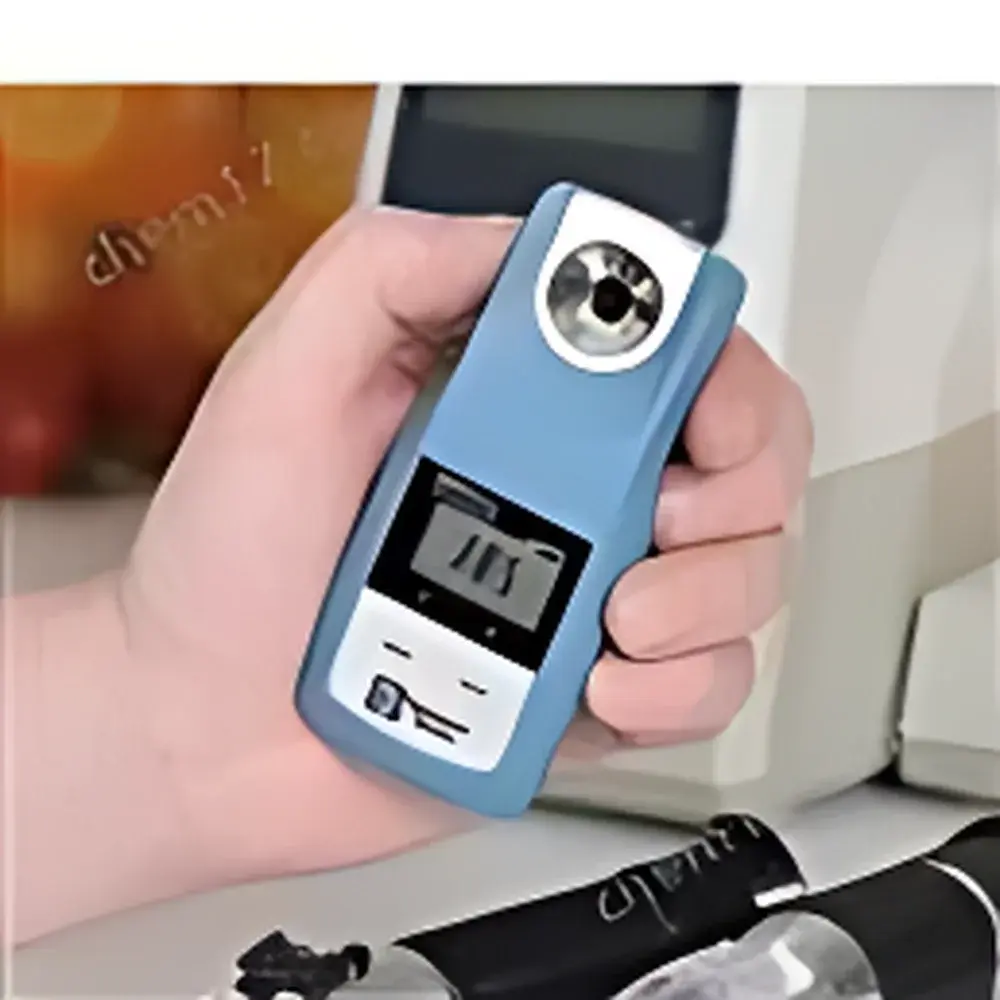
Bellingham + Stanley OPTi Wine & Brew Handheld Refractometer
| Brand | Bellingham + Stanley (B+S) |
|---|---|
| Country of Origin | United Kingdom |
| Model | OPTi Wine & Brew |
| Type | Handheld Digital Refractometer for Alcoholic Beverages |
| Compliance | BS EN ISO 9001:2000, UKAS-accredited manufacturing, CE marked |
| IP Rating | IP65 |
| Calibration | Automatic zeroing with distilled water |
| Temperature Compensation | Built-in Automatic Temperature Compensation (ATC), 10–40 °C |
| Prism | Shallow-depth, easy-clean optical prism |
| Ergonomics | Single-hand operation, dual-scale display option |
| Measurement Units | % Mass w/w, °Brix, °Baumé, Oechsle (German/Swiss), KMW, ABV (°Zeiss), Plato, Alcohol Probable (AP) |
Overview
The Bellingham + Stanley OPTi Wine & Brew Handheld Refractometer is a precision optical instrument engineered for rapid, field-deployable measurement of soluble solids and alcohol-related indices in fermented and distilled beverages. Unlike traditional Abbe refractometers or benchtop polarimeters, the OPTi operates on the principle of critical-angle refractometry—measuring the refraction of light at the interface between a sample and high-grade optical glass prism. Its solid-state optical path, temperature-compensated digital sensor array, and factory-calibrated dispersion algorithm deliver traceable, repeatable results without moving parts or external power sources beyond its integrated lithium battery. Designed explicitly for wineries, craft breweries, distilleries, and quality assurance laboratories operating under variable environmental conditions—including high-humidity cellars, outdoor harvest sites, and mobile QC stations—the OPTi meets the operational demands of real-time process monitoring while maintaining metrological integrity aligned with international standard practices.
Key Features
- True handheld form factor with IP65-rated polycarbonate housing—resistant to corrosion from ethanol, organic acids, and cleaning agents common in beverage production environments
- Shallow-depth prism geometry minimizes sample retention and enables rapid cleaning with lint-free tissue or deionized water—critical for cross-sample contamination control
- Automatic Temperature Compensation (ATC) across 10–40 °C using embedded thermistor array; eliminates manual correction tables and reduces operator-dependent error
- Dual-scale digital LCD display (e.g., % Mass w/w + °Oechsle) configurable per model variant—supports simultaneous verification against regional regulatory benchmarks
- Zero-point calibration using only distilled or deionized water—no proprietary calibration fluids required, reducing consumable dependency and validation overhead
- Battery-powered operation (typical 10,000+ measurements per charge) with low-power OLED display—enables continuous use during multi-hour harvest assessments or fermentation tank rounds
Sample Compatibility & Compliance
The OPTi Wine & Brew series is validated for direct measurement of unfiltered grape must, clarified wine, beer wort, finished lager/ale, cider, and low-viscosity spirits dilutions (≤40% v/v ethanol). It is not intended for highly turbid, viscous, or particulate-laden samples without prior centrifugation or filtration. All units are manufactured in the United Kingdom under a quality management system certified to BS EN ISO 9001:2000 and independently verified by UKAS (United Kingdom Accreditation Service). CE marking confirms conformity with EU Electromagnetic Compatibility (EMC) Directive 2014/30/EU and Low Voltage Directive 2014/35/EU. While not a GLP/GMP-regulated analytical instrument per se, its documented calibration traceability, ATC performance validation reports, and stable optical architecture support inclusion in laboratory SOPs compliant with ISO/IEC 17025:2017 for routine screening applications.
Software & Data Management
The OPTi operates as a standalone instrument with no embedded data logging or USB/Bluetooth connectivity. This design prioritizes robustness, battery longevity, and immunity to electromagnetic interference in industrial settings—where wireless protocols may conflict with fermentation control systems or PLC networks. However, measurement values can be manually recorded into LIMS or electronic batch records following site-specific data integrity protocols. For users requiring audit trails, Bellingham + Stanley provides optional calibration verification kits (e.g., NIST-traceable sucrose standards) and printable calibration certificates issued under UKAS accreditation—supporting 21 CFR Part 11-compliant recordkeeping when paired with controlled documentation workflows.
Applications
- Harvest decision support: Real-time assessment of grape sugar content (% Mass w/w, °Oechsle, KMW) to determine optimal picking windows
- Fermentation monitoring: Tracking specific gravity decline in wine must or beer wort via Plato or °Brix scales, correlating to ethanol yield predictions
- Blending verification: Confirming consistency of alcohol potential (Alcohol Probable, ABV) across tank lots prior to stabilization
- Regulatory compliance checks: Verifying label claims for alcohol content (ABV), residual sugar, or density-based classifications (e.g., German Prädikatswein tiers)
- Supplier qualification: Rapid incoming inspection of juice concentrates, malt extracts, or adjunct syrups against agreed-upon °Brix specifications
FAQ
Is the OPTi suitable for measuring high-alcohol spirits such as brandy or whiskey?
No—the OPTi Wine & Brew models are optimized for aqueous-ethanol matrices up to ~22% v/v alcohol (AP scale) or 40% w/w total solids. Spirits exceeding these concentrations require specialized high-range refractometers or densitometric methods.
Does the instrument require recalibration between samples?
No—zero-point stability is maintained for >100 consecutive readings under stable ambient conditions. Re-zeroing is recommended only after extended idle periods (>8 hours) or exposure to extreme temperature shifts (>10 °C change).
Can the OPTi be used with hot samples directly from the mash tun?
No—samples must be cooled to ≤40 °C prior to measurement. Exceeding the ATC upper limit invalidates compensation accuracy and risks thermal damage to the prism sealant.
How is measurement uncertainty quantified for regulatory reporting?
Each unit ships with a UKAS-issued calibration certificate referencing NPL-traceable sucrose standards. Typical expanded uncertainty (k=2) for % Mass w/w is ±0.3%, validated per ISO 5725-2:2019 repeatability protocols.
Are spare prisms or repair services available outside the UK?
Yes—Bellingham + Stanley maintains authorized service centers in Germany, USA, Australia, and Japan. Prism replacement requires factory recalibration and is performed exclusively at certified facilities to preserve optical alignment integrity.



